Coffee Filter Paper Thickness Guide: A B2B Sourcing Analysis
Coffee Filter Paper Thickness Guide
A technical & commercial sourcing manual for roasters, packaging distributors, restaurant chains, and B2B buyers.
If you run a commercial coffee roasting operation, manage packaging procurement for a food delivery platform, or distribute food-service consumables, you know that a coffee filter isn’t just a piece of disposable paper. It is an engineered fluid-dynamics component. The wrong spec can derail an entire product line: too thin, and the paper bursts under hydraulic pressure on an automated packing line or lets fine sediment cloud the cup; too thick, and flow rates stall, resulting in bitter over-extraction and frustrated customers.
In B2B procurement, evaluating coffee filter paper thickness requires looking past basic millimeter measurements. It demands understanding how basis weight—measured as filter paper GSM (Grams per Square Meter)—interacts with fiber composition, porosity, creping patterns, and wet tensile strength. Whether you are sourcing drip bag rolls, cone filters, basket liners, or cold brew industrial bags, matching the correct thickness profile to your specific application is essential for protecting your margins and brand reputation.
What Is It?
When buyers discuss coffee filter paper thickness, they are referencing two interconnected physical metrics: physical caliper (measured in micrometers, µm, or millimeters, mm) and basis weight, standardized across the paper and non-woven industry as GSM ($g/m^2$).
Unlike standard printing paper, filter paper is a non-woven porous web. It is typically manufactured from long-fiber virgin wood pulp, abaca (Manila hemp), bamboo, or synthetic bio-polymers like Polylactic Acid (PLA). Thickness in filter media is not simply about bulk; it determines the depth of the filtration bed and the tortuosity of the pathways that water must navigate during brewing.
Key Technical Distinction: Caliper vs. GSM vs. Porosity
Two filter papers can share the exact same thickness (e.g., 0.18 mm) but possess completely different GSM values and pore sizes. A paper made with heavy creping (textured crinkles) may feel thick to the touch but have a low GSM and high permeability. Conversely, a calendar-calendered (smooth-pressed) paper might be thin in caliper but dense in GSM, severely restricting flow. Procurement teams must evaluate thickness alongside GSM and air/water permeability (measured in liters per square meter per second).
For high-volume packaging applications—such as automatic drip bag form-fill-seal (FFS) lines—filter paper typically ranges from 18 GSM to 45 GSM. For commercial basket filters and heavy-duty manual pour-overs, weights often reach 50 GSM to 90 GSM. Sourcing managers working with specialized suppliers like coffeeteabag.com often specify customized GSM profiles to balance machine sealability with cup clarity.
Key Benefits
Selecting the optimal coffee filter paper thickness yields direct operational, financial, and sensory advantages across the supply chain:
1. Machine Runnability and Structural Integrity
On high-speed automated packaging lines, thin or inconsistent paper webs are prone to tearing, misfeeding, or burning under ultrasonic and thermal sealing jaws. A properly spec’d thickness provides the tensile strength necessary to endure high-tension roll feeds without snapping, minimizing machine downtime and material scrap.
2. Precision Extraction Control
Water flow rate (flux) is inversely proportional to filter thickness and density. Thicker papers increase contact time between hot water and coffee grounds, making them ideal for light roasts that require higher extraction energy. Thinner, high-permeability papers allow faster drawdowns, preventing dark roasts from becoming harsh or astringent.
3. Sediment and Lipids Retention
Thicker fiber webs trap fine coffee particles (fines) and diterpenes (caFestol and kahweol oils). This delivers a crisp, sediment-free cup with high clarity—a hallmark requirement for premium drip bags and specialty food-service operations.
4. Wet Burst Resistance
When saturated with near-boiling water (90°C–96°C), low-quality thin paper loses its structural bonds. Specifying the correct GSM combined with wet-strength food-grade agents prevents filter collapse, bottom blowouts, and seam ruptures in commercial brewers and hanging-ear pouches.
Applications
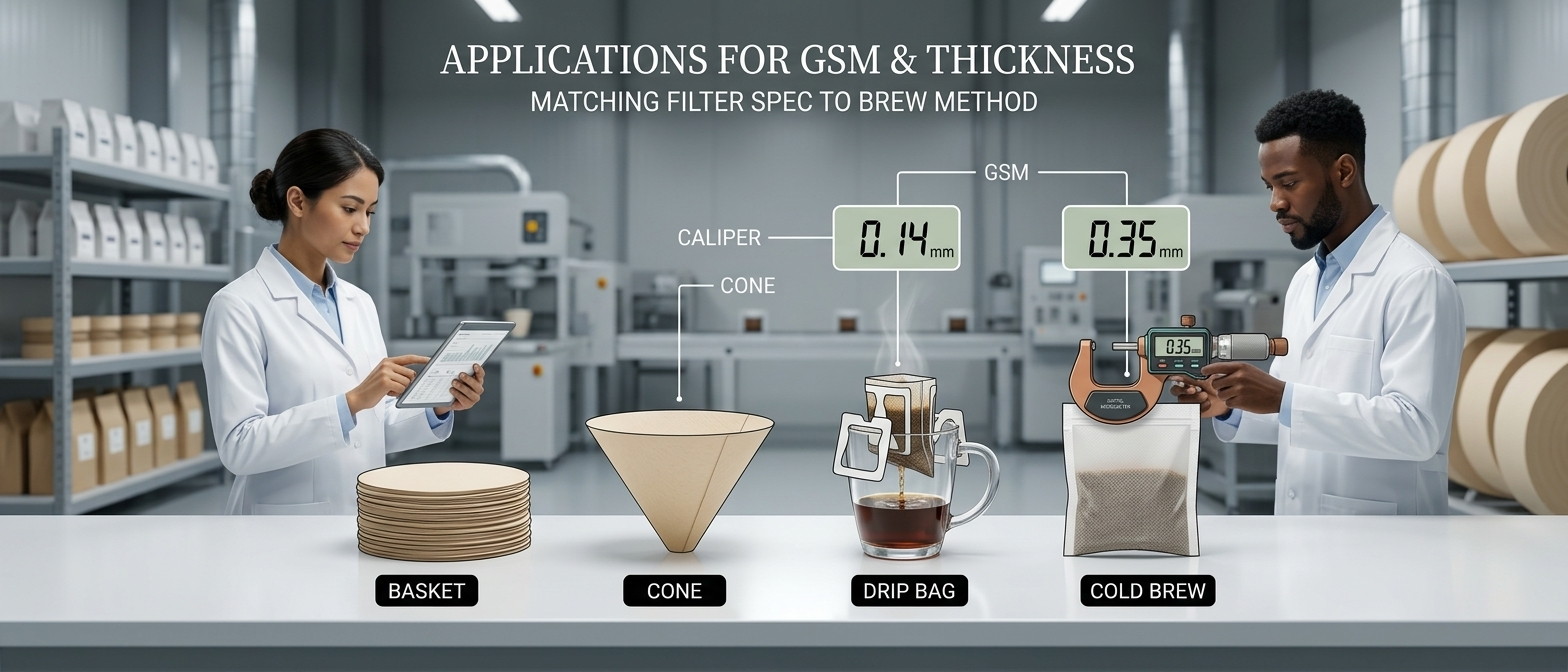
Different commercial channels require distinct thickness and GSM profiles. Below is an overview of how thickness specifications align with common industry formats.
| Application Format | Typical Thickness (mm) | Target GSM Range | Primary Material Fiber | Brewing Characteristics |
|---|---|---|---|---|
| Single-Serve Drip Bags (Hanging Ear) | 0.12 – 0.18 mm | 22 – 30 GSM | PLA Mesh / Non-Woven PP+PET / Abaca Blend | Fast to medium flow; high clarity; heat-sealable for automated packaging. |
| Commercial Basket Filters (Hotel & Office) | 0.15 – 0.22 mm | 40 – 55 GSM | Virgin Wood Pulp (Bleached/Unbleached) | Balanced flow rate; holds heavy wet grounds (up to 100g+) without tearing. |
| Specialty Cone Filters (V60 / Flat Bottom) | 0.18 – 0.28 mm | 50 – 70 GSM | Wood Pulp + Manila Hemp (Abaca) | Slower drawdown; maximum oil retention; exceptional cup clarity. |
| Cold Brew Industrial Packs | 0.25 – 0.40 mm | 70 – 110 GSM | Heavy Reinforced Wet-Strength Cellulose / Bio-PLA | High burst strength; engineered for 12-24 hr cold steep cycles without ripping. |
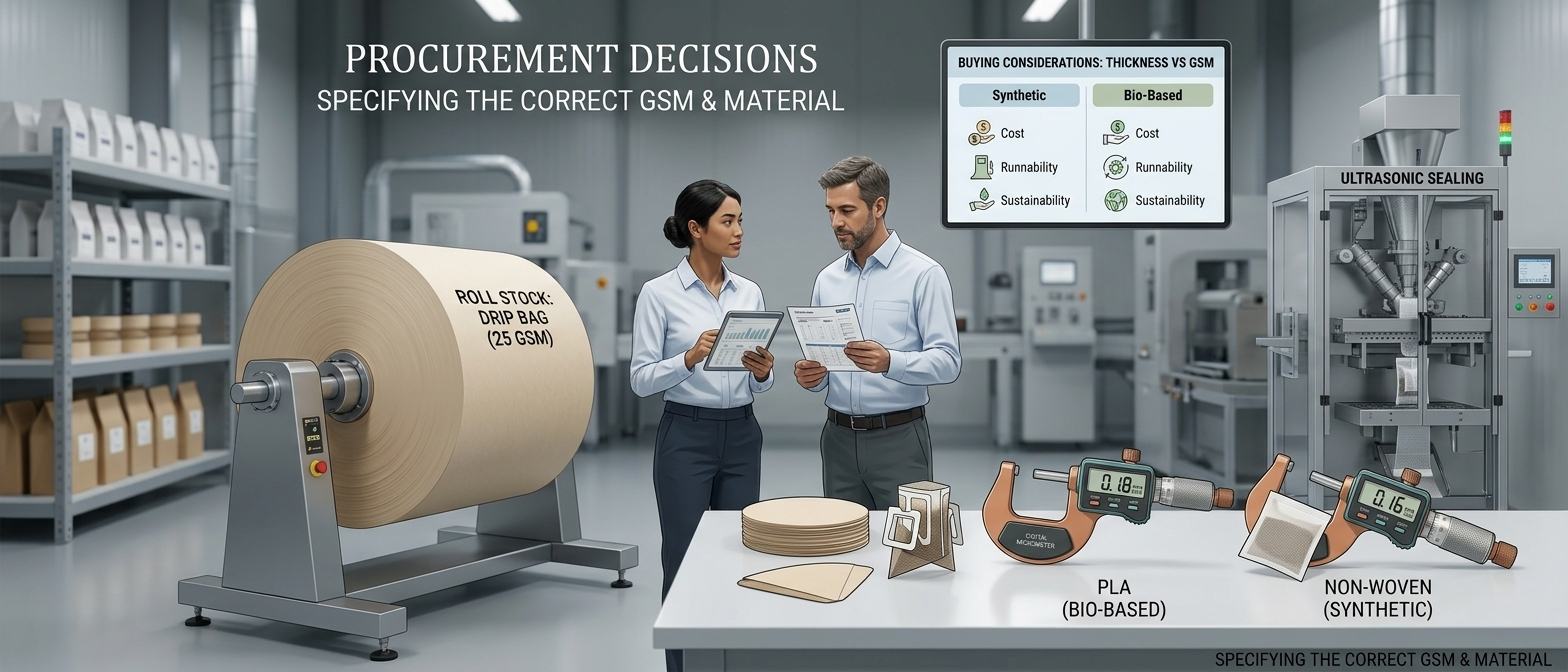
For instance, single-serve coffee roasters sourcing roll stock from partners like coffeeteabag.com generally select a 25 GSM to 28 GSM non-woven or PLA material. This range offers the exact stiffness needed for automatic ultrasonic folding while maintaining an optimal 2.5-minute drawdown for a 10g to 12g coffee dose.
Buying Guide
Navigating factory quotes and raw material datasheets requires a structured approach. Follow these practical sourcing steps when establishing thickness specifications for your brand or client base:
Step 1: Define the Grind and Dose Profile
Before locking in a GSM spec, test your target coffee grind size. Fine grinds require thinner, highly porous papers to prevent clogging; coarse grinds work better with slightly thicker webs that restrict flow to ensure adequate extraction time.
Step 2: Balance Heat-Sealability vs. Bio-Degradability
If you are packaging drip filter bags, thickness directly impacts thermal transfer during sealing. Synthetic non-wovens (PP/PET blends) melt and seal quickly at lower temperatures. If transitioning to eco-friendly 100% PLA (Polylactic Acid) or cellulosic fibers, you may need a slightly thicker web (28–30 GSM) to achieve the same seam strength without burning the material.
Step 3: Evaluate Minimum Order Quantities (MOQs)
Raw material mills roll out filter paper in massive master jumbo rolls. Understanding factory MOQs is critical for budget management:
- Standard Stock Roll Stock (22–28 GSM): Low MOQs (often starting at 50 kg to 100 kg) because suppliers keep jumbo rolls in inventory.
- Custom GSM or Creping Patterns: Requires custom mill runs, pushing MOQs up to 1,000 kg – 3,000 kg per batch.
- Pre-Made Drip Bags (Custom Printed): Typically starts around 30,000 to 50,000 units depending on pouch printing complexity.
Step 4: Request Technical Datasheets (TDS) and Samples
Do not buy based on visual samples alone. Ask potential manufacturers for a full Technical Datasheet that includes:
- Caliper (Thickness) tolerance (e.g., $0.16 \text{ mm} \pm 0.01 \text{ mm}$)
- Dry and Wet Tensile Strength (MD/CD – Machine Direction / Cross Direction)
- Air Permeability ($L/m^2/s$ at 200 Pa)
- Food Safety Compliance Certificates
Common Buyer Concerns
During our discussions with procurement officers, packaging engineers, and roast masters, several recurring technical and commercial challenges surface:
“Will switching to a bio-degradable PLA paper ruin my machine throughput?”
This is a major concern for packaging directors moving away from petroleum-based non-wovens. Pure PLA mesh or PLA non-woven webs conduct heat differently than PP/PE. If the PLA paper is too thick, heat from the sealing jaws won’t penetrate cleanly, resulting in weak side seals. If it is too thin, the ultrasonic horn can cut through the web. The solution is selecting an engineered 25–28 GSM PLA filter roll specifically calibrated for high-speed ultrasonic sealing equipment.
“Why does our coffee taste papery or Woody?”
Papery taste is rarely caused by thickness alone; it is caused by residual lignin in unbleached wood pulp or improper bleaching processes. Thicker unbleached papers (60+ GSM) hold more lignin, which transfers to hot water. To eliminate this issue without sacrificing thickness, buyers should specify oxygen-bleached (TCF – Totally Chlorine Free) virgin pulp or long-fiber abaca blends.
“How do we prevent bottom seam bursting during high-volume brewing?”
Bursting happens when wet tensile strength is insufficient for the weight of the saturated grounds. If your food-service clients report split filters in commercial basket brewers, increasing the GSM by 10–15% or upgrading to an abaca-reinforced paper web solves the problem immediately without altering your grind size.
Certification Considerations
Coffee filter paper comes into direct contact with high-temperature liquids meant for human consumption. Ensuring global regulatory compliance is non-negotiable for importers and retail brands.
- Food Contact Safety: Paper materials must comply with FDA 21 CFR 176.170 (for US markets) and EU Regulation No. 1935/2004 / Resolution AP (2002) 1 (for European markets). Verify that heavy metals, formaldehydes, and fluorinated chemicals (PFAS) are completely absent.
- Compostability & Environmental Claims: If marketing filters as compostable, look for official 3rd-party certifications rather than self-declared claims. Key benchmarks include DIN CERTCO / TÜV Austria (EN 13432) for industrial compostability and BPI Certification.
- Sustainable Forestry: For wood-pulp based papers, sourcing FSC (Forest Stewardship Council) or PEFC certified material ensures responsible forest management along your supply chain.
Reputable manufacturing partners, including coffeeteabag.com, supply full certification dossiers alongside lot-tracked testing reports, making customs clearance and retail compliance audit-ready.
FAQ (5 Questions)
The global industry standard for hanging-ear drip coffee bags typically ranges between 22 GSM and 30 GSM. This provides the optimal balance of wet strength, fast flow rate, and compatibility with automated ultrasonic sealing equipment.
Not necessarily. Thicker paper captures more sediment and oils, producing a clean, bright cup with high clarity. However, if the paper is too thick or dense, it can cause water logging and over-extraction, leading to bitterness. The “best” thickness depends entirely on your roast profile and grind size.
Creping creates micro-folds across the paper surface. This increases the physical thickness (caliper) and surface area without significantly increasing the weight (GSM). Creped paper holds more fine particles before clogging compared to smooth, flat paper of the same weight.
Yes. Slitting width is fully customizable. Standard drip bag machine roll widths range from 180 mm to 220 mm, but suppliers can slit jumbo rolls to exact millimeter specifications to match your machine’s unwind stand and folding shoulder.
Stored in a cool, dry environment away from direct sunlight and strong odors (as paper absorbs ambient smells), raw filter paper rolls have an indefinite shelf life—typically 2 to 3 years without any degradation in tensile strength or sealability.
Conclusion
Mastering coffee filter paper thickness is one of the most effective ways B2B buyers can optimize product performance and control unit costs. By selecting the right filter paper GSM, evaluating wet tensile strength, and ensuring strict food-contact certifications, roasters and packaging distributors can deliver a superior brewing experience every single time. Whether you are scaling an automated drip bag packaging line or developing eco-friendly food-service solutions, partnering with specialized material suppliers provides the technical support required to keep your production running smoothly.
Post time: Nov-06-2026