Coffee Filter Paper Buyer Guide
How Coffee Filter Paper Is Manufactured
A practical B2B guide to raw materials, coffee filter paper manufacturing, production processes, customization, MOQ, lead time, certifications, and sourcing considerations.
Coffee filter paper may look like a simple material, but producing a reliable filter requires much more than turning cellulose pulp into a thin sheet of paper.
For coffee roasters, filter converters, packaging distributors, wholesalers, and private-label brands, filter performance can directly influence extraction time, cup clarity, wet strength, filling-machine efficiency, and the final consumer experience.
Two papers with similar color and thickness can behave very differently. One may drain too quickly. Another may slow the brew considerably. A third may work well in a manual pour-over cone but tear when used in an automatic drip coffee bag.
Understanding coffee filter paper manufacturing helps buyers compare products based on technical performance rather than appearance alone.
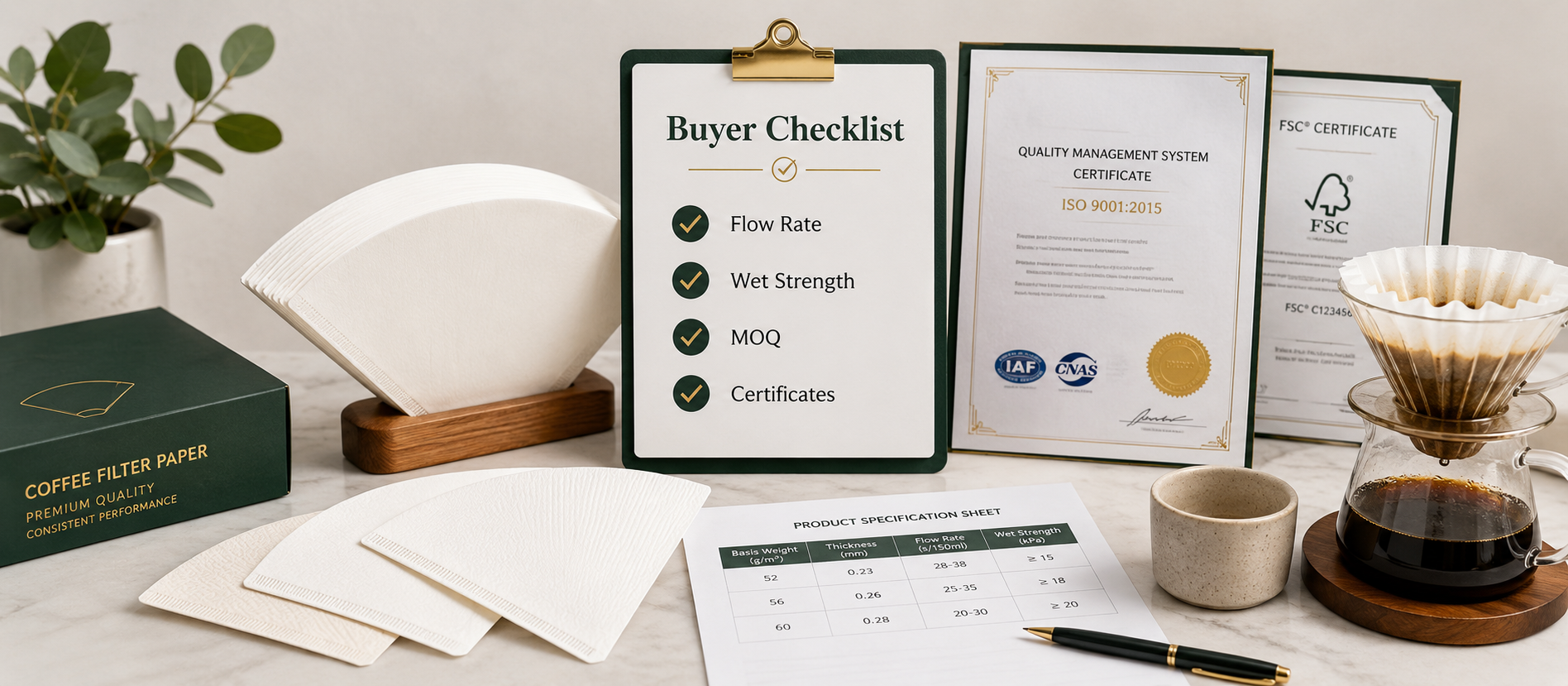
Product Overview: What Is Coffee Filter Paper?
Coffee filter paper is a porous cellulose-based material designed to allow brewed coffee to pass through while retaining coffee particles and part of the oils suspended in the brew.
It is used in both consumer and industrial coffee applications, including:
A commercial filter needs to provide controlled water flow, adequate wet strength, acceptable flavor neutrality, dimensional consistency, and reliable performance during converting or packing.
That is why professional filter paper production usually begins with the intended use rather than a generic paper specification.
Main Materials Used in Coffee Filter Paper
Wood Pulp
Wood pulp is widely used because it provides a good balance between availability, filtration performance, strength, and cost. Softwood fibers generally contribute more strength, while hardwood fibers can improve sheet uniformity.
Abaca Fiber
Abaca is a long plant fiber known for wet strength. It is frequently used in specialty filtration products where the paper needs strength without becoming excessively dense.
Cellulose Blends
Manufacturers can combine different fibers to balance flow rate, tensile strength, wet strength, paper formation, and overall material cost.
The exact fiber formula can vary by manufacturer and product grade. For automatic single-serve coffee packaging, fiber selection must also support reliable handling at commercial machine speeds.
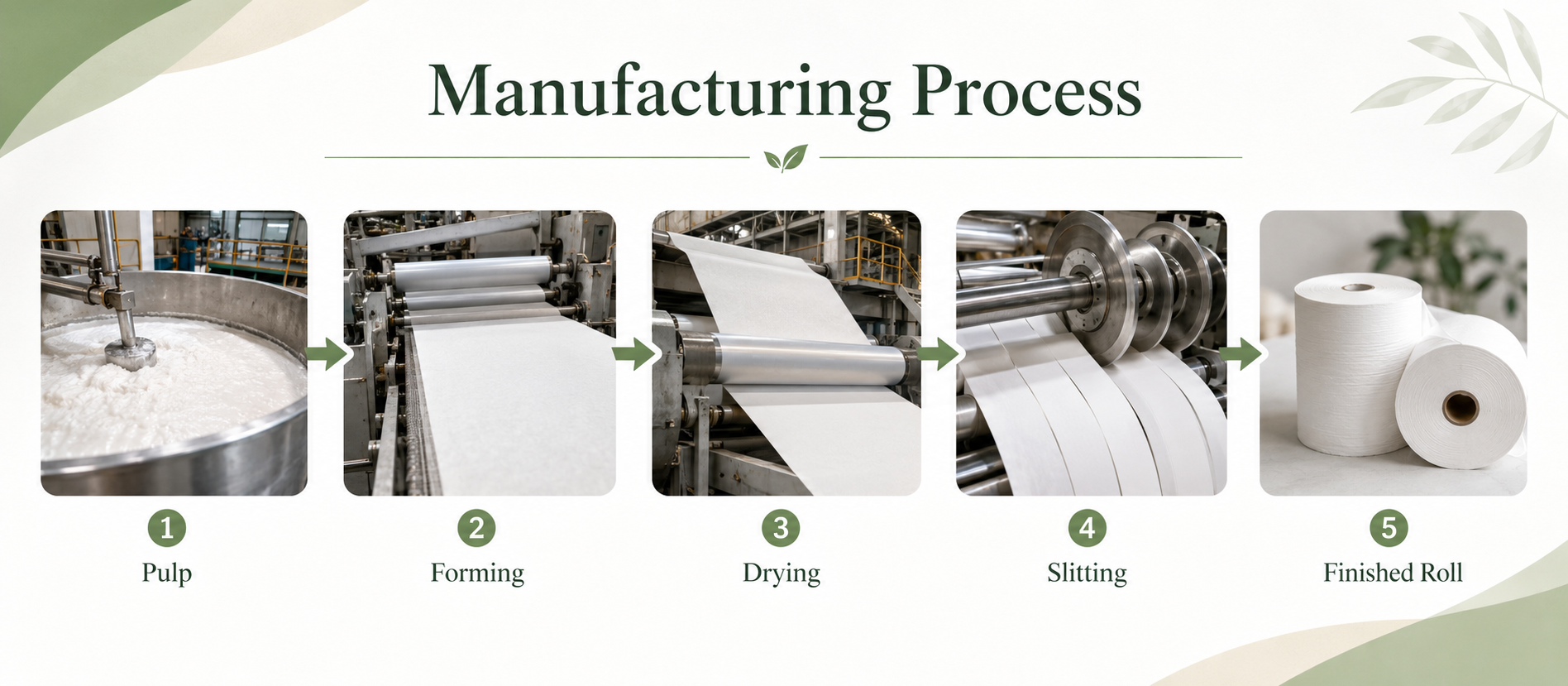
How Coffee Filter Paper Is Manufactured
1. Pulp Preparation
The process begins with selected cellulose pulp. Dry pulp sheets or bales are mixed with a large amount of water in a pulper, which separates the fibers and creates a uniform pulp suspension.
Fiber selection at this stage affects almost everything that follows. Longer fibers can improve mechanical strength, while shorter fibers often contribute to more even sheet formation.
2. Fiber Refining
The pulp may pass through refining equipment that modifies the surface of the fibers and improves bonding.
This step needs careful control. Insufficient refining can result in weak paper. Excessive refining can close the paper structure too much and reduce water flow.
3. Cleaning and Screening
Before forming the sheet, the pulp is cleaned and screened. The goal is to remove contaminants, large fiber bundles, and other irregularities that may create holes, weak spots, or uneven filtration.
4. Sheet Formation
The diluted pulp suspension is distributed across a moving forming screen. Water passes through the screen while the fibers remain on the surface, forming a continuous wet paper web.
This stage is critical because the distribution of fibers influences pore structure, thickness consistency, filtration uniformity, and strength.
5. Pressing and Water Removal
The newly formed sheet contains a large amount of water. Mechanical pressing removes part of that water and consolidates the fiber structure.
Pressing must be balanced carefully. Excessive pressure can reduce porosity and slow extraction. Too little consolidation may leave the paper weaker than required.
6. Drying
The paper passes through controlled drying equipment until it reaches the required moisture level.
Consistent drying matters to industrial converters because variable moisture can cause curling, dimensional changes, or unstable behavior during high-speed production.
7. Creping or Surface Treatment
Some filter papers receive a creped or textured surface. The texture can improve flexibility and increase effective surface area while influencing how water spreads through the paper.
8. Wet-Strength Development
Ordinary paper quickly becomes weak in water. Coffee filter paper must remain stable while holding wet coffee grounds and hot water.
Manufacturers manage wet strength through fiber choice, paper structure, and appropriate food-contact-compliant processing methods where required.
9. Bleached or Unbleached Production
Coffee filter paper can be supplied as white bleached paper or natural brown unbleached paper.
White paper receives an additional whitening process. Unbleached paper keeps more of the natural pulp color.
Color itself does not determine flow rate or brewing quality. Fiber structure, basis weight, pore size, and paper density are more important.
10. Heat-Sealable Treatment
Traditional cone or basket filters may only require folding or die cutting. Certain drip coffee bags, however, need material that can be heat sealed during automated production.
A standard pour-over filter paper should therefore not automatically be substituted for heat-sealable roll material.
11. Slitting and Rewinding
After the master roll is completed, it may be slit into narrower rolls according to customer specifications.
Important parameters include:
- Roll width
- Core diameter
- Maximum roll diameter
- Roll weight
- Winding direction
- Roll tension
12. Quality Inspection
Finished rolls are checked before shipment to confirm that physical and filtration properties remain within the required specification.
Quality Control in Filter Paper Production
Professional filter paper production should combine technical measurements with practical brewing tests.
Influences paper weight, strength, and handling.
Affects stiffness and converting behavior.
Influences water flow and extraction.
Helps the filter remain intact during brewing.
Affects storage and machine stability.
Important for automatic converting.
Two papers with the same basis weight can still produce different extraction speeds because the internal pore structure may be different.
Coffee Filter Paper Comparison
| Paper Type | Appearance | Typical Application | Main Buyer Concern |
|---|---|---|---|
| Bleached Wood-Pulp Paper | White | Pour-over, basket and drip filters | Flow rate and sensory neutrality |
| Unbleached Paper | Natural brown | Specialty and natural-positioned coffee | Paper aroma and branding |
| Abaca Blend | White or natural | Premium filtration | Wet strength and cost |
| Heat-Sealable Filter Paper | Varies | Automatic drip coffee bags | Sealing and machine compatibility |
| Filter Paper Roll | White or natural | Industrial converting | Roll dimensions and production stability |
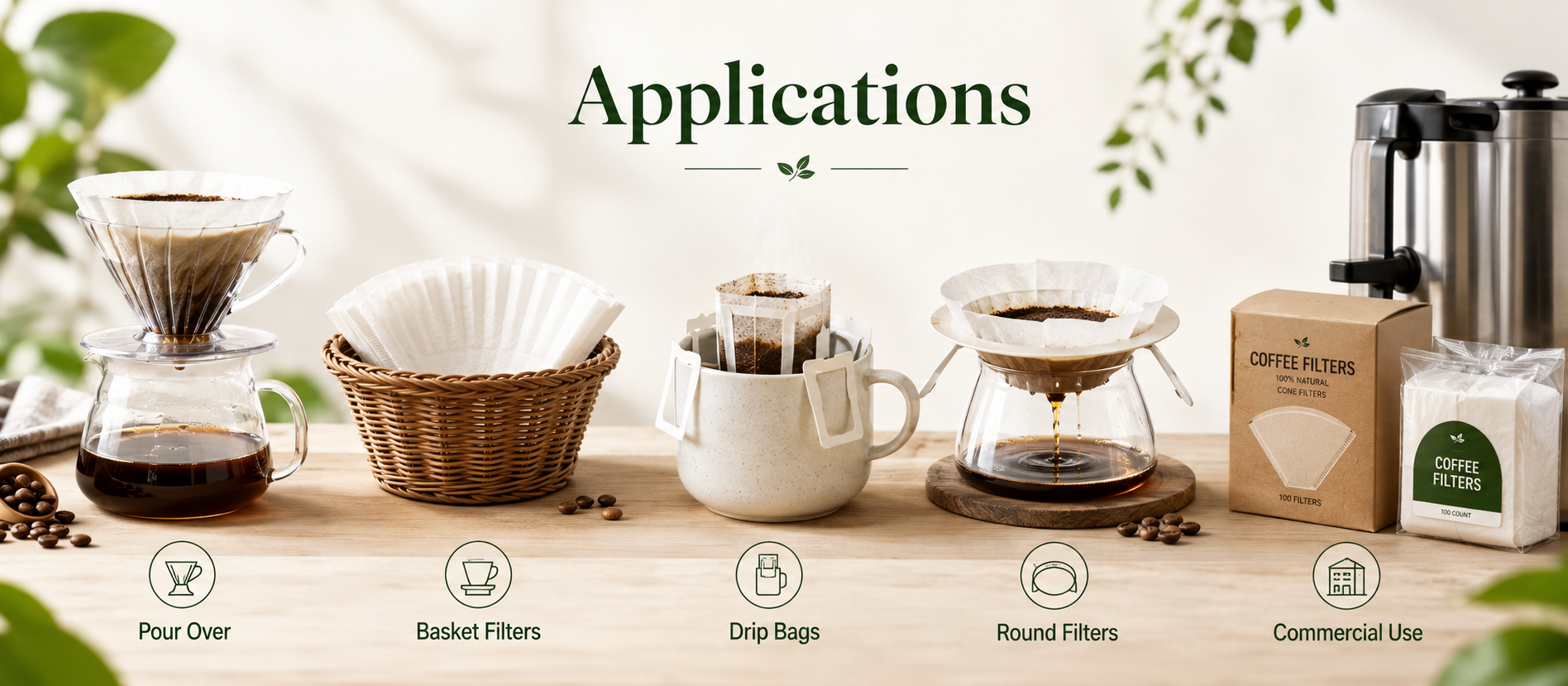
Applications
Pour-Over Coffee
Cone and flat-bottom filters require stable flow and low paper aroma, especially for specialty coffee.
Drip Coffee Bags
The material must combine filtration performance, wet strength, and converting compatibility.
UFO / Round Filters
Filter flow must be matched to the chamber shape, coffee dose, and grind size.
Commercial Brewing
Hotels, restaurants, offices, and catering operations often use larger basket-style filters.
Key Advantages
- Clean cup profile: paper retains fine particles and part of the coffee oils.
- Consistent extraction: controlled porosity helps maintain predictable brewing times.
- Good wet strength: properly designed filter paper remains stable during brewing.
- Easy use: disposable paper filters reduce cleanup.
- Flexible formats: suitable for cone, basket, drip, round, and custom designs.
- Industrial scalability: roll material can be converted at high production volumes.
Customization Options
B2B buyers can customize several technical parameters depending on production volume and application.
For many projects, using an existing filter grade and customizing only the roll width or finished dimensions provides the best balance between performance, cost, MOQ, and lead time.
MOQ
Minimum order quantity depends largely on how much customization is required.
| Product Type | Relative MOQ |
|---|---|
| Standard Stock Paper | Low |
| Standard Roll Width | Low to Medium |
| Custom Slit Width | Medium |
| Custom Basis Weight | Medium to High |
| Custom Fiber Formula | High |
| Custom Heat-Sealable Material | High |
Buyers should confirm whether MOQ is calculated by paper grade, width, basis weight, or total quantity. These definitions can make a major difference when several machines or filter formats are involved.
Lead Time
Stock filter paper usually has a shorter lead time than custom-developed material.
A typical customized project may include:
- Application and specification review
- Sample preparation
- Brewing evaluation
- Machine testing if required
- Technical approval
- Production scheduling
- Paper manufacturing
- Slitting or converting
- Inspection
- Packing and shipment
Importers should also include ocean freight, customs clearance, and warehouse receiving time when calculating their real replenishment cycle.
Certificates and Compliance
Coffee filter paper comes into direct contact with hot water and coffee, so buyers should verify compliance for the exact product specification.
Depending on the destination market, relevant documentation may include:
- FDA-related food-contact documentation
- EU food-contact compliance
- Migration testing where applicable
- LFGB-related testing where applicable
- ISO 9001 quality management documentation
- Food-safety management documentation where applicable
- FSC or other responsible fiber sourcing documentation where applicable
- Technical data sheets for the specific paper grade
What Buyers Should Confirm Before Ordering
For automated production, buyers should test the real material on the intended machine. Paper thickness, tension, surface friction, stiffness, and sealing behavior can all affect line performance.
Frequently Asked Questions
1. What is coffee filter paper made from?
Most coffee filter paper is made primarily from cellulose fibers, commonly wood pulp. Specialty filter papers may also include abaca or other cellulose fiber blends.
2. How is coffee filter paper manufactured?
The process generally includes pulp preparation, refining, screening, sheet formation, pressing, drying, surface treatment, quality testing, and roll converting.
3. What determines the flow rate?
Flow depends on fiber blend, pore structure, basis weight, density, thickness, refining level, and sheet formation.
4. Is brown coffee filter paper better than white paper?
Neither is automatically better. Both can deliver good brewing performance. Buyers should compare flow rate, paper aroma, wet strength, converting performance, and brand positioning.
5. What information is needed for a quotation?
Provide the intended application, filter dimensions, roll width, coffee dose, grind size, machine model, expected volume, destination market, and required documentation.
Post time: Aug-31-2026