When the coffee industry talks about sustainability, the conversation usually revolves around the farms: shade-grown coffee beans, fair trade wages, and water conservation.
However, a massive, invisible carbon footprint lies hidden within your supply chain. It occurs after the coffee is roasted, during the thousands of miles it travels to reach the customer’s cup.
We are referring to the weight of the goods.
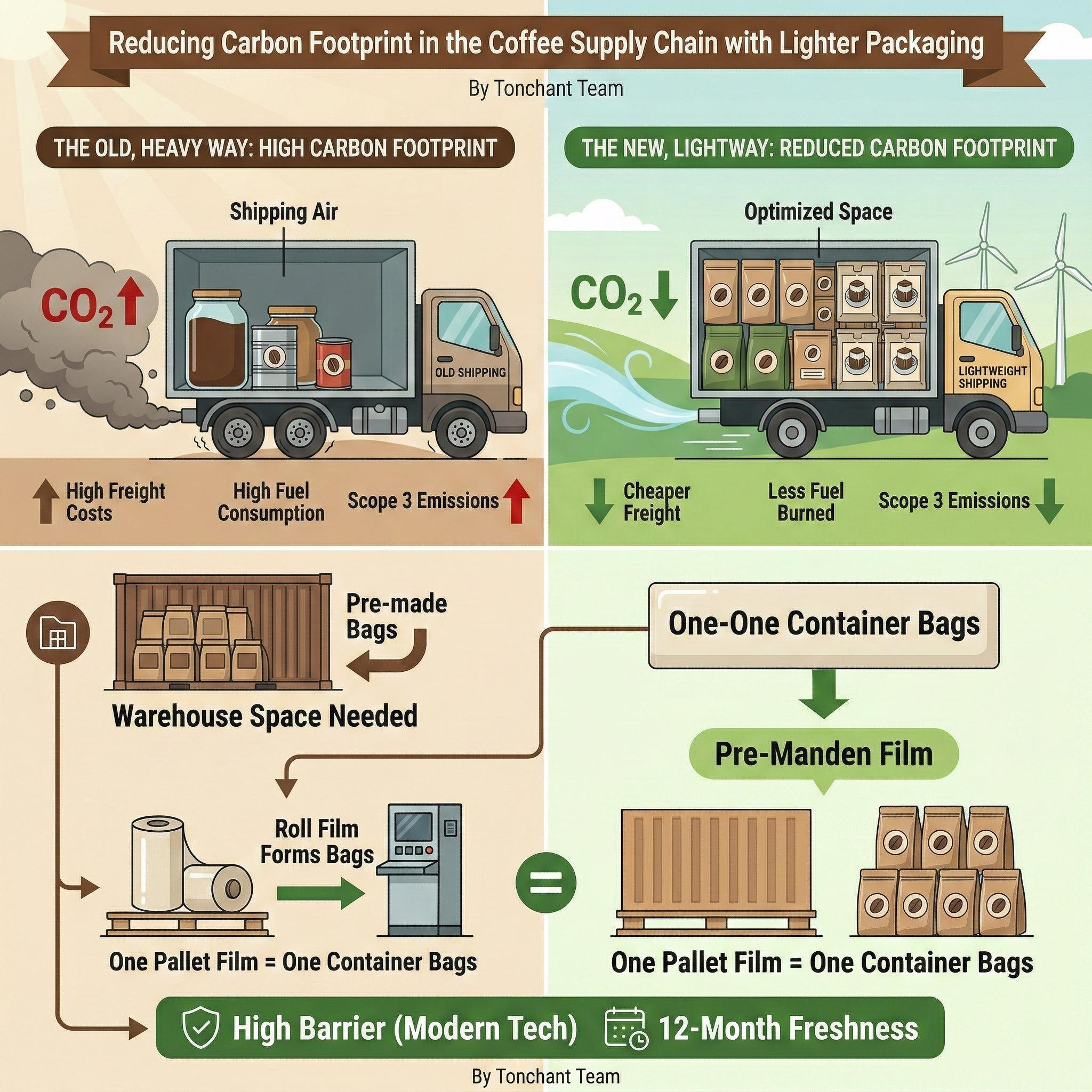
If you package your coffee in heavy glass jars, thick tin cans, or bulky, overly designed plastic bags, you are paying for dead weight. In the logistics world, heavier weight means more fuel consumption, higher transportation costs, and greater carbon emissions.
At Tonchant, we help roasters and tea brands address this issue at its source. The secret to a greener and more efficient supply chain isn’t always a magical new ingredient—sometimes, it’s simply about reducing the amount of material used.
Here is how transitioning to lightweight, flexible packaging can significantly reduce your Scope 3 emissions and increase your profit margins.
1. The Mathematics of “Lightweighting”
“Lightweighting” is a packaging engineering term that refers to redesigning packaging to make it significantly lighter while maintaining its structural and protective properties.
Let’s do the math. A standard empty glass coffee jar can weigh up to 300 grams. A flexible, high-barrier coffee pouch of the exact same capacity weighs about 15 grams.
When packaging scales up to pallets or shipping containers, the difference in fuel consumption is staggering. Switching to flexible packaging bags or single-serve drip coffee bags can significantly reduce the weight loads of trucks and cargo ships. You should be paying to transport coffee, not heavy packaging.
2. Air Freight vs. Roll Film Transport
If you buy pre-made 3D coffee bags from overseas suppliers, you are essentially paying to ship boxes filled with air. These take up a massive amount of warehouse and shipping space.
This is exactly why medium and large-sized roasters are switching to Roll Film.
Tonchant produces highly compact rolls of printed barrier film capable of manufacturing thousands of coffee bags. A single pallet of roll film can hold the equivalent of an entire shipping container of pre-made bags.
By utilizing our automated packaging machines in your facility, you can form the bags on-site. This drastically reduces the number of delivery trucks required to transport your packaging materials, immediately slashing the carbon footprint of your inbound supply chain.
3. High Barrier Properties, Low Weight
There is a widespread concern among roasters that thinner, lighter packaging will compromise the freshness of the beans. Ten years ago, this concern might have been valid. Back then, thick layers of aluminum foil were required to keep oxygen out.
Materials science has advanced rapidly.
At Tonchant, we use advanced coatings such as EVOH or ALOX (transparent ceramic) to design lightweight laminated films. These ultra-thin coatings provide superior Oxygen and Water Vapor Transmission Rates (OTR/WVTR) while completely avoiding the bulk and environmental cost of heavy metal foils.
Your coffee can stay fresh for up to 12 months after roasting, but the packaging weight is only a fraction of that of a traditional multi-layered foil bag.
4. Drip Coffee Bags: Extreme Packaging Efficiency
Single-cup coffee has historically been considered wasteful (think of those rigid, hard-plastic coffee capsules). But drip coffee bags have completely changed that perception.
These drip coffee filters are incredibly lightweight. Paired with a precisely sized outer aluminum foil pouch and a compact cardboard box, the product-to-pack weight ratio is optimized to the extreme.
They are flat and highly stackable, perfectly fitting into standard e-commerce mailers. This means less dead space in shipping boxes and fewer delivery vehicles needed to fulfill the same number of online orders.
The Business Case for Going Light
Sustainable development should not be an economic burden. Optimizing your packaging weight yields immediate returns on investment:
-
Lower inbound shipping costs when you buy raw materials from us.
-
Lower outbound shipping costs when you mail orders to your customers.
-
Less physical waste ending up in landfills.
At Tonchant, we do more than just sell packaging bags; we are committed to optimizing your entire packaging supply chain. Whether you need thinner high-barrier bags, lightweight drip coffee filters, or the automated equipment to bring your packaging in-house, we have the engineering expertise to help you achieve sustainable, large-scale production.
Post time: Feb-27-2026