Today, if you’re a coffee roaster, you face immense pressure. Your customers want quality coffee, but they also want peace of mind when they throw away the packaging afterward.
You may have narrowed your search down to two keywords: Recyclable and Compostable.
On the surface, both seem good. But from a manufacturing and supply chain perspective, they are two completely different worlds. Choosing the wrong approach for a particular market can lead to shelf-life issues, customer confusion, or unnecessary costs.
Tonchant manufactures both materials. We supply PLA corn fiber (compostable) and high-barrier single-layer PE (recyclable) roll film and bags. Our commitment to neutrality allows us to provide you with an objective comparative analysis.
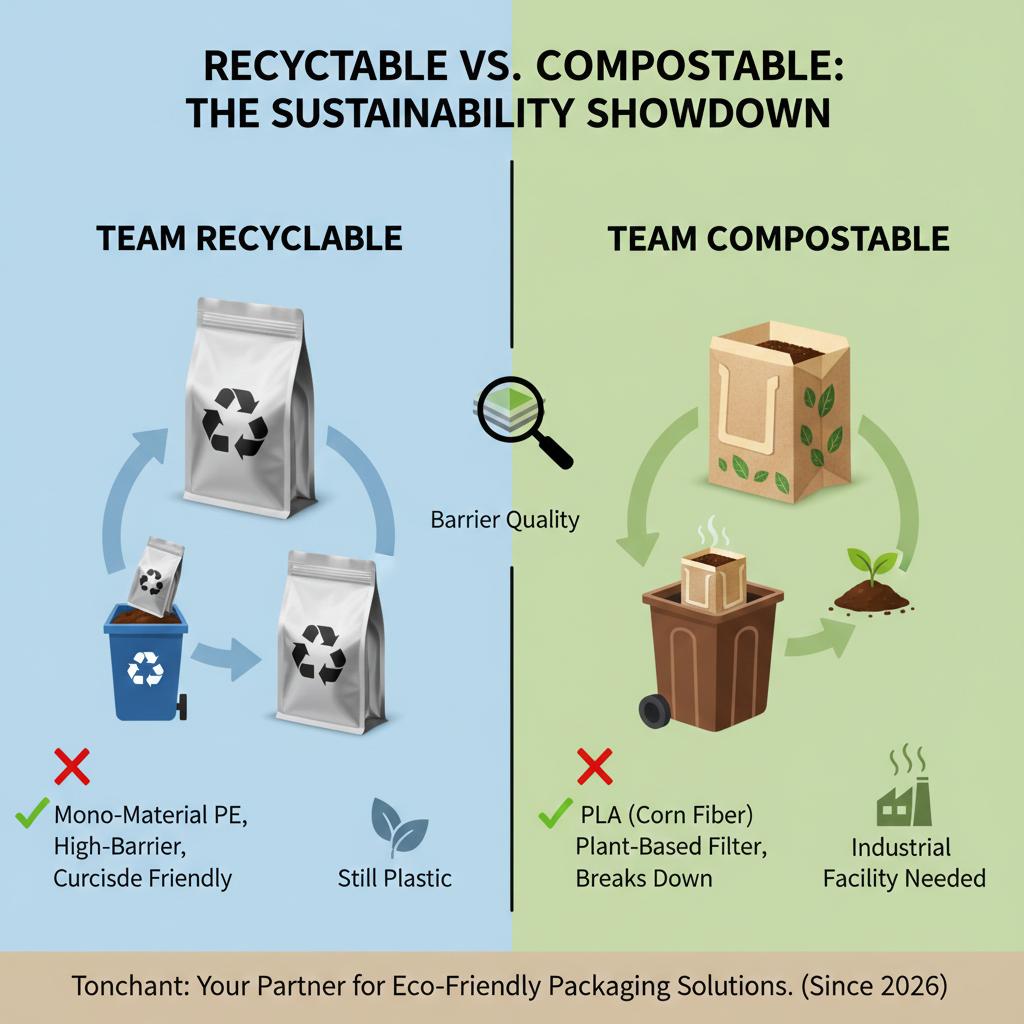
Team Compostable (The “Back to Earth” Choice)
-
Materials: Typically PLA (Polylactic Acid), made from corn starch or sugarcane, often mixed with kraft paper.
-
The Promise: “Plastic-free.” The concept is that the packaging will eventually decompose into organic matter, water, and carbon dioxide, leaving no trace.
The Advantages
-
Marketing Gold: It resonates deeply with environmentally conscious consumers who abhor the idea of plastic sitting in landfills for 500 years.
-
The Perfect Filter: For the inside of a coffee bag (the drip filter itself), PLA mesh is undoubtedly the best choice. It allows customers to brew their single cup without microplastic guilt.
The Reality Check
-
Shelf Life: Compostable materials generally have lower oxygen barrier properties than traditional plastics. If you need your coffee to stay fresh for 18 months, you’ll need to use a high-end (and expensive) high-barrier compostable film.
-
Disposal Infrastructure: Most compostable bags require industrial composting facilities (high temperatures) to decompose. If your customers dispose of them in their own gardens or regular trash cans, they may not break down as advertised.
Team Recyclable (The “Circular Economy” Solution)
-
Materials: Single-material LDPE (Low-Density Polyethylene).
-
The Promise: “Recyclable.” Unlike traditional aluminum-foil composite bags (which are mixed materials and cannot be recycled), mono-material bags are made from a single type of plastic, meaning they can be melted down and reused.
The Advantages
-
Infrastructure: Recycling bins are everywhere. For the average consumer, understanding “put this in the recycling bin” is much easier than finding an industrial composting facility.
-
High Barrier Properties: Modern single-layer polyethylene film offers superior oxygen and moisture barrier performance. Your coffee stays fresh longer compared to most standard compostable options.
-
Cost: Generally speaking, recyclable materials are more affordable than certified compostable biomaterials.
The Reality Check
-
It’s Still Plastic: Even though it can be recycled, some “zero-waste” purists may still view any plastic usage as a negative.
Which One Should You Choose?
This decision is not just about saving the planet; it’s about understanding your customer’s behavior.
Choose Compostable (PLA) If:
-
You are selling drip coffee filters or tea bags. Because the filters become wet and covered in organic matter (coffee grounds) after use, they are perfect for the compost bin.
-
Your Brand Positioning: You market yourself as “ultra-premium,” “plastic-free,” or “zero-waste.”
-
Your Geography: Your target market (e.g., Europe, parts of California) has strong municipal composting programs (Brown Bins).
Choose Recyclable (Mono-PE) If:
-
You are selling large bags: Such as 250g or 1kg whole bean/ground coffee bags.
-
Priority on Freshness: You need a guaranteed long shelf life for retail distribution.
-
Mass Market Appeal: Your customers want the convenience of curbside recycling rather than specialized disposal.
The Manufacturing Impact (Machinery Matters)
Whether you choose recyclable or compostable packaging, there is a technical challenge: Your Packaging Machine.
Both of these eco-friendly materials behave differently than standard aluminum foil laminates.
-
PLA is heat-sensitive and will shrink if the sealing temperature is too high.
-
Mono-PE has a narrow sealing window and will stretch under tension.
This is where Tonchant’s strength lies. We don’t just sell films; we offer customized solutions. If you use our Automated Packaging Machines, we specifically configure ultrasonic sealing jaws or precision heating strips based on your chosen material. We test the film’s “runnability” to ensure they won’t clog, melt, or leak on your production line.
Still Unsure?
You don’t need to guess. We can send you a Sustainability Sample Kit, which includes our high-barrier recyclable bags and certified compostable PLA filter cartridges.
Touch them, tear them open, and see which one best aligns with your brand’s vision.
[Contact Tonchant Today] to discuss your eco-friendly packaging transformation.
Post time: Jan-24-2026