Coffee convenience is changing. Consumers still want a fast, reliable cup, but more buyers are questioning how that convenience is packaged.
For restaurant chains, food delivery companies, distributors, wholesalers, and importers, this creates a practical challenge. A modern coffee format must protect aroma, survive storage and transport, work with existing equipment, remain easy for consumers to use, and increasingly support a credible sustainability strategy.
That is why single-serve drip coffee bags, portioned filter systems, recyclable flexible packaging, paper-based components, compostable filters, and lightweight barrier structures are receiving more attention.
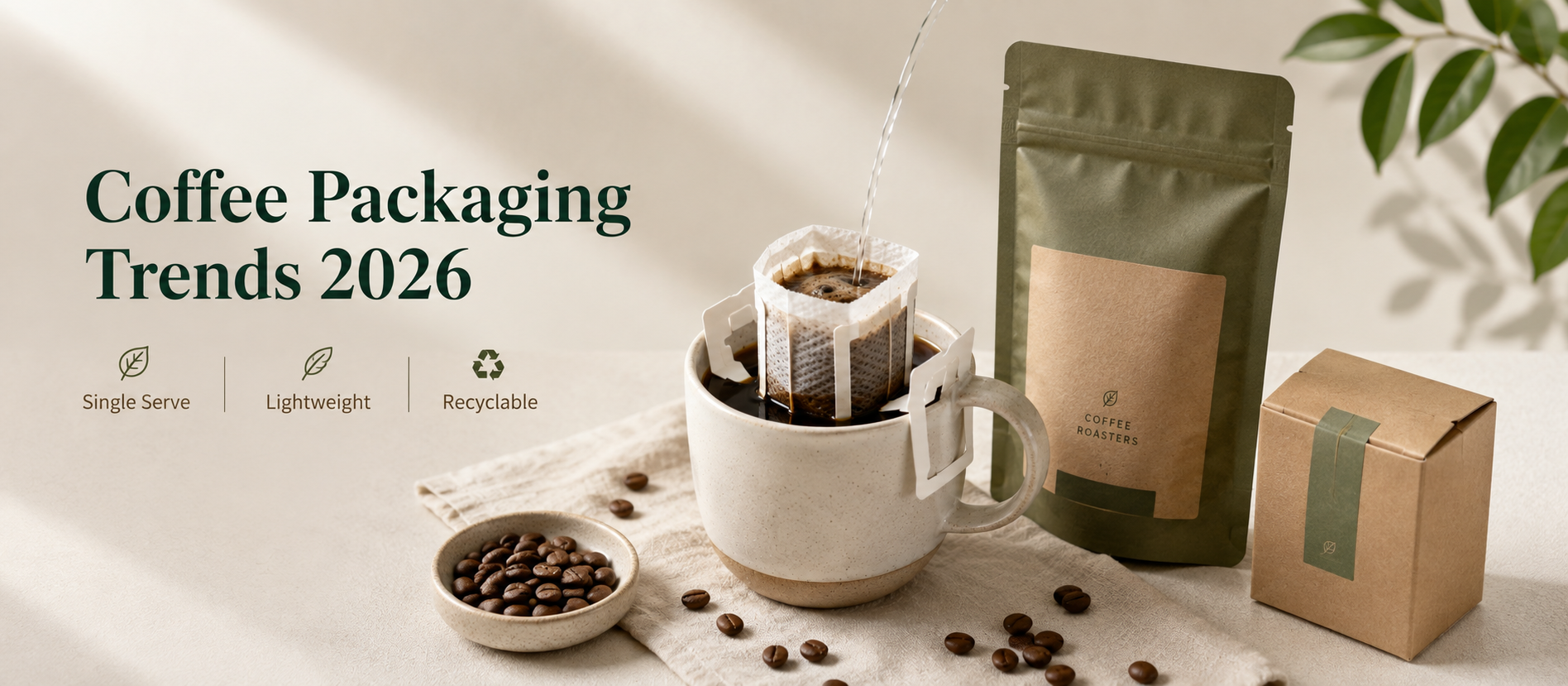
The conversation around sustainable coffee packaging has also become more technical. Buyers are moving away from broad claims such as “eco-friendly” and asking more specific questions: What is the material structure? Is it recyclable in the destination market? Does the compostability claim apply to the entire pack or only one component? Can the new film run reliably on existing equipment?
Those questions are increasingly shaping commercial purchasing decisions.
Traditional coffee packaging was relatively simple. Coffee was sold in larger bags, while consumers supplied the grinder, brewer, paper filter, or coffee machine themselves.
Single-serve formats changed that relationship. Capsules, pods, drip coffee bags, steeped coffee sachets, and pre-portioned filter systems combine the coffee and part of the brewing process into one packaged product.
That delivers convenience, but it can also increase the number of packaging components.
A drip coffee product, for example, may contain a filter, paper support, printed outer pouch, ink, adhesive, and retail carton. A capsule may combine a molded cup, barrier layer, sealing lid, coffee, and secondary packaging.
For this reason, sustainability is becoming less about choosing one “green material” and more about designing the entire packaging system around performance, compliance, logistics, and end-of-life options.
Regulation is reinforcing that shift. In Europe, new packaging rules are putting greater emphasis on packaging reduction, recyclability, labeling, and material design. For buyers supplying the EU market, that means packaging decisions increasingly need to be made with the destination market in mind from the beginning.
Single-serve coffee remains attractive because it reduces preparation time and standardizes the portion. But machine-dependent capsules are no longer the only option.
Drip coffee bags are increasingly used by specialty roasters, hotels, office suppliers, and private-label brands because they require only a cup and hot water. They also allow real ground coffee to be served without installing a dedicated brewing machine.
This format is especially established in parts of Asia, where portable pour-over coffee has been familiar for years. For buyers in Europe and North America, the same format is becoming more relevant for premium sampling, hotel rooms, outdoor use, subscription boxes, and food-delivery programs.
Flexible pouches remain attractive because they use relatively little material and take up less transport space than many rigid formats.
The difficulty is barrier performance. Ground coffee needs protection against oxygen, moisture, external odors, and sometimes light. Traditional coffee pouches often achieve this through multilayer laminates, which can be difficult to recycle.
Packaging developers are therefore working with thinner structures, mono-material films, improved barrier coatings, and simplified laminates. The goal is not simply to create eco coffee bags, but to reduce complexity without shortening the usable shelf life of the coffee.
A few years ago, terms such as biodegradable, compostable, plant-based, and recyclable were often used loosely.
That is becoming harder to justify. Buyers increasingly want product-specific documentation. A PLA filter may support an industrial compostability claim under certified conditions, for example, while the outer barrier pouch may still require a completely different disposal route.
This is pushing suppliers toward clearer and more specific claims.
| Region | Recent Development | Implication for Coffee Packaging Buyers |
|---|---|---|
| European Union | Packaging rules are placing greater emphasis on recyclability, material reduction, and labeling | Buyers need stronger documentation and more careful packaging design |
| United States | Food-contact packaging is under tighter scrutiny, including coatings and chemical substances | Importers should review food-contact declarations and material compliance |
| Asia | Single-serve coffee remains commercially important, while recycling rules continue to evolve by market | Buyers need country-specific material and labeling checks |
In Europe, packaging policy is becoming a direct procurement issue. Buyers need to consider not only whether a package protects the coffee, but also whether it fits recyclability and labeling expectations in the target market.
In the United States, food-contact packaging continues to face stronger chemical and material scrutiny. This increases the importance of supplier documentation, especially for coatings and paper-based food-contact materials.
Across Asia, there is no single regional rule. Japan, South Korea, China, and Southeast Asian markets each have their own packaging and recycling frameworks. Importers should avoid assuming that one sustainability claim will work equally well everywhere.
A growing number of commercial buyers want coffee formats that do not require grinders, brewers, capsule machines, or extensive employee training.
Consider a restaurant group with large flagship locations and smaller takeaway outlets. The main restaurants may justify espresso equipment, while smaller sites only have hot-water dispensers. A pre-portioned drip filter gives both sites a branded coffee option without duplicating equipment investment.
This same logic applies to hotels, offices, food delivery companies, and travel products.
For importers, regulations in the destination market increasingly influence packaging development from the beginning.
A pouch developed only around visual appearance and barrier performance may need to be reconsidered if the target market has stronger requirements around recyclability, labeling, or restricted substances. This is especially important for private-label projects. If the artwork already includes environmental claims, changing the material later can create additional cost and delay.
Consumers may never see the technical barrier layer inside a pouch, but they do notice a paper support, compact package, reduced plastic content, clear recycling instructions, or natural material appearance.
This is pushing product designers to connect material engineering with visible brand communication. A sustainable packaging strategy that customers can understand is often more valuable than a complex technical improvement that is never explained.
Ground coffee loses aroma quickly when exposed to oxygen. A lower-impact package that provides inadequate barrier protection can create a different kind of environmental problem: wasted coffee.
This is why the correct packaging specification depends on the supply chain.
A local roaster supplying nearby stores every few weeks may not need the same barrier performance as an importer shipping six months of inventory by sea and holding additional stock in a warehouse. Sustainable coffee packaging has to protect the product for the real distribution cycle, not just perform well in a short laboratory test.
A technically recyclable package does not guarantee that every consumer can recycle it.
The same applies to compostable packaging. Industrial composting infrastructure remains uneven, and many compostable materials should not be described as home compostable unless that specific claim has been verified.
Europe, North America, Japan, South Korea, Southeast Asia, and other markets all have different collection and labeling systems. For distributors selling into multiple countries, a single packaging claim may not work equally well everywhere.
Replacing a conventional laminate with a recyclable or bio-based alternative may affect stiffness, surface friction, sealing temperature, film tension, and cutting behavior.
A material can look perfectly acceptable as a pouch sample but still require adjustments when it enters continuous production.
Tonchant Earth factory experience shows why this matters: the packaging material, filter structure, coffee dose, sealing temperature, and machine speed need to work as one system. This is one of the most common areas where buyers underestimate development time.
The most useful change buyers can make is to replace broad sustainability questions with specific technical questions.
For example, a drip filter that works perfectly on a ceramic mug may not fit a takeaway cup with a wider opening. That problem should be discovered before a national rollout, not afterward.
Food delivery companies should conduct transport tests. Filters can bend, outer packs can absorb surrounding odors, and retail cartons can become crushed when placed beside hot or heavy food.
Importers should include shipping and warehouse time when discussing barrier performance. They should also confirm whether recyclability or compostability claims are recognized in the destination market.
Distributors managing several private-label accounts may benefit from using one proven filter structure and changing the outer artwork, retail box, or coffee blend. This reduces technical variation while keeping visible customization.
Coffeeteabag.com is one industry participant working with single-serve coffee filter and packaging formats. The same sourcing principle applies across the sector: evaluate the complete finished pack, not only the individual filter or film sample.
The next generation of sustainable coffee brewing is unlikely to rely on one universal material.
Instead, the market is moving toward more specialized packaging systems.
High-volume coffee may increasingly use recyclable mono-material pouches where barrier requirements allow. Premium single-serve programs may combine paper supports with certified filter components. Hotels may use more equipment-free pour-over formats in selected rooms. Foodservice suppliers may keep several packaging structures for different regions.
European policy will continue pushing packaging toward measurable recyclability and material efficiency.
North American buyers are likely to increase scrutiny of coatings and food-contact chemistry.
In Asia, strong single-serve coffee culture will continue to create opportunities for compact brewing formats, while packaging requirements will remain highly country-specific.
Documentation will also become a competitive factor.
A professional B2B quotation will increasingly need to explain more than dimensions and unit cost. Buyers will expect material identification, compliance information, environmental claim status, production compatibility, and recommended end-of-life handling. That may make sourcing more complicated in the short term, but it should also reduce vague environmental claims and make serious suppliers easier to compare.
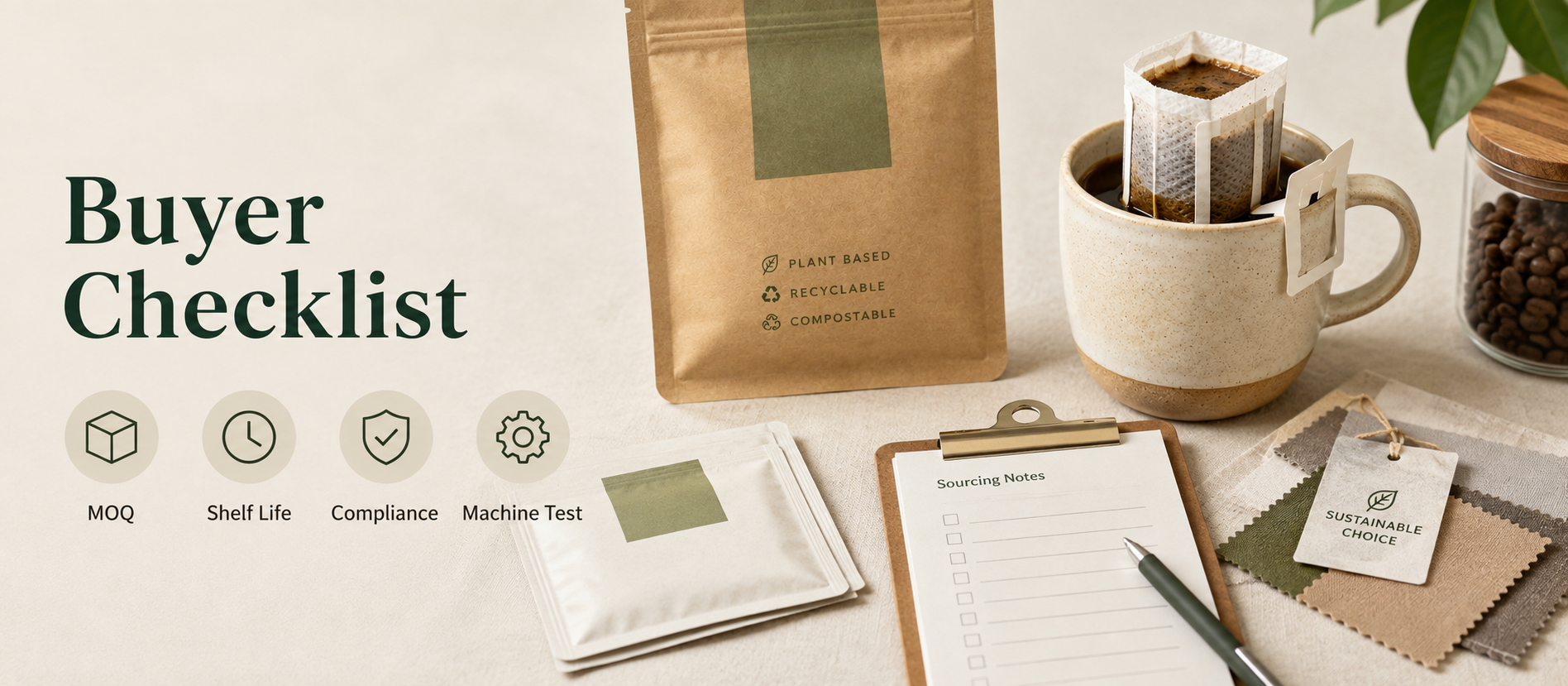
Sustainable coffee brewing is moving from a niche packaging discussion into a mainstream procurement issue.
Consumers still expect convenience and good coffee. Regulators are placing greater emphasis on packaging waste, recyclability, and food-contact chemistry. Brands, meanwhile, want environmental improvements that customers can understand without compromising freshness or production reliability.
For restaurant chains, food delivery companies, distributors, wholesalers, and importers, the strongest strategy is not to chase the newest material simply because it appears more sustainable.
The better approach is to evaluate the complete system: coffee, filter, pouch, machine, logistics, destination market, and disposal route.
The future of sustainable coffee packaging will be shaped less by how green a package looks and more by whether its performance, compliance, environmental claims, and end-of-life route can be demonstrated clearly.
Post time: Aug-28-2026