For decades, the coffee industry has had a legitimate reason to use plastic.
“We need them to keep it fresh,” we said. “Paper leaks oxygen. Biodegradable films dissolve too quickly. If we want to ship coffee all over the world and still have it delicious six months later, we need aluminum and polyethylene.”
For a long time, this was indeed the case. But by 2026, this excuse will no longer hold water.
The future of coffee packaging lies not only in reducing waste, but also in completely eliminating fossil fuel-based plastics—without compromising the quality of the roast. From the filter paper in the cup to the packaging bag on the shelf, technology has finally made this a reality.
This is what a plastic-free future looks like, and how your brand can be a part of it.
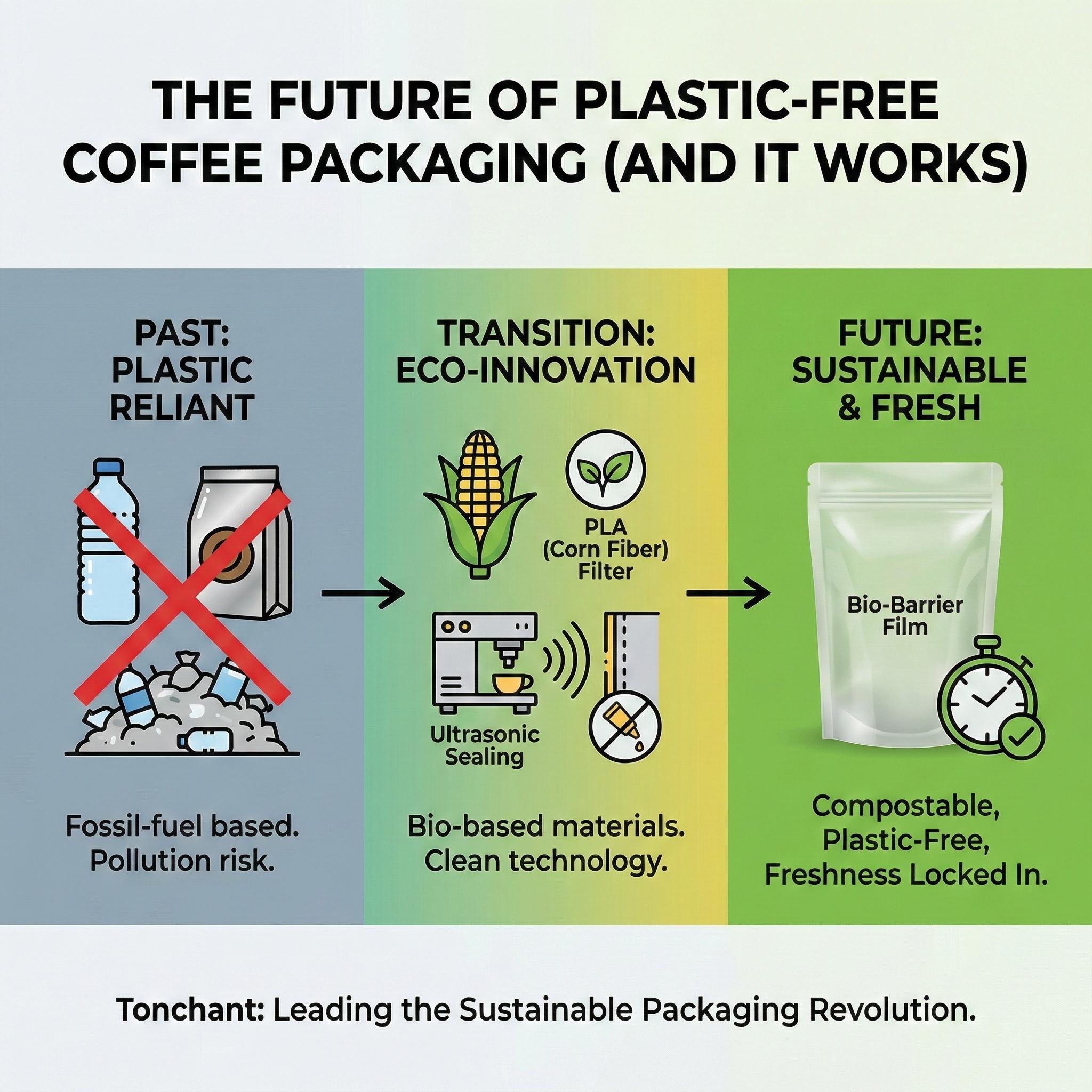
1. The End of “Invisible” Plastic in Filters
The biggest problem with single-serve coffee (drip coffee bags) and tea drinks has always been the filter paper itself. To make the filter paper strong enough to hold moist coffee grounds, it is usually reinforced with synthetic fibers. To allow the nylon mesh to be heat-sealed, plastic polymers are required.
The future belongs to PLA (Polylactic Acid), often referred to as Corn Fiber.
This is the disruptive technology that Tonchant has high hopes for. PLA mesh is derived from renewable plant starch (corn or sugarcane).
-
Its properties are like plastic: It is strong, silky, and transparent.
-
Its nature is like plants: It can be completely biodegraded and composted under industrial conditions.
We’re seeing a huge shift happening at roasters, who are replacing older PP/PET filters with PLA mesh filters. This allows you to confidently tell your customers: “No, your morning coffee won’t contain microplastics.”
2. Transitioning from Heat Sealing to Ultrasonic Sealing
When discussing plastic-free materials, we cannot ignore machinery. Many brands fall short in this area.
Traditional packaging production lines use heat-sealing technology. Heating rods clamp glue or plastic, melting it to seal the package. The problem is that biomaterials like PLA are very sensitive. If ironed with a high-temperature bar, they can shrink, burn, or fail to seal properly.
The future of packaging lies in Ultrasonic Technology. Our latest generation of Tonchant packaging machines doesn’t use heating bars; instead, it employs high-frequency ultrasonic vibration. This energy instantly binds the molecules of the PLA mesh material tightly together.
-
No Glue Used: This is crucial. If synthetic adhesives are used for sealing, it cannot be called a “plastic-free” product.
-
Energy Efficiency: Ultrasonic sealing requires only a fraction of the energy of thermal sealing.
3. Solving the “Preservation Paradox” (Bio-Barrier Films)
The final hurdle is the outer packaging bag. How can oxygen be prevented from entering without using plastic film?
The innovation of Bio-Based Barrier Films is developing rapidly. We are currently investigating composite materials using cellulose and biodegradable coatings to mimic the high barrier properties of traditional VMPET (metallized films).
While the shelf life of compostable outer packaging bags is still catching up with that of traditional aluminum foil bags (typically 6–9 months, compared to 12–18 months), the gap is narrowing. For brands with high turnover rates or local distribution, this trade-off often justifies the marketing value it brings.
4. Regulation is the Driving Force
Why make changes now? Because soon, you may have to.
The EU and parts of North America are actively enacting legislation to restrict Single-Use Plastic products (SUPs).Extended Producer Responsibility (EPR) regulations are making waste costly.
Make Your Brand Future-Proof
At Tonchant, we are at the intersection of materials and machinery. We not only sell you environmentally friendly filters but also the machines that can seal those filters.
The future will not be about sacrificing quality to protect the planet, but about using more advanced technologies to achieve both.
Ready to explore plastic-free solutions? [Contact Tonchant] to request a sample of our PLA corn fiber filter and learn about our ultrasonic packaging solutions.
Post time: Jan-26-2026