When roasters want to scale up the production of single-cup coffee, they typically focus on two things: the quality of the filter paper and the speed of the packaging machine.
But there is a hidden, highly technical detail that could determine the success or failure of your entire product line: How are the edges of your drip coffee bags sealed?
If you purchase pre-made empty bags or invest in fully automatic packaging machines, you will encounter two main technologies: Heat Sealing and Ultrasonic Sealing.
Choosing the wrong processing method for a specific filter media can lead to scorched edges, fragile seams, and even large-scale machine downtime. At Tonchant, we manufacture both filter rolls and automated equipment, so we witness firsthand how these technologies perform on the production line.
The following is the ultimate analysis of ultrasonic sealing and heat sealing in drip coffee packaging, and how to choose the right packaging solution for your brand.
The Industry Standard: Heat Sealing
How It Works
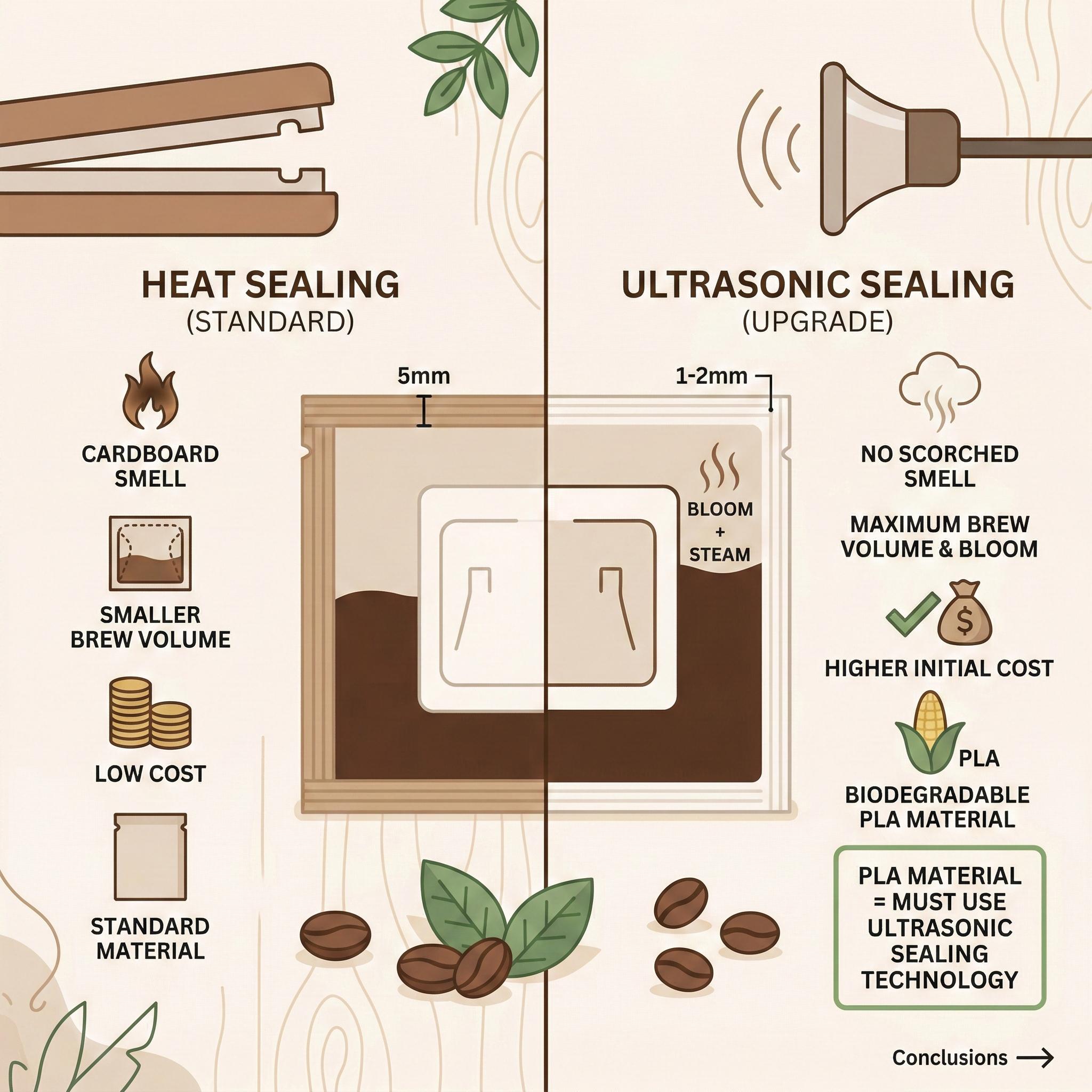
Heat sealing, as the name suggests, uses heated metal jaws (or sealing bars) to clamp the edges of the filter paper. The heat melts a thin layer of plastic (usually PE or PP) inside the filter paper, fusing the two sides together.
The Advantages
-
Economical: The heat sealing mechanism is relatively simple to manufacture and maintain, so the initial cost of the machinery is slightly lower.
-
Ideal for Outer Packaging: While we’re primarily focused on the inner drip filter here, heat sealing is the absolute gold standard for keeping coffee fresh in the outer foil bags. It creates a wide and perfectly airtight barrier.
The Reality Check
The heat-sealing process can be unforgiving. The heating strips remain at a high temperature continuously. If the machine stops running for even a few seconds, the material clamped between the jaws can easily be scorched.
Furthermore, heat sealing requires wider edges (typically 5 mm or more), which reduces both the aesthetic appeal of the drip filter bag and its internal brewing capacity.
The Modern Upgrade: Ultrasonic Sealing
How It Works
Ultrasonic sealing may seem magical, but it’s based purely on physics. It doesn’t use an external heat source; instead, it utilizes an acoustic tool called a “horn” to emit high-frequency sound waves.
As these sound waves pass through the filter material, they generate rapid microscopic friction. This friction instantly generates highly localized heat, fusing the fibers together within milliseconds.
The Advantages
-
Clean, Narrow Edges: The ultrasonic seal is extremely thin, typically only 1 to 2 millimeters wide. This gives drip coffee bags a premium, sophisticated, and “frameless” look.
-
No Burnt Edges: Because heat is generated instantly and internally, there’s absolutely no need to worry about the filter paper burning. Your customers will smell the aroma of roasted coffee, not the smell of burnt plastic.
-
Maximizing Space: A narrower seal means more space inside the filter bag, allowing the coffee grounds to fully expand and extract during the pour-over process.
The Decisive Factor: PLA (Compostable Materials)
If your brand is committed to sustainability and you want to use PLA (Corn Fiber) biodegradable filters, then your decision is already made: you must use ultrasonic sealing.
PLA is an aesthetically pleasing and environmentally friendly material, but it is incredibly sensitive to temperature. If you attempt to run PLA mesh material through a traditional heat sealing machine, the continuous heat will cause the material to shrink, deform, or melt and adhere to the metal jaws, resulting in severe machine blockages.
Ultrasonic energy can cleanly and efficiently cut and seal PLA, making it the only viable option for environmentally conscious roasters scaling their automated production lines.
Which Technology Should You Choose?
The final decision depends on your brand positioning and the materials you choose.
Choose Heat Sealing If: You are producing standard, entry-level drip coffee bags using traditional nonwoven fabrics (PP/PE blend), and your primary goal is to minimize machinery costs.
Choose Ultrasonic Sealing If: You position your coffee as a premium product, you value the sleek aesthetics of the packaging, or—most importantly—you plan to use biodegradable PLA materials.
The Tonchant Engineering Advantage
One of the biggest mistakes a roaster can make is buying roll film from one supplier and machines from another, only to find that the sealing technology doesn’t match the melting point of the materials.
At Tonchant, we eliminate the guesswork.
If you upgrade to our automatic drip coffee packaging machine, our engineering team will configure the precise sealing modules based on the specific materials you will be using: a precision heated jaw for the outer aluminum foil, and an advanced ultrasonic horn for the inner filter.
We calibrate the frequency, pressure, and speed before delivery, ensuring your production line runs perfectly the moment you press the start button.
Ready to upgrade your packaging production line? Contact Tonchant today to learn about our ultrasonic packaging machinery and request sample packs to witness the difference in sealing performance firsthand.
Post time: Feb-28-2026