In the past, it was easy to market “green” coffee packaging. You just had to print a green leaf on the box and call it “eco-friendly.”
Those days are over.
Today, consumers are skeptical of “greenwashing,” and governments worldwide are tightening regulations on packaging claims. If you print “compostable” on your drip coffee bags without the corresponding certification, you could damage your brand reputation and even face fines.
For roasters and tea brands, dealing with various certification standards (ASTM, EN, ISO) can be a headache. At Tonchant, we face these standards daily when producing PLA and corn fiber materials.
Below is an easy-to-understand guide explaining what these certifications actually mean and why they are so important to your business.
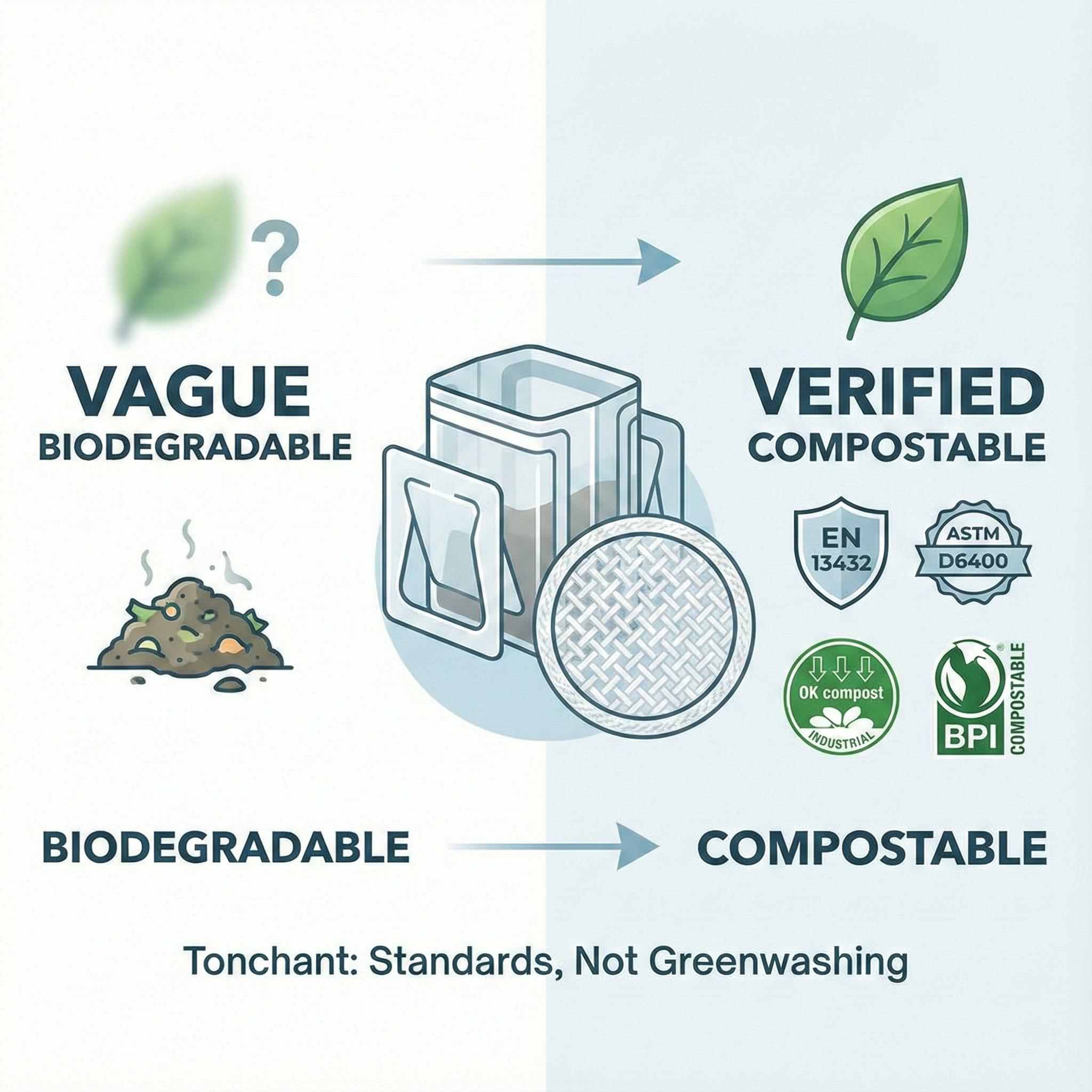
1. The Main Difference: Biodegradable vs. Compostable
Before looking at the codes, let’s clarify one of the biggest misconceptions in the industry.
-
“Biodegradable” is a vague term. Technically, almost anything can biodegrade given enough time (even wood takes decades). But it doesn’t specify how long degradation takes or what kind of environment is required.
-
“Compostable” is a specific legal standard. It refers to a material that, under specific conditions and after a specific period of time, decomposes into organic matter (humus), water, and carbon dioxide, leaving no toxic residues.
The Rule: Always look for “compostable” certification, rather than just vague “biodegradable” claims.
2. The European Gold Standard: EN 13432
If you’re selling coffee in Europe, this is the first standard you must know.
EN 13432 is the European standard for packaging materials that can be recycled through composting and biodegradation. Coffee filter paper must pass four rigorous tests to meet this standard:
-
Biodegradation: At least 90% of the material must decompose into carbon dioxide within 6 months.
-
Disintegration: After 12 weeks, at least 90% of the material must be small enough to pass through a 2mm sieve.
-
Chemical Analysis: The content of heavy metals and fluorine must meet strict limits.
-
Ecotoxicity: The resulting compost must be beneficial to plants (tested by planting seedlings in it).
Tonchant’s Role: Our PLA (polylactic acid) mesh filter is designed to meet these stringent standards, ensuring compliance for the European market.
3. The American Standard: ASTM D6400
Across the Atlantic, the standard is ASTM D6400.
Developed by the American Society for Testing and Materials (ASTM), this standard covers plastics designed for aerobic composting in municipal or industrial facilities. It is very similar to EN 13432 in terms of time frame and toxicity levels.
Why it matters: If you are exporting to the United States or Canada, ensuring that your packaging supplier meets ASTM standards is crucial to validating your marketing claims.
4. Industrial vs. Home Composting: Managing Expectations
This is the key to winning customer trust through honesty.
Most PLA and corn fiber coffee filters on the market (including our products) are Industrial Compostable Certified. This means they require high temperatures (58°C / 136°F) and controlled microbial conditions in specialized facilities to decompose efficiently.
If a customer throws an industrial compostable bag into a cold compost bin in their backyard, the bag may take a very long time to decompose.
Brand Tip: Be transparent with your packaging. Use statements like “Industrially compostable – consult your local composting facility” rather than implying it will disappear overnight in a garden. Consumers will appreciate this honesty.
5. Why is the “OK Compost” Logo Important?
You may see logos similar to TÜV Austria’s “OK Compost Industrial” or the BPI (Biodegradable Products Institute) logo.
These are third-party verifications. They prove that the product has indeed passed the laboratory tests of EN 13432 or ASTM D6400.
Raw Materials vs. Finished Products: Please note that sometimes the raw materials (PLA resin) are certified, but the final mesh material also needs to be verified. At Tonchant, we ensure from the outset that our supply chain uses verified and compliant materials.
The Tonchant Commitment
We know that for you, compliance is risk management.
When you purchase drip coffee filters or tea bags from Tonchant, you’re not just buying a mesh fabric, but also assurance. We can provide the necessary Technical Data Sheets (TDS) and material certifications to help you demonstrate your commitment to sustainability.
Green packaging—don’t blindly follow trends. [Contact Us] to learn more about our certified compostable material solutions and request samples for your next project.
Post time: Dec-27-2025