Why Specialty Coffee Brands Prefer Drip Coffee Bags
Why Specialty Coffee Brands Prefer Drip Coffee Bags
An industry analysis on shifting consumer formats, commercial scalability, and packaging engineering in the specialty coffee sector.
Walk into a specialty roastery in Tokyo, Seoul, London, or San Francisco today, and you will notice something distinct on the shelf. Next to the standard 250-gram bags of whole-bean microlots, you will almost certainly find single-serve drip coffee bags. What was once dismissed by Western purists as a compromise on quality has turned into one of the fastest-growing sectors in specialty coffee packaging.
This shift is not accidental. Specialty roasters, hotel purchasing directors, and packaging distributors are recognizing that drip coffee bags bridge an important gap: they deliver a fresh, precise pour-over extraction without requiring expensive grinders, gooseneck kettles, or barista training. Below is an operational and economic analysis of why specialty brands are scaling up their adoption of drip coffee bags.
Industry Background
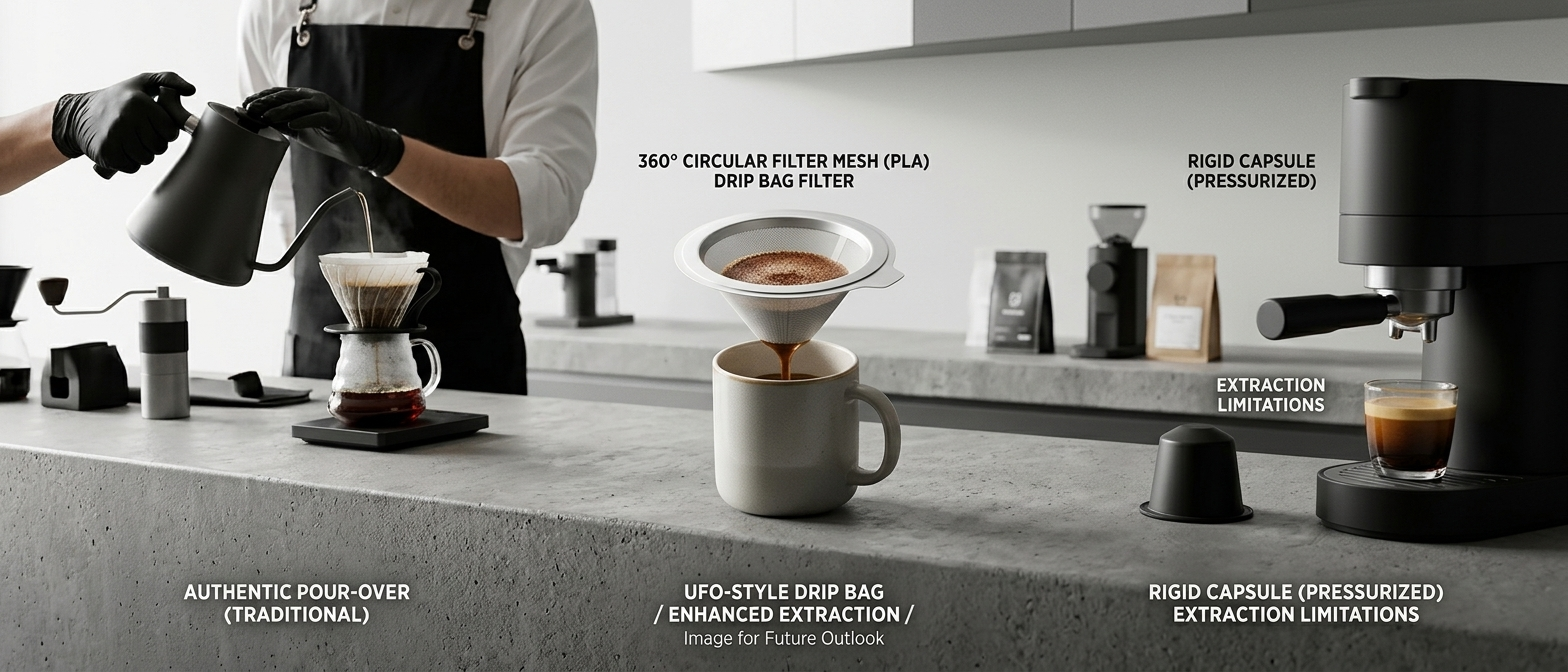
For decades, single-serve coffee was dominated by rigid plastic or aluminum capsules. While pods solved the convenience equation for home and office environments, they introduced two major technical drawbacks for the specialty coffee segment:
- Thermal and Flow Constraints: Rigid capsules rely on pressurized extraction, which works well for dark espresso blends but often over-extracts or scorches light-to-medium specialty roasts.
- Material Waste and Cost: Rigid pods require heavy plastic or aluminum housing, creating significant end-of-life waste and requiring specialized, capital-intensive filling equipment.
Drip coffee bags—originally invented in Japan during the 1990s—rethink single-serve coffee around gravity filtration. By housing precision-ground coffee inside a non-woven or PLA mesh filter suspended over a cup by paper hanging arms, the user can replicate a traditional manual pour-over. As the specialty market matured, roasters realized they could package high-scoring, single-origin coffees into this format without sacrificing delicate tasting notes like acidity, floral aromas, or complex berry flavors.
Current Market Trends
Demand for drip coffee bags is accelerating across multiple regional markets, driven by changing consumer habits and commercial procurement strategies:
1. Expansion Beyond Asia into Western Retail
While East Asia accounts for the largest market volume, European and North American specialty roasters are rapidly adopting drip bags. D2C coffee subscriptions, boutique hotel chains, and premium grocery outlets are utilizing drip bags as a high-margin entryway for new customers who do not own manual brewing equipment.
2. Adoption in Commercial Foodservice and In-Flight Service
Restaurant chains, premium food delivery services, cruise lines, and airlines are turning to drip bags to upgrade their hot beverage offerings. Instead of relying on bulk commercial brewers that sit on heating plates for hours, foodservice operators can serve freshly brewed single-origin coffee on demand with minimal waste.
3. Advanced Barrier Materials and Sustainable Substrates
Early iterations of drip coffee bags suffered from short shelf life due to oxygen permeability. Modern specialty coffee packaging systems now combine ultrasonic-sealed PLA bio-mesh filters with high-barrier, nitrogen-flushed outer sachets. This keeps dissolved oxygen levels below 1%, protecting volatile aromatic compounds for 12 to 18 months.
Key Drivers Behind the Trend
Uncompromised Extraction Quality
Unlike instant coffee or immersion tea bags, a drip coffee bag acts as a true percolation filter. The geometry of the filter web allows hot water to pass evenly through the coffee bed, achieving an optimal extraction yield (18%–22%) and revealing the bean’s authentic origin profile.
Higher Margins per Gram
From a commercial standpoint, single-serve formats yield significantly higher retail margins than bulk whole-bean bags. A 250g bag of specialty coffee might retail for $18 to $22. When converted into 10g or 12g drip coffee bags sold in 10-pack boxes, the effective retail value rises to $30–$40 per 250 grams of coffee. This margin expansion helps roasters absorb rising green coffee and logistics costs.
Low Equipment Barrier for Consumers and B2B Clients
Corporate offices, boutique hotel rooms, and luxury hospitality venues want to offer high-end coffee without installing $5,000 espresso machines or dealing with continuous maintenance. Drip bags require only hot water, making them a practical choice for B2B amenity programs.
Challenges Facing the Industry
Despite its rapid growth, scaling a drip coffee bag line presents operational challenges that buyers and brands must manage carefully:
- Grind Size and Dose Precision: Drip coffee bags require a tight particle size distribution. If the grind is too fine, the water stalls, causing over-extraction and bitterness; if too coarse, the water channels, resulting in a weak, under-extracted cup.
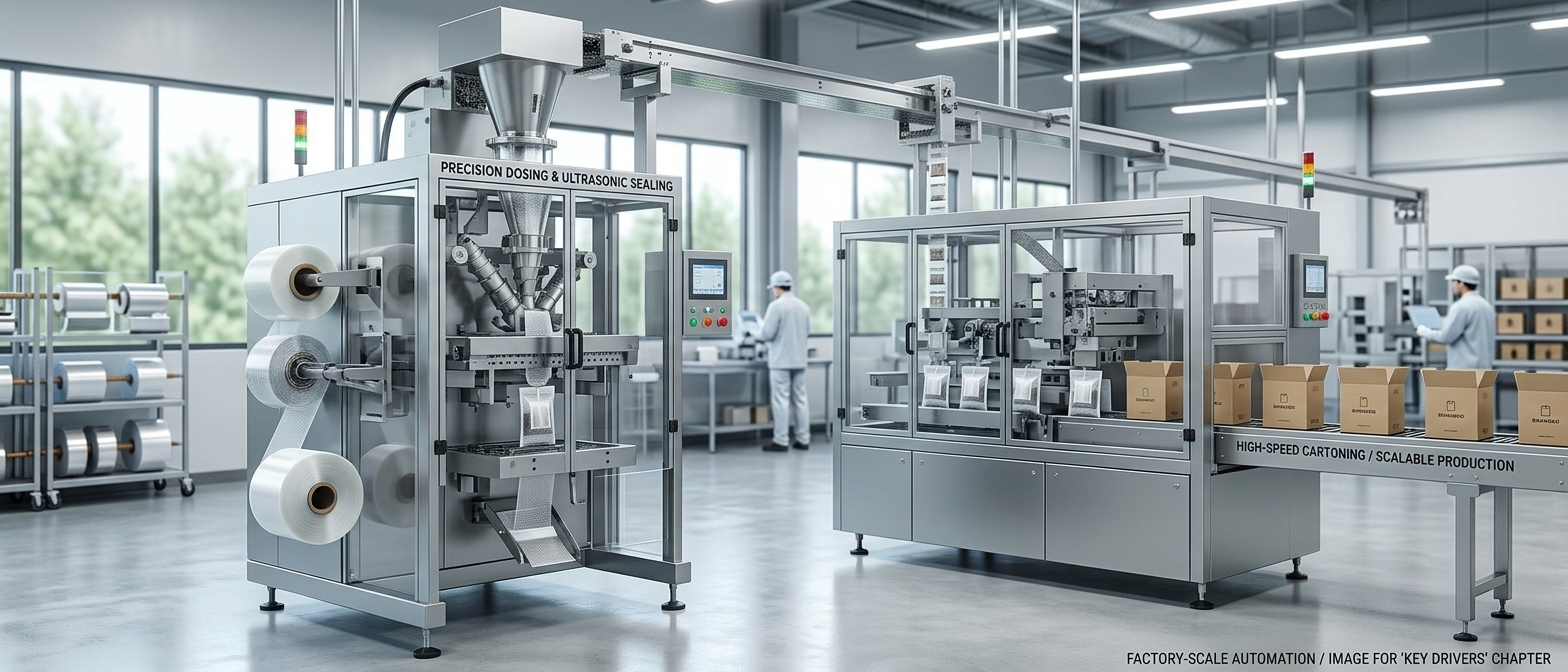
- Automated Packaging Capital Expenditure: Automatic form-fill-seal (FFS) machines capable of feeding filters, dosing ground coffee, ultrasonically sealing edges, and nitrogen-flushing individual sachets require significant capital investment. Many growing brands opt for co-packing partners or specialized OEM suppliers like coffeeteabag.com to handle custom manufacturing without upfront equipment overhead.
- Regulatory and Sustainability Mandates: Tightening EU and North American regulations on single-use plastics mean packaging buyers must carefully vet filter webs and outer foils. Transitioning from traditional non-woven PP filters to industrially compostable PLA corn fiber mesh requires careful calibration of heat-sealing temperatures on packing lines.
What This Means for Buyers
For packaging distributors, importers, and food service buyers, the rise of drip coffee bags creates immediate commercial opportunities. Adding these products to your portfolio allows you to address the growing demand for portable, single-serve solutions across retail, office, and hospitality sectors.
| Material Configuration | Inner Filter Substrate | Outer Sachet Barrier | Shelf Life (Nitrogen Flushed) | Best Suitable Market |
|---|---|---|---|---|
| Standard Conventional | PP / PET Non-Woven Web | PET / AL / PE Laminate | 18+ Months | High-volume wholesale, traditional retail, budget-conscious foodservice |
| Recyclable Mono-Material | High-Flow Non-Woven or PLA | MDO-PE / EVOH / PE | 12–14 Months | Modern grocery, supermarket chains, eco-focused retail brands |
| Fully Compostable | 100% PLA Corn Fiber Mesh | Kraft / NatureFlex™ / Bio-PE | 9–12 Months | Organic specialty roasters, zero-waste cafes, boutique hospitality |
When selecting a manufacturing partner, procurement managers should verify technical specifications such as filter tensile strength, ultrasonic seam integrity, and oxygen transmission rates (OTR) of outer barrier materials. Partnering with established production platforms like coffeeteabag.com helps brands secure food-contact certifications (FDA, EU 10/2011, DIN CERTCO) while maintaining consistent supply chain performance.
Future Outlook
The specialty coffee packaging landscape will continue to favor formats that combine convenience, sensory performance, and lower environmental impact. Over the next three to five years, several key developments are expected:
- Next-Generation Bio-Based Barrier Films: Advances in bio-coatings will extend the shelf life of fully compostable outer sachets closer to the 18-month standard of traditional foil structures.
- Smart Packaging and Traceability: Brands will increasingly print scannable QR codes on outer drip bag packaging, linking consumers directly to producer stories, roast data, and precise water-to-coffee brewing guides.
- Custom Form Factors: Innovations in hanging ear geometry—such as 360-degree circular “UFO” filters—will accommodate larger dose weights (up to 15g) for consumers who prefer larger mug sizes or stronger extractions.
Frequently Asked Questions
Freshness is maintained through nitrogen flushing during the automated outer-sachet packaging process. By displacing oxygen inside the high-barrier foil sachet to levels under 1%, oxidation is halted, preserving volatile coffee aromatics for up to 18 months.
Most standard rectangular drip coffee bags hold between 10 grams and 12 grams of ground coffee, ideal for brewing 150ml to 180ml of coffee. Larger 360-degree circular filters can hold up to 15 grams for higher yield extractions.
Yes. Pure PLA (Polylactic Acid) corn fiber mesh is food-grade, non-toxic, and heat-stable at standard brewing temperatures (90°C–96°C). It releases no microplastics, synthetic binders, or chemical odors into the cup.
Not typically. Drip coffee bags require specialized packing machines equipped with precision auger fillers capable of handling ground coffee densities, along with specialized ultrasonic sealing jaws designed for hanging-ear filter geometry and integrated nitrogen flushing.
Conclusion
The shift toward drip coffee bags represents a practical evolution in specialty coffee packaging. By combining manual pour-over quality with single-serve convenience, drip bags offer roasters, distributors, and foodservice buyers an effective way to expand their customer base and improve profit margins. As sustainable substrates and high-barrier packaging technologies advance, drip coffee bags will remain a central growth driver across the global coffee supply chain.
Post time: Oct-23-2026