Custom printed drip coffee bags are becoming popular with restaurant chains, food delivery companies, hotels, distributors, and private-label coffee brands.
The format is simple. A pre-portioned filter bag hangs over a cup, and hot water is poured through the ground coffee. No machine is required.
For buyers, however, the project involves more than adding a logo. Filter performance, coffee dose, pouch barrier, printing method, MOQ, certifications, and lead time all affect the final product.
What Are Custom Printed Drip Coffee Bags?
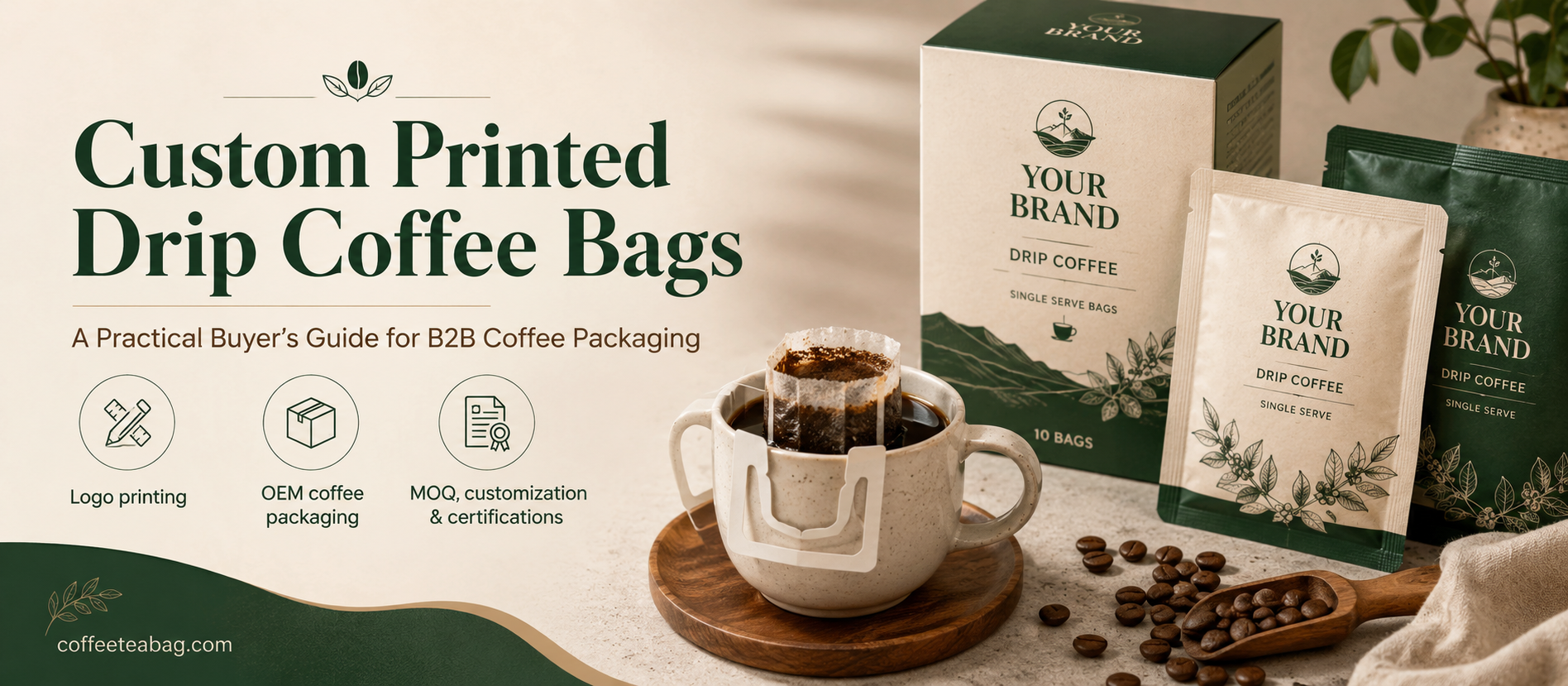
Custom printed drip coffee bags are single-serve coffee filters combined with branded packaging.
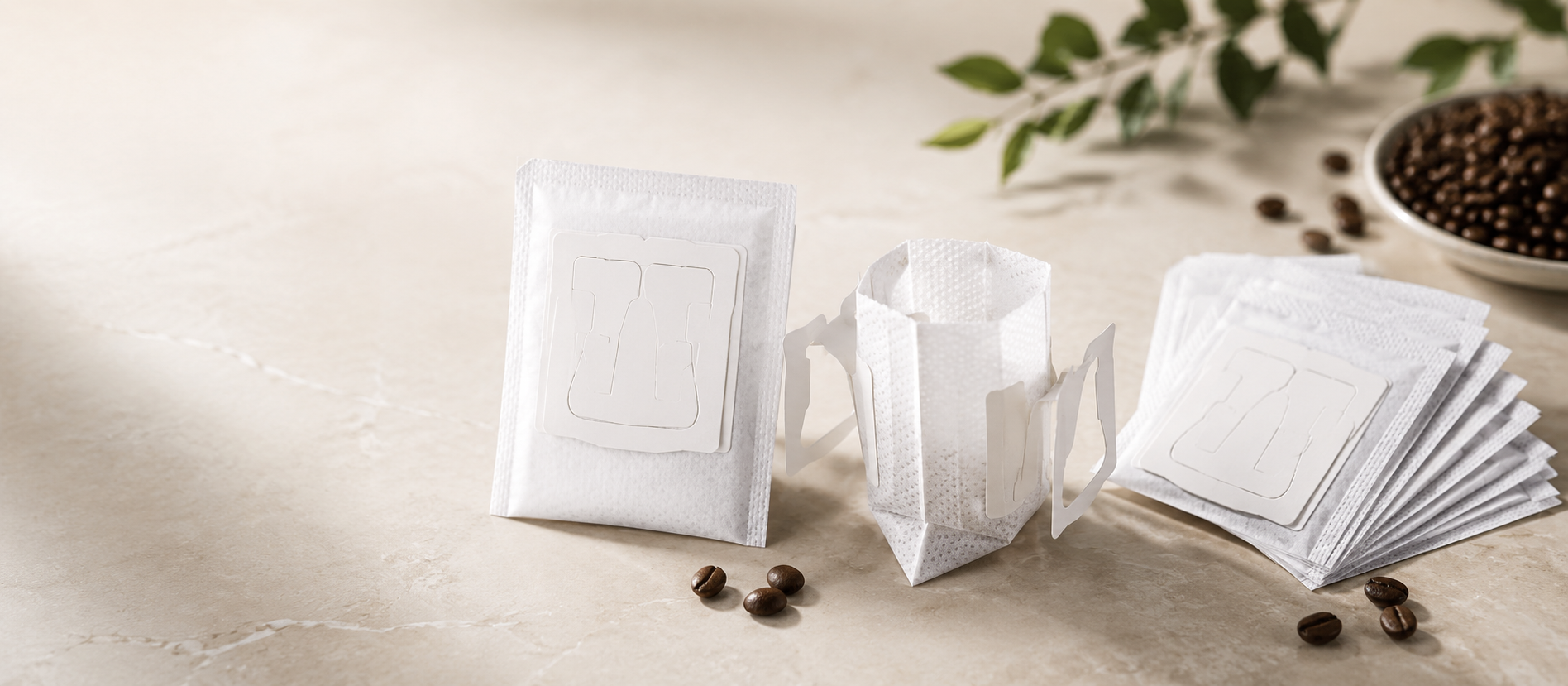
A complete product normally includes:
- A filter bag
- Paper hanging arms
- Ground coffee
- An individual outer pouch
- Optional retail packaging
Customization may be added to the hanging arms, pouch, carton, or gift box.
Some buyers only need empty filters. Others require full OEM coffee packaging, including coffee sourcing, filling, nitrogen flushing, sealing, coding, and final packing.
Tonchant Earth usually recommends confirming the complete product specification before starting artwork. This helps avoid problems with pouch size, coffee flow, filling equipment, or carton dimensions.
Key Benefits
Strong Brand Visibility
Logo printing can be added to the outer pouch, hanging arms, cartons, and display boxes. The hanging arms remain visible while the coffee is brewing, giving the brand extra exposure.
Easy Single-Serve Brewing
Consumers only need hot water and a cup. This makes drip coffee bags useful in locations without coffee machines.
Consistent Portions
Each bag contains a fixed coffee dose, helping restaurant chains and distributors maintain consistent flavor and cost control.
Flexible Product Development
Brands can create different designs for coffee origins, roast levels, seasonal campaigns, or customer groups. Digital printing is especially useful for smaller launches and multiple artworks.
Convenient Sampling
A custom drip bag gives customers a complete brewing experience. It is easier to use than a loose coffee sample and simple to include in online orders, gift sets, or food delivery boxes.
Common Applications
Restaurant Chains
Restaurants may use drip coffee bags in breakfast sets, takeaway orders, or smaller branches without professional coffee equipment. The buyer should test brewing speed, cup fit, coffee strength, and ease of use before placing a large order.
Food Delivery Companies
Food delivery businesses can add them to breakfast boxes, meal kits, and subscription packages. The outer pouch must resist handling and protect the coffee from moisture, oxygen, and food odors.
Distributors and Wholesalers
Distributors usually need stable specifications and reliable repeat supply. A standard filter combined with different printed pouches is often more practical than creating a separate filter design for every customer.
Hotels and Offices
Hotels can use drip bags as an upgrade from instant coffee. Offices can offer better coffee without installing capsule or espresso machines. Clear instructions and cup compatibility are important in both settings.
Retail and Gift Sets
Custom printed drip coffee bags work well in tasting collections, corporate gifts, subscription boxes, and seasonal packs.
Buying Guide
1 Confirm the Supply Scope
Before requesting a quotation, decide whether you need:
- Empty filters
- Filters and printed pouches
- Contract filling
- Full private-label production
Two suppliers may quote very different prices because they are offering different services.
2 Test the Filter with the Actual Coffee
The filter should be tested with the final grind size, roast level, coffee dose, cup, and water volume. A filter that works with 10 grams of coffee may drain too slowly with 15 grams.
During testing, check:
- Brewing time
- Water flow
- Cup stability
- Sediment
- Overflow risk
- Flavor consistency
Tonchant Earth’s factory experience shows that many flow problems come from the combination of filter, grind, and filling weight rather than from one component alone.
3 Choose the Printing Method
| Printing Method | Best For | Main Consideration |
|---|---|---|
| Digital printing | Small launches and multiple designs | Higher unit cost at large volume |
| Gravure printing | Large repeat orders | Higher MOQ and cylinder cost |
| Flexographic printing | Standard commercial runs | Suitability depends on material |
| Labels | Samples and pilot projects | Less premium appearance |
Digital printing is often the safest option for a first order.
4 Plan Logo Printing
Logo printing may be applied to:
- Hanging arms
- Outer pouches
- Cartons
- Gift boxes
Printed hanging arms provide strong visibility but usually require a higher MOQ. Smaller buyers may get better value by using standard filters with custom printed pouches.
5 Select the Outer Pouch
The pouch protects the coffee from oxygen, moisture, light, and odors.
| Pouch Type | Main Benefit | Main Limitation |
|---|---|---|
| Aluminum foil laminate | Strong barrier | Limited recyclability |
| Metallized film | Good cost-performance balance | Barrier varies by structure |
| Transparent barrier film | Product visibility | Less light protection |
| Paper-look laminate | Natural appearance | May still contain plastic layers |
Ask for the complete material structure rather than relying on terms such as “foil pouch” or “eco pouch.”
6 Understand MOQ
MOQ may apply separately to the filter, pouch, carton, printed hanging arms, coffee blend, and each artwork.
| Customization | Typical MOQ Level |
|---|---|
| Stock filter | Low |
| Digital printed pouch | Low to medium |
| Printed hanging arms | Medium to high |
| Gravure printed pouch | High |
| Custom filter size | High |
Always ask whether the MOQ is calculated per design.
7 Review Customization Options
Common options include:
- Filter size and shape
- Hanging-arm printing
- Pouch artwork
- QR codes
- Brewing instructions
- Coffee origin and roast
- Filling weight
- Matte or glossy finish
- Retail cartons
- Gift packaging
- Nitrogen flushing
- Date coding
Not every project needs full customization. A standard filter with strong outer packaging is often enough for a successful launch.
8 Check Certifications
Relevant documents may include:
- Food-contact declarations
- Migration test reports
- FDA-related documentation
- EU food-contact compliance
- ISO 9001
- ISO 22000
- HACCP
- FSC certification
- Compostability certification
Check that each certificate applies to the exact material and manufacturing site. A certificate for the carton does not cover the filter or pouch.
9 Confirm Lead Time
Custom production may include artwork approval, material preparation, printing, lamination, pouch converting, filling, inspection, and packing.
Ask when the lead time officially begins. Many factories start counting only after the deposit, artwork, and final specifications are confirmed.
Common Buyer Concerns
Q: Will the Printed Colors Match?
Printed colors can differ from screen colors. Provide Pantone references and approve a proof before production.
Q: Will Production Match the Sample?
Request written tolerances for dimensions, sealing, printing, filling weight, and color variation. For larger orders, consider pre-shipment inspection.
Q: Can Several Designs Share One MOQ?
Digital printing may allow flexible artwork combinations. Gravure printing often requires separate minimums and cylinders for each design.
Q: Can We Print Sustainability Claims?
Only use claims supported by valid documentation. “Recyclable,” “biodegradable,” “compostable,” and “plastic-free” do not mean the same thing.
Q: Why Do Quotations Vary So Much?
Suppliers may be quoting different filter materials, pouch barriers, coffee quality, filling services, inspection standards, or tooling costs. Compare all offers against the same written specification.
FAQ
Q: What Is the MOQ for Custom Printed Drip Coffee Bags?
It depends on the filter, printing method, pouch, and number of designs. Digital printing usually supports smaller orders than gravure printing.
Q: Can I Print My Logo on the Hanging Arms?
Yes, but printed arms normally require a higher MOQ than printed outer pouches.
Q: Can a Supplier Provide Full OEM Coffee Packaging?
Yes. Services may include coffee sourcing, roasting, grinding, filling, nitrogen flushing, printing, coding, and packing.
Q: How Long Does Production Take?
Standard filters with digital printing are generally faster. Custom tooling, gravure printing, and gift packaging require longer lead times.
Q: How Should Samples Be Tested?
Use the final coffee, grind, dose, cup, and water volume. Check brewing time, flow rate, cup fit, flavor, and pouch sealing.
Conclusion
Custom printed drip coffee bags offer a practical combination of branding, convenience, and real ground coffee. They are suitable for restaurants, delivery companies, hotels, distributors, retailers, and gift programs.
The most important step is testing the complete product before mass production. The filter, coffee, pouch, cup, and filling process should work together.
Coffeeteabag.com supports both printed packaging projects and full OEM coffee packaging programs. Whatever supplier you choose, focus on clear specifications, realistic MOQ expectations, verified certifications, and repeatable production quality.
Post time: Jul-21-2026