Coffee Packaging Machinery Buyer Guide
How Coffee Packaging Machines Work
A practical guide to machine types, packaging materials, filling systems, customization, MOQ, lead time, compliance, and sourcing.
A coffee packaging machine does much more than place coffee into a bag. Depending on the model, it can measure the product, form the package, fill each portion, flush with nitrogen, seal, print batch information, count finished units, and discharge them for secondary packing.
For coffee roasters, private-label manufacturers, distributors, and food factories, the right machine depends on the finished product first.
A drip coffee bag line, a capsule filling machine, a round filter packing system, and a bag-in-bag powder machine all solve different production problems. Buyers should compare them by application, filling accuracy, packaging compatibility, speed, maintenance, and total operating cost.
What Is a Coffee Packaging Machine?
A coffee packing machine is designed to automatically or semi-automatically package coffee into a defined format.
Typical applications include:
Main Types of Coffee Packaging Machines
| Machine Type | Typical Product | Main Function | Best For |
|---|---|---|---|
| Drip Coffee Bag Packing Machine | Hanging-ear drip coffee | Filter forming, dosing, sealing, outer packing | Roasters and drip coffee brands |
| High-Speed Round Filter Filling Machine | UFO / round filter coffee | Automatic filling, sealing, high-speed packing | Large single-serve programs |
| Automatic Coffee Capsule Filling Machine | Coffee capsules | Cup feeding, dosing, sealing, discharge | Capsule manufacturers |
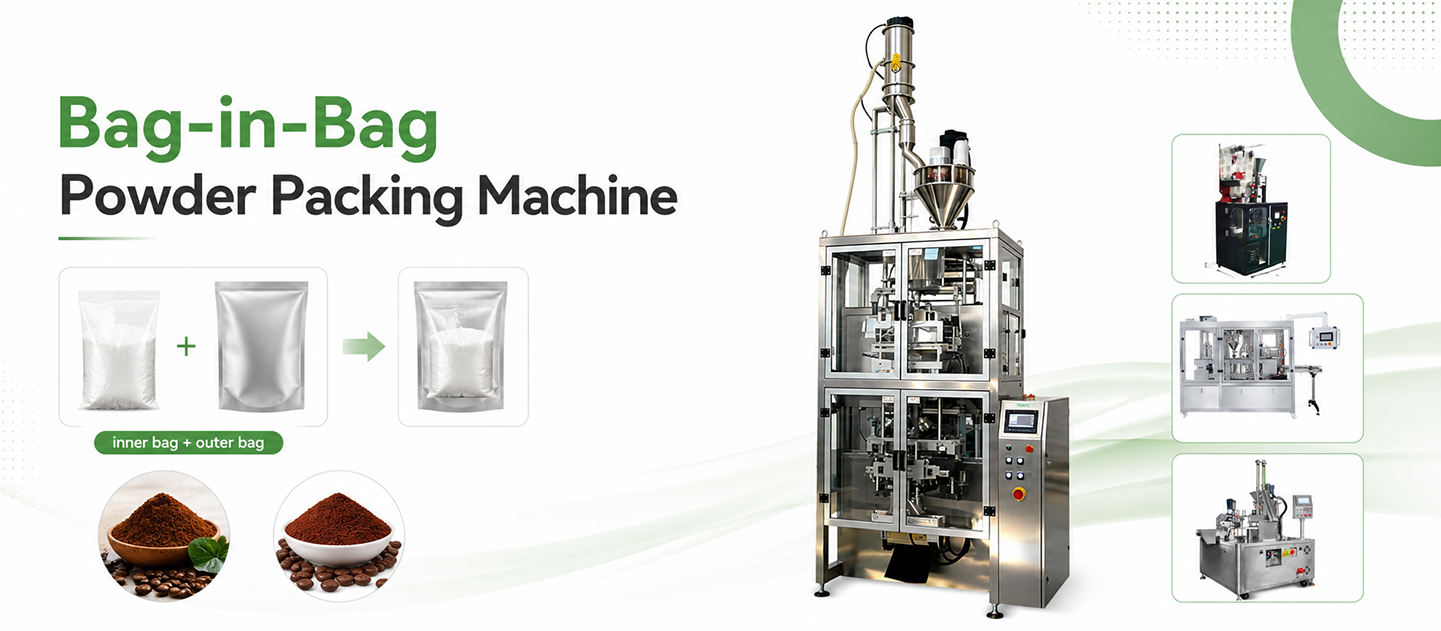
| Bag-in-Bag Powder Packing Machine | Ground / instant coffee | Inner bag filling + outer bag packing | Food factories and private-label producers |
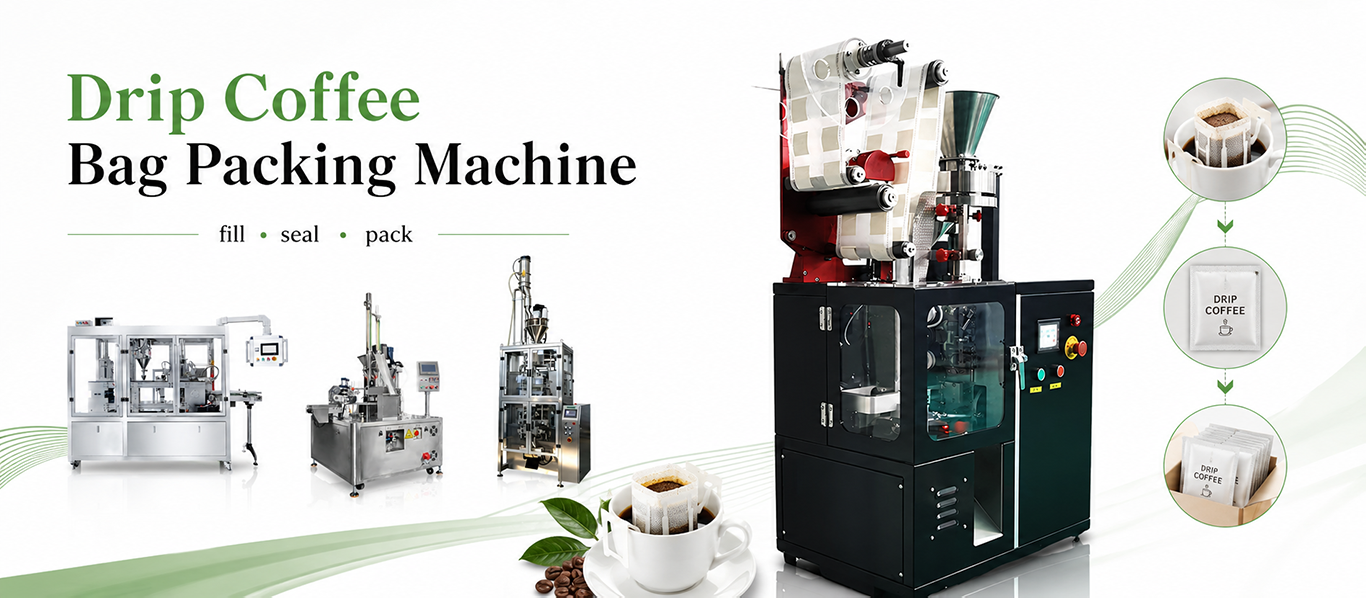
How Does a Coffee Packaging Machine Work?
Coffee Feeding
Coffee enters through a hopper. Whole beans generally flow easily, while ground coffee can be affected by grind size, oil content, density, and static electricity.
Dosing
The machine measures each portion using volumetric cups, auger fillers, or electronic weighing systems. Accuracy matters because even small overfills become costly at large volumes.
Bag or Filter Forming
Some machines form bags directly from rollstock. Others use pre-made filters, pouches, or capsules. Specialized drip coffee machines may form the filter before filling.
Filling
Coffee is transferred into the filter, capsule, or pouch. The sealing area must remain clean because trapped coffee particles can weaken the seal.
Nitrogen Flushing
Nitrogen can reduce residual oxygen before sealing and help protect coffee aroma. It should be used together with an appropriate high-barrier package.
Sealing and Discharge
The package is heat sealed, cut, coded, and discharged. Some lines also include automatic counting, conveyors, checkweighing, or secondary packing.
Packaging Materials and Machine Compatibility
| Material | Typical Use | Key Machine Concern |
|---|---|---|
| Nonwoven filter material | Drip coffee bags | Sealing and forming stability |
| PLA-based filter material | Plant-based filter applications | Sealing temperature range |
| Metallized film | Outer coffee pouches | Film tension and heat sealing |
| Aluminum laminate | Long shelf-life coffee | Seal strength and temperature |
| Capsule lid film | Coffee capsules | Accurate positioning and sealing |
A machine that performs well with one film may not run smoothly with another. Buyers should provide final packaging samples before the equipment configuration is confirmed.
Applications
Drip Coffee Brands
Suitable for automatic filter forming, coffee dosing, inner sealing, and outer pouch packing.
Round / UFO Filters
Specialized high-speed equipment is used for round single-serve filters and other non-standard formats.
Coffee Capsules
Full automatic lines can feed capsules, dose coffee, place lids, seal, and discharge finished units.
Powder Products
Bag-in-bag systems are used for instant coffee, ground coffee powder, and other portioned food products.
Main Advantages
- Higher output: automatic lines can produce far more packs than manual filling.
- Better weight control: automated dosing helps reduce product giveaway.
- Lower labor dependency: repetitive filling and sealing tasks are automated.
- Consistent packaging: bag size, seal position, coding, and fill weight become more repeatable.
- Easier scaling: manufacturers can move from pilot orders to recurring commercial production.
Automatic vs Semi-Automatic Machines
| Factor | Fully Automatic | Semi-Automatic |
|---|---|---|
| Production speed | High | Medium |
| Labor requirement | Low to medium | Medium |
| Investment | Higher | Lower |
| Consistency | High | Good |
| Best for | Large recurring production | Growing manufacturers and smaller runs |
Customization Options
A commercial coffee packing machine may be configured for:
Co-packers serving several brands often value fast format changeovers more than maximum production speed.
MOQ and Supporting Materials
Machines are usually purchased one unit at a time, but the surrounding packaging project may involve several minimum order quantities.
| Item | MOQ Consideration |
|---|---|
| Standard machine | Usually 1 unit |
| Custom tooling | Additional tooling cost |
| Printed rollstock | Printing MOQ applies |
| Custom filter material | Material MOQ may apply |
Lead Time
Standard machines may take several weeks to assemble and test. Customized lines can require longer.
A typical project includes:
- Product specification
- Packaging sample review
- Machine configuration
- Tooling and assembly
- PLC setup
- Factory testing
- Sample production
- Buyer approval
- Shipment
- Installation and training
Buyers should also allow time for freight, customs clearance, commissioning, and operator training.
Certificates and Compliance
Depending on the market and machine type, buyers may request:
- CE documentation where applicable
- Electrical drawings
- User manuals
- Machine safety documentation
- Food-contact declarations for product-contact parts
- Stainless-steel material information
- ISO-related factory documentation
Safety features should also be reviewed, including emergency stops, machine guards, temperature protection, and electrical safety systems.
What Buyers Should Check Before Ordering
Roast level, grind size, filling weight, density.
Bag style, dimensions, film structure, thickness, roll width.
Required speed, daily operating hours, monthly volume, number of SKUs.
Voltage, compressed air, nitrogen, floor space, installation conditions.
Common Buyer Concerns
Can one machine pack different coffee products?
Sometimes. Different pouch sizes may only require tooling changes, but whole beans, powder, drip filters, and capsules often need different dosing or machine systems.
Can sustainable packaging run on the machine?
Potentially, but PLA, recyclable films, and paper-based structures should be tested because their sealing and mechanical properties may differ from conventional materials.
What about after-sales service?
Ask about spare parts, remote troubleshooting, warranty, operator training, manuals, and electrical diagrams before ordering.
Should we buy a machine or use a co-packer?
Contract packing is often lower risk for uncertain volume. Machine ownership becomes more attractive when recurring production is stable enough to keep the equipment utilized.
FAQ
1. What is a coffee packaging machine?
It is equipment used to measure, fill, form, seal, and package coffee products such as beans, ground coffee, drip bags, capsules, and powder sachets.
2. Is a coffee packing machine the same thing?
In most sourcing discussions, yes. The terms coffee packaging machine and coffee packing machine are commonly used interchangeably.
3. What machine is used for drip coffee bags?
A specialized drip coffee bag packing machine is used to form or feed the filter, dose the coffee, seal the inner bag, and often pack it inside an outer pouch.
4. Can one machine produce UFO and hanging-ear coffee bags?
Usually these formats require different forming or feeding systems. Some machines can be customized, but the buyer should confirm this before purchase.
5. How should a machine be tested before ordering?
Use the final coffee and packaging material, run at realistic speed, and check filling accuracy, seal quality, waste rate, ease of operation, and finished-pack consistency.
Post time: Aug-10-2026