Drip coffee bags are becoming a practical choice for far more than specialty coffee brands.
Restaurant groups use them in breakfast service. Food delivery companies add them to premium meal kits. Distributors sell them into hotels, offices, and retail stores. Sustainable packaging buyers are also looking at drip coffee formats as an alternative to capsules and other single-serve systems.
The opportunity is clear. The sourcing process is not.
Two drip coffee bags may look almost identical in a product photo, yet perform very differently in real use. One may drain smoothly and stay secure on the cup. Another may collapse, leak grounds, brew too slowly, or create problems on an automatic filling line.
That is why choosing a reliable drip coffee bag manufacturer should involve more than comparing prices and requesting a few samples.
Buyers need to look at filter material, brewing performance, production consistency, outer pouch barrier, machine compatibility, minimum order quantity, certifications, customization options, and delivery capability. The right supplier should understand how all these elements work together.
This guide explains what to check before placing an order, with practical examples for restaurant chains, food delivery companies, wholesalers, distributors, and sustainable packaging buyers.
What Is a Drip Coffee Bag Manufacturer?
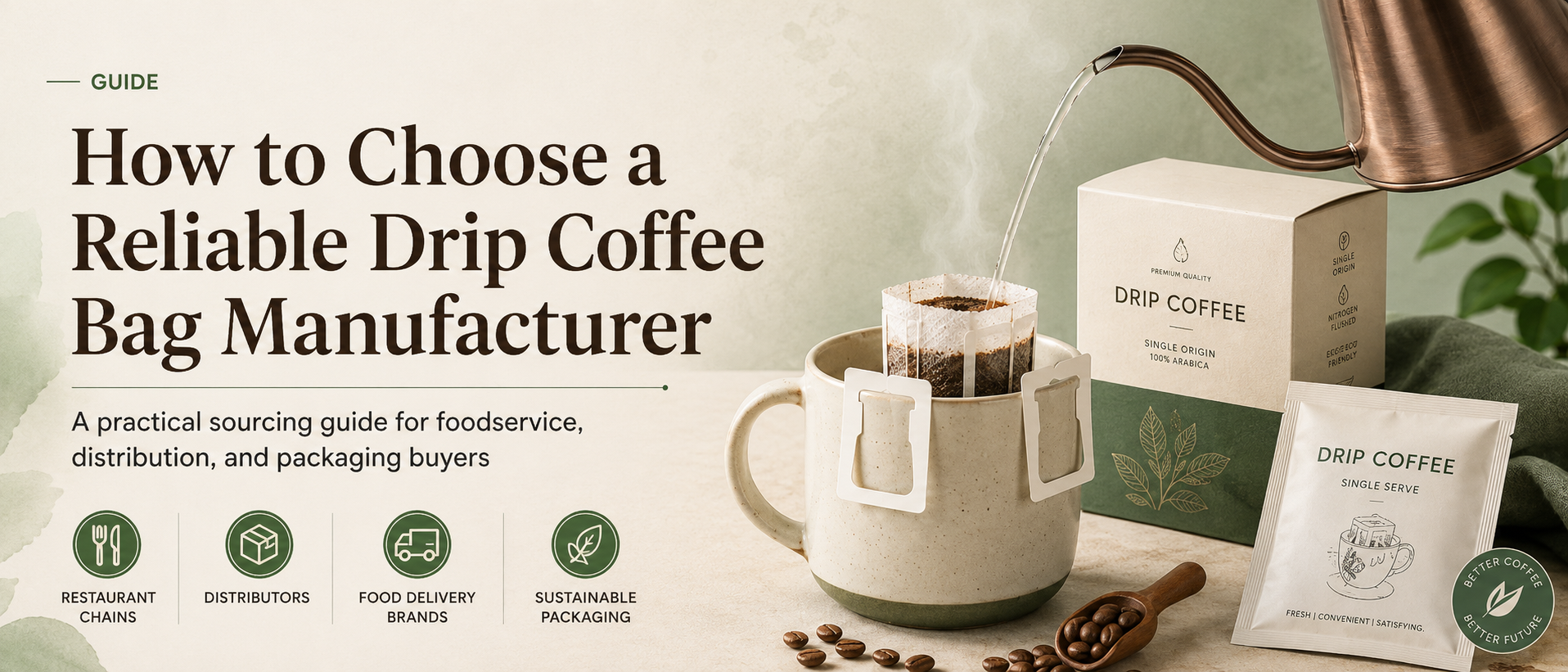
A drip coffee bag manufacturer produces the small single-serve filters used to brew ground coffee directly over a cup.
The filter usually includes two fold-out paper supports, often called hanging ears. These supports sit on the rim of the cup while hot water passes through the coffee grounds and into the cup below.
Some factories focus only on empty filters. Others offer a wider service package that may include:
- Printed hanging ears
- Individual outer pouches
- Retail cartons
- Coffee filling
- Nitrogen flushing
- Date and batch coding
- Finished-product packing
- Private-label coffee development
The difference matters.
A coffee roaster with its own filling line may only need empty filters and printed pouches. A restaurant chain launching a branded coffee program may want one supplier to manage the filter, coffee, pouch, carton, and final packing.
A buyer should define the required scope before requesting quotations. Otherwise, it is easy to compare two prices that cover completely different services.
| Supplier Type | Main Service | Best For | Main Sourcing Risk |
|---|---|---|---|
| Filter-only manufacturer | Produces empty drip filters | Roasters and packers with filling equipment | Buyer must manage pouches, coffee, and filling separately |
| Packaging converter | Produces filters and printed packaging | Brands needing custom packs | May have limited coffee-processing experience |
| Contract packer | Fills and seals finished coffee products | Brands with approved packaging | Filter sourcing may be outsourced |
| Integrated manufacturer | Coordinates filter, pouch, printing, filling, and packing | Private-label and turnkey projects | More technical details must be confirmed early |
The supplier model should match the buyer’s internal capability.
A distributor that does not roast or pack coffee may benefit from an integrated partner. A large coffee producer may prefer a specialist coffee filter bag supplier and keep filling in-house.
Key Benefits of Choosing the Right Manufacturer
Consistent Brewing Performance
A drip coffee bag is part of the brewing system, not just the packaging.
Its material, shape, depth, pore structure, and sealing lines all affect water flow. The paper supports influence how securely the bag sits on the cup. Even small dimensional differences can change the extraction.
If the filter drains too quickly, the coffee may taste thin. If it drains too slowly, the user may wait several minutes or experience overflow.
Consider a restaurant chain serving 12 grams of medium-roast coffee in each bag. The approved sample brews in around three minutes. After changing to a cheaper filter, the same coffee takes more than five minutes and staff begin pouring too quickly to save time. The result is inconsistent flavor across locations.
The filter itself may not be defective. It may simply be a poor match for the grind size, dose, and bag dimensions.
Stable Quality Across Production Batches
Commercial buyers need repeatability.
A sample order of 500 pieces can be inspected manually. An order of 500,000 pieces cannot. At that scale, process control becomes more important than the appearance of one sample.
Common production problems include:
- Paper arms attached at slightly different positions
- Weak side seals
- Irregular bag dimensions
- Variation in material thickness
- Poorly cut opening lines
- Inconsistent print registration
- Filters that stick together during machine feeding
These issues affect more than appearance. They can slow down filling equipment, increase waste, or create complaints from end users.
Wholesalers and restaurant groups should ask how dimensions and seal strength are checked during production. It is also useful to confirm whether the supplier keeps retained samples from each batch.
Better Coordination Between Filter, Coffee, and Packaging
A finished drip coffee product often involves several components:
- Inner filter
- Paper hanging ears
- Ground coffee
- Individual pouch
- Printed carton
- Labels or coding
- Export carton
When these parts come from different sources, misunderstandings are common.
A pouch may be designed before the filled filter dimensions are confirmed. A carton may be printed before the pouch thickness is tested. The filter may work perfectly by hand but fail to open consistently on an automatic line.
At Tonchant Earth, factory testing usually treats the filter, coffee dose, grind size, pouch, and filling process as one system. This matters because changing one element can affect the others.
For example, increasing the coffee dose from 10 grams to 12 grams may seem minor. In a small filter chamber, however, it can reduce water flow, create a higher coffee bed, and make the top harder to open without spilling grounds.
More Practical Customization Advice
Many buyers begin by asking for a fully customized filter.
That is not always the best starting point.
A new food delivery brand may only need a standard filter and custom-printed outer pouch. A hotel group may gain more value from simple multilingual brewing instructions than from a unique hanging-ear shape. A large retail brand may justify custom tooling because it has predictable annual volume.
A good drip coffee bag manufacturer should explain the cost and production impact of each option.
Customization should solve a business problem. It should not create unnecessary tooling, higher MOQ, or slower lead times without delivering a clear benefit.
Lower Compliance Risk
The filter comes into contact with hot water and coffee. The pouch protects a food product that may remain in storage for months.
Buyers therefore need more than a statement saying the material is “food grade.”
Relevant documents may need to cover:
- Filter fabric
- Paper supports
- Adhesives
- Printing inks
- Outer pouch layers
- Manufacturing site
A test report for one material does not automatically apply to the full product.
This is particularly important for sustainable packaging claims. A plant-based filter may still use a conventional plastic pouch. A paper-look outer pack may contain multiple laminated layers. Buyers should review the entire structure before making claims such as compostable, biodegradable, or plastic-free.
Applications Across Foodservice and Distribution
Restaurant Chains
Drip coffee bags can help restaurant groups offer fresh brewed coffee without installing a full coffee system at every branch.
This is especially useful for smaller outlets, breakfast concepts, takeaway counters, and temporary locations.
Imagine a chain with 80 locations. Only 20 have trained baristas and professional equipment. The remaining outlets still want to offer a consistent coffee product. A pre-portioned drip bag allows staff to prepare coffee with hot water and a standard cup.
For this scenario, the buyer should prioritize:
- • Easy opening
- • Clear instructions
- • Fast brewing
- • Stable cup fit
- • Consistent dose
- • Reliable reorder supply
The product should be tested with the cups used in every location. A filter that fits a ceramic mug may not work on a narrow takeaway cup.
Food Delivery Companies
Food delivery businesses can use drip bags in breakfast boxes, office meal kits, subscription packages, and promotional bundles.
The biggest challenge is often not brewing. It is transport.
The individual pouch may travel next to hot food, cold drinks, sauces, or strongly scented products. It needs enough barrier and seal strength to protect the coffee.
A food delivery buyer may also need flat, compact packaging that does not increase shipping volume.
In this case, sourcing decisions may focus on:
- • Pouch durability
- • Aroma protection
- • Pack thickness
- • Easy storage
- • Clear consumer instructions
- • Batch coding
- • Shelf-life stability
Distributors and Wholesalers
Distributors usually need a product that can work across several channels.
They may supply hotels, cafés, supermarkets, offices, and gift companies at the same time. A highly specialized bag designed for one cup or one machine may be less useful than a proven standard format.
For distributors, the best coffee filter bag supplier is often the one that can maintain the same specification over repeated orders.
Important points include:
- • Stable material supply
- • Consistent carton quantity
- • Clear labeling
- • Export-ready documentation
- • Predictable lead times
- • Low variation between batches
A distributor may also want neutral stock filters that can be combined with different customer pouches or labels.
Hotels and Hospitality
Hotels often use drip coffee bags as a more premium alternative to instant coffee.
The product can be placed in guest rooms, meeting spaces, welcome packs, or minibar programs. No machine is required, and the guest still brews real ground coffee.
Hospitality buyers should pay close attention to the user experience.
Can the guest understand the instructions immediately? Does the bag fit the room cup? Does the pouch open cleanly without scissors? Is the recommended water volume realistic for the kettle and cup provided? These small details determine whether the product feels premium or frustrating.
Sustainable Packaging Buyers
Sustainability-focused buyers may consider PLA-based filter materials, certified paper supports, reduced-material cartons, or alternative pouch structures.
The difficulty is balancing environmental goals with actual product performance.
Coffee requires good protection from oxygen and moisture. A low-barrier pouch may reduce packaging complexity but shorten freshness. A compostable material may require specific disposal conditions that are not available in the target market. The most responsible approach is to compare the full life cycle and avoid unsupported claims.
Buying Guide: How to Evaluate a Drip Coffee Bag Manufacturer
1. Confirm the Filter Material
Start by asking what the filter is actually made from.
Common options include conventional nonwoven fabrics and PLA-based materials. Different materials behave differently during sealing, filling, and brewing.
Request information about:
- • Material composition
- • Basis weight
- • Thickness
- • Heat resistance
- • Food-contact compliance
- • Recommended sealing temperature
- • Suggested coffee dose
- • Suitable grind range
Two materials may look the same but have different pore structures. That difference can change brewing time significantly.
2. Test with the Real Coffee
Do not approve a filter based only on an empty sample.
The coffee itself affects performance. Grind size, roast level, density, and filling weight all influence flow.
A proper trial should use:
- • Final coffee blend
- • Final grind
- • Final dose
- • Intended cup
- • Recommended water volume
- • Expected brewing instructions
During testing, check:
- • Opening performance
- • Bag stability
- • Drainage time
- • Overflow risk
- • Sediment
- • Flavor consistency
- • Ease of removal
Tonchant Earth’s factory experience has shown that many apparent filter problems are actually system problems. A bag may drain slowly because the grind is too fine. It may feel unstable because the selected cup is too wide. It may spill because the dose is too high for the chamber. Real testing reveals these issues early.
3. Review Production Capability
Ask which processes are handled in-house.
A supplier may make the filter but outsource the paper supports. Another may produce the empty bag but send it elsewhere for printing. Outsourcing is not automatically a concern, but buyers should know who is responsible for each critical stage.
Useful questions include:
- • What is the monthly capacity?
- • How are raw materials inspected?
- • How often are dimensions checked?
- • How is seal strength tested?
- • Are production samples retained?
- • Is there backup equipment?
- • How are complaints traced to a batch?
Large restaurant and distribution programs should also discuss forecast planning. A supplier that can produce the first order but cannot support repeat demand may create serious problems later.
4. Check Machine Compatibility
Buyers using automatic filling equipment should share technical details before ordering.
Provide the machine model, drawing, sample bag, or operating video. Confirm:
- • Bag dimensions
- • Feeding direction
- • Seal width
- • Material stiffness
- • Static behavior
- • Opening accuracy
- • Sealing temperature
- • Target output speed
One common factory issue is static electricity. Lightweight filter bags may stick together and fail to feed smoothly. This may not appear during hand filling, but it becomes obvious at production speed. A machine trial is worth the effort for large orders.
5. Compare Outer Pouch Structures
The outer pouch protects freshness. Ground coffee is highly sensitive to oxygen, moisture, light, and odors. The correct structure depends on target shelf life, shipping conditions, printing needs, and sustainability goals.
| Pouch Type | Main Advantage | Main Limitation | Suitable Use |
|---|---|---|---|
| Aluminum foil laminate | Strong protection from oxygen, moisture, and light | Difficult to recycle in many markets | Long shelf-life products |
| Metallized film | Good barrier at a competitive cost | Performance varies by structure | Foodservice and mainstream retail |
| Transparent high-barrier film | Allows product visibility | Provides less light protection | Premium presentation |
| Paper-look laminate | Natural appearance | May still contain several plastic layers | Eco-focused branding |
Ask for the complete layer structure. A pouch described as “eco-friendly” may still be a complex laminate. A pouch described as “foil” may use metallized film rather than aluminum foil.
Also confirm:
- • Oxygen barrier
- • Moisture barrier
- • Seal strength
- • Tear notch
- • Printing method
- • Nitrogen-flushing compatibility
- • Coding area
- • Shelf-life target
6. Understand MOQ Clearly
MOQ is often misunderstood. There may be separate minimum quantities for the filter, pouch, hanging-ear print, carton, coffee blend, and each design. A quotation stating 30,000 pieces may mean 30,000 per artwork, not 30,000 in total.
| Product Option | Typical MOQ Level | Best Use |
|---|---|---|
| Stock unprinted filters | Low | Samples and smaller launches |
| Printed hanging ears | Medium to high | Established brands and chain programs |
| Digitally printed pouches | Low to medium | Multiple designs and test markets |
| Gravure-printed pouches | High | Large repeat orders |
| Custom filter size | High | Special brewing or machine needs |
For first orders, standard filters and digital printing usually offer more flexibility. Once the product has stable demand, buyers can move to higher-volume printing or custom tooling.
7. Review Customization Options
A manufacturer may offer customization across the entire product.
Options can include:
- • Filter size
- • Filter depth
- • Hanging-ear shape
- • Printed logos
- • Brewing instructions
- • QR codes
- • Pouch artwork
- • Matte or gloss finish
- • Metallic effects
- • Retail cartons
- • Display boxes
- • Gift packaging
- • Coffee filling weight
- • Private-label blends
- • Nitrogen flushing
- • Date coding
The right choice depends on the sales channel. A restaurant chain may want branded hanging ears because the filter remains visible while brewing. A wholesaler may prefer a neutral filter and flexible outer labels. A sustainable buyer may choose minimal printing and simpler secondary packaging. Customization should remain practical for production and reordering.
8. Check Certifications Carefully
Certification requirements vary by destination market.
Documents may include:
- • Food-contact declarations
- • Migration testing
- • FDA-related documentation
- • EU food-contact compliance
- • ISO 9001
- • ISO 22000
- • HACCP
- • BRCGS Packaging Materials
- • FSC certification
- • Compostability certification
- • Halal or Kosher certification
Review the details rather than the logo on the certificate.
Check:
- • Product description
- • Material covered
- • Test standard
- • Date
- • Issuing laboratory
- • Factory name
- • Production address
- • Validity period
A factory may hold ISO certification while the specific filter material still requires separate food-contact documentation.
9. Confirm Lead Time and Reorder Planning
Custom packaging takes time.
The process may include sample testing, artwork approval, material production, printing, lamination, curing, converting, filling, inspection, and packing.
Buyers should ask when the quoted lead time begins.
In many cases, the production schedule starts only after:
- • Deposit is received
- • Artwork is approved
- • Technical specifications are confirmed
- • Raw material is available
Shipping must be added separately. For repeat orders, discuss whether the supplier can hold raw material or maintain safety stock. This may be important for restaurant chains and distributors with regular demand.
Common Buyer Concerns
Will Mass Production Match the Sample?
The concern is valid. Request written tolerances for dimensions, seal strength, print position, and quantity. For larger orders, consider pre-production samples and pre-shipment inspection. The inspection should test function, not only appearance. A beautiful pouch with a weak seal is still a failed product.
Can the Supplier Support Future Growth?
Ask about monthly capacity and busy-season schedules. A small supplier may offer excellent samples but struggle when order volume doubles. Buyers planning a national launch should discuss future demand before selecting a partner.
Will the Bag Fit Different Cups?
Send cup measurements or physical samples. Test the product on paper cups, ceramic mugs, and any other formats used in the final application. Cup fit is often overlooked until after production.
Are Sustainability Claims Accurate?
Ask for evidence. A bio-based filter is not automatically home compostable. A paper pouch is not automatically recyclable. A compostable component does not make the complete pack compostable. Review each material separately.
Why Are Supplier Prices So Different?
The products may not be equivalent.
Lower prices may reflect:
- • Lighter filter material
- • Lower pouch barrier
- • Different paper quality
- • Less inspection
- • Fewer included services
- • Excluded tooling costs
- • Simpler export packing
Compare quotations against one written specification.
Frequently Asked Questions
Q 1. What Is a Reasonable MOQ for Custom Drip Coffee Bags?
The MOQ depends on the filter, printing method, pouch, and customization level.
Stock filters may be available in smaller quantities. Printed hanging ears and gravure-printed pouches usually require larger orders. Digital printing is often the best option for pilot launches or multiple designs.
Q 2. Should I Work with a Filter Manufacturer or a Full-Service Supplier?
Choose a filter specialist if you already manage filling, pouches, and quality control. Choose a full-service supplier if you need support with filters, coffee filling, pouch printing, coding, and retail packaging.
Q 3. How Can I Test Filter Quality?
Use the actual coffee, grind, dose, cup, and water volume. Check drainage time, cup stability, seal strength, sediment, overflow risk, and taste. Empty filter appearance alone is not enough.
Q 4. What Certifications Should a Coffee Filter Bag Supplier Provide?
At minimum, request food-contact documentation suitable for the target market. Depending on the project, buyers may also require migration reports, ISO certifications, HACCP, BRCGS, FSC, or compostability documentation.
Q 5. How Long Does a Custom Order Take?
Lead time varies by specification. Stock products may be available quickly. Custom printed and fully packed products may require several weeks after artwork and technical details are approved. Freight and customs time should be calculated separately.
Conclusion
Choosing a reliable drip coffee bag manufacturer is not simply a matter of finding the lowest price.
The filter must work with the coffee. The pouch must protect freshness. The bag must fit the cup and run properly on the filling equipment. Certifications must cover the actual materials. Lead times and reorder capacity must match the buyer’s sales plan.
Restaurant chains may care most about ease of use and supply stability. Food delivery companies may focus on pouch durability and compact packing. Distributors need consistent specifications and export documentation. Sustainable packaging buyers require clear, supportable material claims.
The safest approach is to test the complete product before mass production.
Evaluate the filter, coffee dose, grind, cup, pouch, sealing process, and target shelf life together. This practical development work can prevent costly problems later.
A dependable supplier, whether Tonchant Earth or another experienced manufacturer, should be willing to discuss these details openly. Good sourcing begins with clear specifications, realistic testing, and a shared understanding of how the product will be used.
Post time: Jul-16-2026