B2B Coffee Packaging Buyer Guide
MOQ Guide for Custom Coffee Filter Bags: What B2B Buyers Need to Know
A practical guide to custom coffee filter bags MOQ, private label MOQ, printing options, certification, order planning, and supplier evaluation.
Minimum order quantity is one of the first questions buyers ask when sourcing custom coffee packaging. It is also one of the most misunderstood.
A restaurant chain testing a new single-serve coffee program may only need a few thousand units. A national distributor may need hundreds of thousands across several customer accounts. A sustainable packaging buyer may be willing to accept a higher starting quantity if the material meets a specific compostability requirement.
These projects may all involve similar-looking coffee filter bags, yet the realistic MOQ can be very different.
The reason is simple: custom coffee filter bags MOQ is determined by more than the bag itself. Filter material, printing method, dimensions, artwork count, packaging structure, machinery setup, and certification requirements all affect the minimum economical production quantity.
This guide explains how MOQ works in real sourcing projects and how restaurant groups, wholesalers, distributors, foodservice companies, and private-label buyers can choose an order structure that makes commercial sense.
What Is a Custom Coffee Filter Bag?
A custom coffee filter bag is a food-contact filter designed around a specific coffee product, brewing method, brand, or packing process.
Depending on the application, it may refer to:
- Hanging-ear drip coffee filter bags
- UFO or round drip coffee filters
- Flat coffee filter pouches
- Tea and coffee filter sachets
- Empty filters supplied for customer filling
- Pre-filled private-label drip coffee bags
Customization can be relatively simple, such as printing a logo on an existing filter format, or much more involved, such as developing a new filter size, paper support structure, material specification, and outer pouch.
A lower MOQ is usually easier to achieve when buyers use an existing filter shape and material. New dimensions, custom tooling, special printing, or uncommon materials normally increase the practical starting quantity.
Key Benefits of Custom Coffee Filter Bags
Consistent Portion Control
Filter dimensions can be matched to a defined coffee dose, helping maintain consistent filling and brewing performance.
Stronger Brand Recognition
Custom filter ears, outer sachets, and retail packaging create a more recognizable private-label product.
Better Product Fit
The filter can be selected around coffee dose, grind size, cup dimensions, water flow, and filling machinery.
More Procurement Control
Buyers can standardize specifications across multiple outlets, distributors, or private-label customers.
For B2B buyers, the real advantage is repeatability. Once the correct format is established, the same specification can be reordered across multiple production cycles with fewer surprises.
Applications
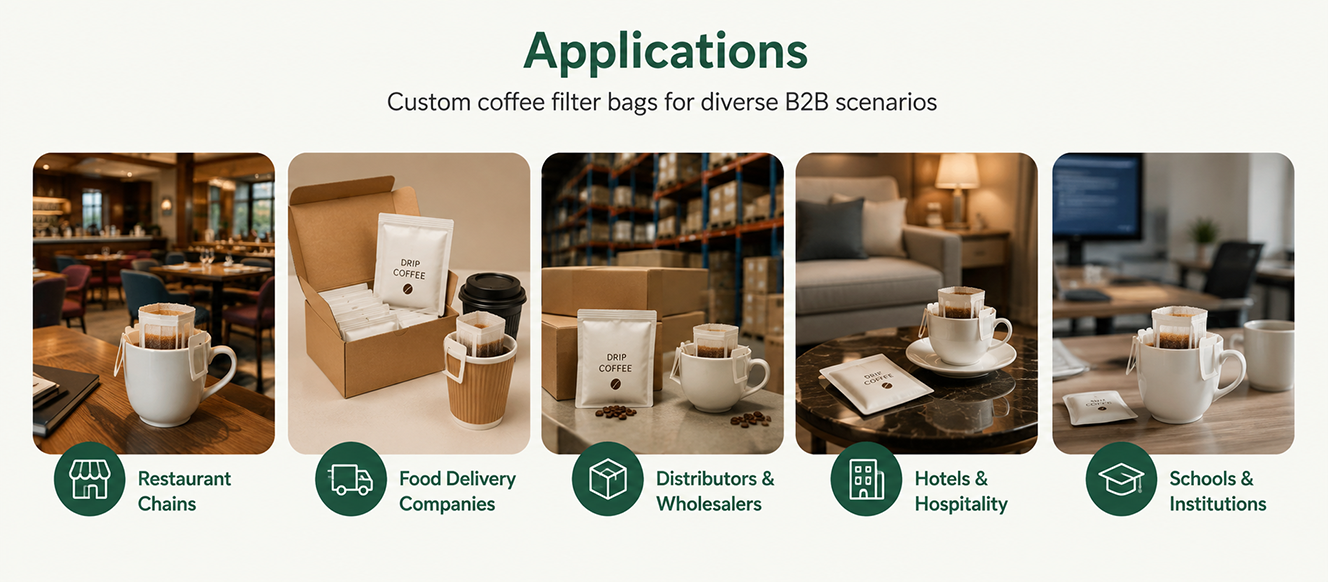
Custom coffee filters are used across a surprisingly wide range of commercial channels.
| Buyer Type | Typical Application | Main MOQ Concern |
|---|---|---|
| Restaurant Chains | Single-serve coffee for dine-in, takeaway, or hotel-style service | Balancing outlet volume with centralized purchasing |
| Food Delivery Companies | Meal kits, premium beverage add-ons, subscription boxes | Need for smaller trial quantities and seasonal SKUs |
| Distributors | Supplying several coffee brands or hospitality customers | Multiple artworks and mixed specifications |
| Wholesalers | Stock programs and private-label supply | Inventory turnover and repeat-order economics |
| Sustainable Packaging Buyers | PLA, cellulose, or lower-plastic filter programs | Material availability, certification, and higher material MOQs |
A distributor managing five brands may actually face a higher MOQ challenge than a single large coffee chain because every artwork can create a separate production batch.
Buying Guide: How Custom Coffee Filter Bags MOQ Really Works
1. Start With the Level of Customization
Not all custom projects require the same production setup.
| Customization Level | Typical MOQ Direction | Suitable Buyer |
|---|---|---|
| Stock filter, no printing | Lowest | Testing, small roasters, trial programs |
| Stock filter + custom outer pouch | Low to medium | Private-label launches |
| Custom printed filter ears | Medium | Established branded programs |
| Custom filter size or structure | Medium to high | Large-volume buyers |
| Special material + custom construction | Highest | Strategic or sustainability-focused programs |
Buyers often focus on the minimum number of finished bags, but factories normally think in terms of material consumption, machine setup, printing setup, and production efficiency.
That is why a supplier may quote a lower MOQ for an existing filter format but require a much larger volume for a fully custom design.
2. Understand Private Label MOQ
Private label MOQ usually depends on which part of the product carries the customization.
For example, a restaurant group may use a standard unprinted inner drip filter and customize only the outer sachet. This can reduce development complexity while still giving the finished product a strong branded appearance.
By contrast, a premium retail brand may want custom ear printing, a unique pouch structure, and a printed retail carton. Each additional component can introduce its own MOQ.
A useful sourcing question is therefore:
“Is the MOQ based on the finished product, each artwork, each material, or each individual packaging component?”
The answer can change the economics of the project significantly.
3. Printing Method Has a Major Impact
Digital printing is often attractive for short runs because it avoids traditional printing cylinders and makes multiple designs easier to manage.
Gravure printing generally makes more sense for larger recurring quantities. Setup costs are higher, but unit economics can improve once volume increases.
For distributors carrying several private-label customers, digital printing can sometimes reduce inventory risk. For a national restaurant chain ordering the same design every quarter, a higher-volume printing process may be more economical.
4. Filter Material Changes the MOQ
Standard nonwoven materials are usually easier to source in smaller production batches because they are widely used.
PLA-based filters, cellulose blends, or other specialty materials may have different minimum material requirements depending on the supplier and production schedule.
Sustainable packaging buyers should be particularly careful here. A material may technically be available, but the realistic MOQ could be much higher than expected if it is not part of the manufacturer’s regular production program.
At coffeeteabag.com, this type of discussion is usually most productive when the buyer confirms both the environmental target and expected annual volume before selecting the final filter structure.
5. Consider Machinery Compatibility
A custom filter still has to run through filling and sealing equipment reliably.
If the buyer already owns a drip coffee packing machine, the supplier needs to know filter dimensions, sealing area, roll width, feed method, and any tooling limitations.
If production is outsourced, the contract packer’s equipment may determine which filter formats are practical.
A small dimensional change that looks insignificant on a drawing can create feeding or sealing problems on an automatic line.
6. Do Not Ignore Grind Size and Fill Weight
Filter selection is connected to brewing performance.
A filter developed for 10 g of medium-fine coffee may not perform the same way when filled with 15 g of a finer grind. Water flow can slow significantly, increasing brew time or causing overflow.
This is especially important for restaurant chains where customers may prepare the product without precise pour-over technique.
Before approving mass production, test the actual coffee, grind, dose, filter, and cup together.
7. Plan MOQ Around Annual Demand, Not One Purchase
Procurement managers often negotiate aggressively for the lowest possible first-order quantity. That can be useful during product testing, but it is not always the best long-term strategy.
If a distributor expects to sell 300,000 units per year, ordering 5,000 units repeatedly may create unnecessary setup costs, freight charges, and stock-management work.
A better approach is to divide annual forecast volume into sensible production batches based on shelf life, cash flow, warehouse capacity, and lead time.
Customization Options Buyers Should Confirm
Nonwoven, PLA-based, cellulose blend, or other suitable food-contact material.
Width, height, chamber volume, support design, and coffee capacity.
Custom logo, ear printing, outer pouch graphics, QR codes, and brewing instructions.
Metallized, foil, recyclable, paper-look, or other barrier structures.
Cartons, display boxes, multi-packs, and gift packaging.
Empty filter supply or complete coffee filling and packing.
Certification Considerations
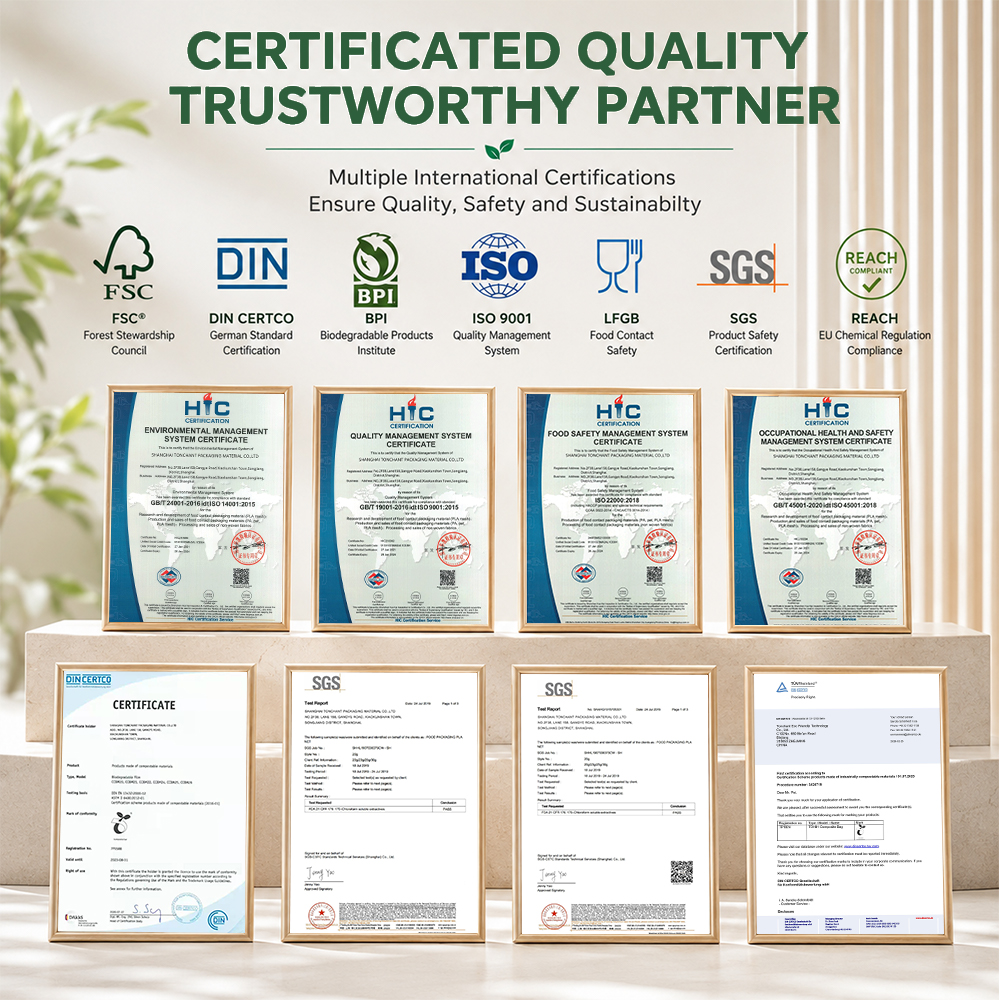
Certification should be treated as a specification issue, not a marketing afterthought.
Depending on the destination market and material, buyers may need:
- Food-contact compliance documentation
- FDA-related documentation for relevant U.S. applications
- EU food-contact compliance for European markets
- Migration testing where required
- Compostability certification for specific certified materials
- Factory quality-management or food-safety documentation
Sustainable claims require particular care.
PLA does not automatically mean that every finished filter is home compostable, and a compostable inner filter does not make a multi-layer or pouch compostable.
Procurement teams should ask for documentation that applies to the exact material code being purchased rather than accepting a generic certificate from a product family.
Buyers working with coffeeteabag.com or any other manufacturer should confirm documentation before artwork is finalized, especially if environmental claims will be printed directly on the packaging.
Common Buyer Concerns
“Why is my MOQ higher than expected?”
The most common reasons are custom printing, multiple artworks, non-standard dimensions, special filter materials, or tooling requirements.
“Can different designs share one MOQ?”
Sometimes, but not always. If each design requires a separate print setup or material change, the supplier may calculate MOQ per SKU rather than across the total order.
“Can I start with a small test run?”
Usually the easiest route is to use a standard filter structure and customize the outer pouch first. Once sales are proven, more extensive filter customization can be introduced.
“Will a lower MOQ increase unit cost?”
In most manufacturing environments, yes. Setup, printing, quality control, and production changeover costs are spread across fewer units.
“Should we prioritize MOQ or unit price?”
It depends on the stage of the project. A new food-delivery concept should usually prioritize lower inventory risk. An established wholesaler with predictable turnover may benefit more from a larger order and lower unit cost.
FAQ
1. What is a typical custom coffee filter bags MOQ?
There is no universal MOQ. Standard unprinted filters usually start lower than custom printed or custom-shaped filters. Material, size, printing method, and tooling all influence the final quantity.
2. How can I reduce private label MOQ?
Use an existing filter size, standard material, and customize the outer pouch rather than developing every component from scratch. Digital printing can also help with smaller branded runs.
3. Can I order several coffee blends under one MOQ?
Possibly, but separate outer pouch designs or filling specifications may create separate SKU requirements. Confirm whether the supplier calculates MOQ by artwork, filter specification, or total production quantity.
4. Do compostable filter bags have higher MOQs?
They can. Specialty materials may have larger raw-material minimums or fewer production slots. Buyers should confirm the exact certification, material availability, and MOQ before committing to sustainability claims.
5. Should I request samples before placing a bulk order?
Yes. Test filter flow, seal strength, cup fit, coffee capacity, grind compatibility, printing quality, and outer pouch performance before approving commercial production.
A Practical MOQ Strategy for B2B Buyers
For most buyers, the smartest approach is not to chase the absolute lowest MOQ.
Instead, match the order structure to the stage of the business.
A restaurant group testing drip coffee in 20 locations may begin with a standard filter and digitally printed pouch. If the trial performs well, the next stage might introduce custom filter printing and larger production batches.
A wholesaler with confirmed annual contracts may move directly into higher-volume production because inventory turnover is more predictable.
A sustainability-focused buyer may decide that a higher initial MOQ is acceptable if it provides access to a verified material that supports the company’s packaging goals.
The key is to treat MOQ as part of the total sourcing model rather than as an isolated number.
Post time: Aug-14-2026