B2B Tea Packaging Comparison Guide
PLA Tea Bags vs Nylon Tea Bags: Which Mesh Tea Bag Material Is Better for B2B Buyers?
A practical comparison of material performance, cost, environmental impact, applications, certifications, and sourcing considerations for importers, distributors, manufacturers, and private-label buyers.
For tea brands and packaging buyers, the choice between PLA tea bags vs nylon tea bags is not simply about appearance. The material affects sealing behavior, heat resistance, mesh structure, brewing performance, environmental claims, unit cost, and compatibility with packing equipment.
Both materials are commonly used for premium pyramid and mesh tea bag formats. Nylon has a long history in commercial tea packaging because of its strength and stability. PLA has gained attention as brands look for plant-derived alternatives and packaging stories that better align with sustainability goals.
Neither material is automatically the right choice for every project.
A hotel tea supplier may prioritize durability and production stability. A specialty tea brand may prefer PLA because the material supports a more natural brand position. A distributor serving several private-label customers may care most about MOQ, machine compatibility, documentation, and repeat-order consistency.
This guide compares both materials from a practical B2B sourcing perspective so buyers can make a decision based on actual product requirements rather than assumptions.
Quick Comparison Table
| Factor | PLA Tea Bags | Nylon Tea Bags |
|---|---|---|
| Material Origin | Typically plant-derived polymer feedstock | Petrochemical-based synthetic polymer |
| Appearance | Clear to translucent mesh | Clear, smooth mesh |
| Strength | Good, but depends on formulation and mesh structure | Very good wet strength and toughness |
| Heat-Sealing | Requires a controlled sealing window | Generally stable on established equipment |
| Environmental Positioning | Potential industrial compostability depending on certified construction | Not generally positioned as compostable |
| Cost | Often higher | Often more economical |
| Best Fit | Sustainability-led and premium tea programs | High-volume, performance-focused programs |
What Is PLA?
PLA stands for polylactic acid, a thermoplastic polymer commonly produced from renewable plant-based feedstocks such as corn starch or sugar-derived materials.
In tea packaging, PLA can be formed into fine mesh structures suitable for pyramid tea bags and other premium filter formats. The resulting material is lightweight, visually clean, and capable of allowing tea leaves to expand during brewing.
From a branding perspective, PLA is often attractive because it gives buyers an alternative to conventional petroleum-based plastics. However, environmental claims need to be made carefully. A PLA mesh tea bag should not automatically be described as home compostable, biodegradable in all environments, or plastic-free.
The correct claim depends on the exact material, additives, thread, tag, sealing components, and certification status of the finished tea bag.
If compostability is part of the product positioning, request certification for the exact tea bag construction rather than relying only on a general statement that the raw PLA material is compostable.
What Is Nylon?
Nylon is a synthetic polymer with strong mechanical properties and a long record of use in filtration and food-packaging applications.
Nylon tea bags are particularly common in premium pyramid formats because the material can be manufactured into a smooth, transparent mesh with excellent wet strength. This allows tea leaves, herbs, flowers, and fruit pieces to remain visible while still providing reliable filtration.
For manufacturers, nylon is familiar. It generally performs consistently on established tea-bag filling and sealing equipment, which can reduce process risk during high-volume production.
Its main limitation is environmental positioning. Nylon is not typically selected by brands trying to reduce fossil-based plastic use or make compostability-related claims.
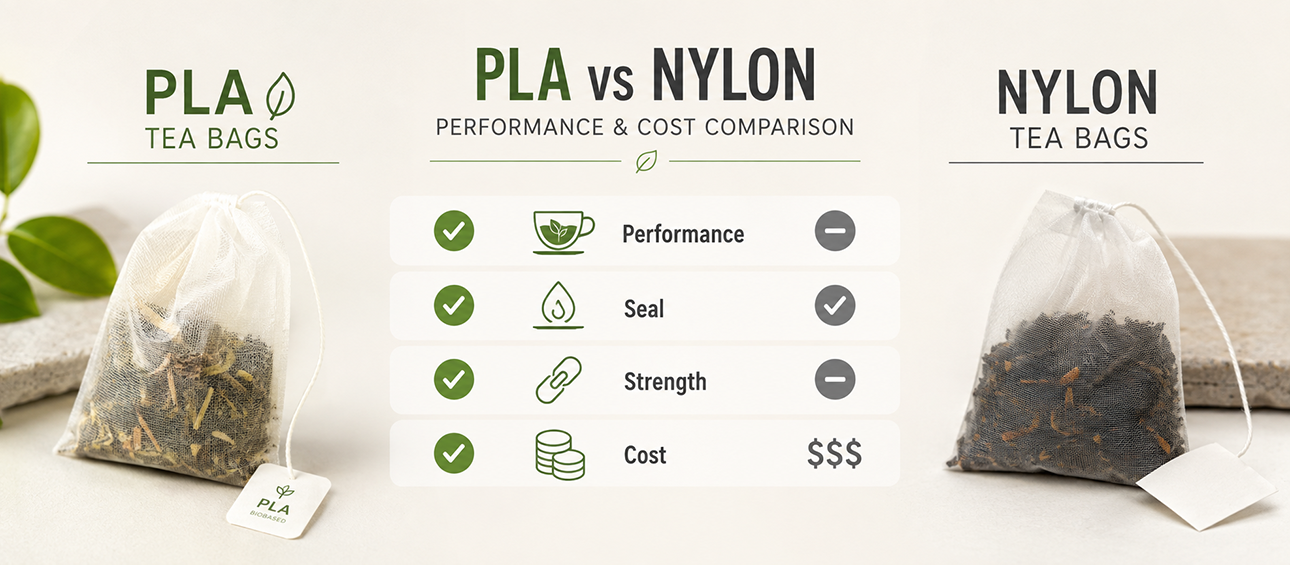
Key Differences Between PLA and Nylon Tea Bags
At first glance, the two materials can look very similar. Both can create transparent, premium-looking pyramid filters. Their differences become clearer when buyers consider sourcing, production, and disposal.
| Area | PLA | Nylon | Why It Matters |
|---|---|---|---|
| Feedstock | Renewable plant-derived sources | Petroleum-based | Affects sustainability messaging |
| Thermal Window | Can be narrower | Often more forgiving | Affects machine speed and seal consistency |
| Wet Strength | Good | Excellent | Important for large leaf and herbal blends |
| End-of-Life Positioning | May support certified industrial composting claims | Conventional disposal | Relevant to sustainable packaging policies |
| Typical Unit Cost | Higher | Lower to moderate | Affects landed cost and margin |
Advantages of PLA Tea Bags
Plant-Derived Material Story
PLA gives brands a clearer renewable-material narrative than nylon. This can be useful in markets where retailers, hotels, or consumers are actively looking for alternatives to conventional petroleum-based tea packaging.
Premium Visual Appeal
PLA mesh can provide the transparent appearance associated with high-end pyramid tea bags. Whole leaves, flowers, herbs, and fruit inclusions remain visible, which helps communicate product quality.
Potential Compostability Route
Certain PLA structures may qualify for industrial compostability when the full product construction meets the relevant standard. For buyers with defined packaging sustainability targets, that can be commercially useful.
Good Brewing Performance
Properly engineered PLA mesh provides sufficient water flow and internal space for tea expansion. It works particularly well with pyramid formats where leaf movement is part of the brewing experience.
Advantages of Nylon Tea Bags
High Mechanical Strength
Nylon is tough and stable when wet. This is useful for blends containing large leaves, spices, dried fruit, or other ingredients that put more stress on the filter.
Established Production Performance
Many packing lines have been optimized for nylon over years of production. That familiarity can translate into stable sealing, fewer material adjustments, and reliable high-speed operation.
Clear Premium Appearance
Nylon can produce a very clean, transparent mesh. For brands where visual presentation is more important than environmental positioning, this remains a strong advantage.
Competitive Cost
Nylon is often less expensive than PLA, particularly for established high-volume specifications. For distributors and large foodservice buyers, this difference can become meaningful across millions of tea bags.
Performance Comparison
Buyers should evaluate performance in three areas: brewing, sealing, and handling.
Brewing Performance
Both PLA and nylon can deliver good infusion when the mesh size is appropriate for the tea blend. The bag geometry often has more influence on brewing than the polymer alone.
Pyramid bags provide extra internal volume, allowing larger leaves to open more freely than in compact flat tea bags.
For fine rooibos, powdered ingredients, or very small particles, buyers need to pay close attention to mesh opening size. A highly open mesh may allow fine material into the cup regardless of whether the bag is PLA or nylon.
Sealing Performance
Nylon is often regarded as more forgiving in industrial processing. PLA can perform well, but machine temperature, dwell time, pressure, and production speed must be correctly matched to the material.
At Coffeeteabag, one of the most important pre-production checks is not simply whether a material can be sealed, but whether it maintains seal consistency at the buyer’s intended operating speed.
Handling and Storage
Both materials should be stored in controlled conditions before conversion. Heat, moisture, and poor roll handling can affect production performance. PLA may require more attention to storage conditions depending on its exact formulation.
Cost Comparison
Buyers often ask which material is cheaper. In most sourcing programs, nylon tends to have the lower material cost, while PLA carries a premium.
That comparison, however, should be made using total packaged cost rather than raw filter price alone.
Important cost components include:
- Filter material
- Tag and thread
- Printing
- Machine setup
- Packing speed
- Reject rate
- Outer envelope
- Retail carton
- MOQ and inventory carrying cost
- Freight
A material that costs slightly more per bag may still be commercially sensible if it supports a higher-value retail position. Conversely, a procurement manager supplying a hotel chain with millions of conventional tea bags may find the nylon cost advantage difficult to ignore.
Request quotations using the same bag size, mesh specification, packing format, and annual volume. Comparing different constructions can create a misleading cost difference.
Environmental Impact Comparison
This is where the debate around PLA tea bags vs nylon tea bags is most visible.
PLA is made from renewable feedstocks, which can reduce reliance on fossil-derived raw materials. Certain PLA products may also be certified for industrial composting.
Nylon, by contrast, is derived from petrochemical feedstocks and is not typically compostable.
However, environmental performance should not be simplified into “PLA good, nylon bad.”
Commercial composting infrastructure is not available everywhere. Even a certified industrially compostable tea bag may enter general waste if the local collection system does not support compostable packaging.
Buyers should also consider the tag, thread, adhesive, envelope, and carton. A PLA mesh bag packaged inside a conventional multilayer plastic envelope is not a fully compostable packaging system.
The most credible approach is to define exactly which part of the product meets which environmental standard.
Applications Comparison
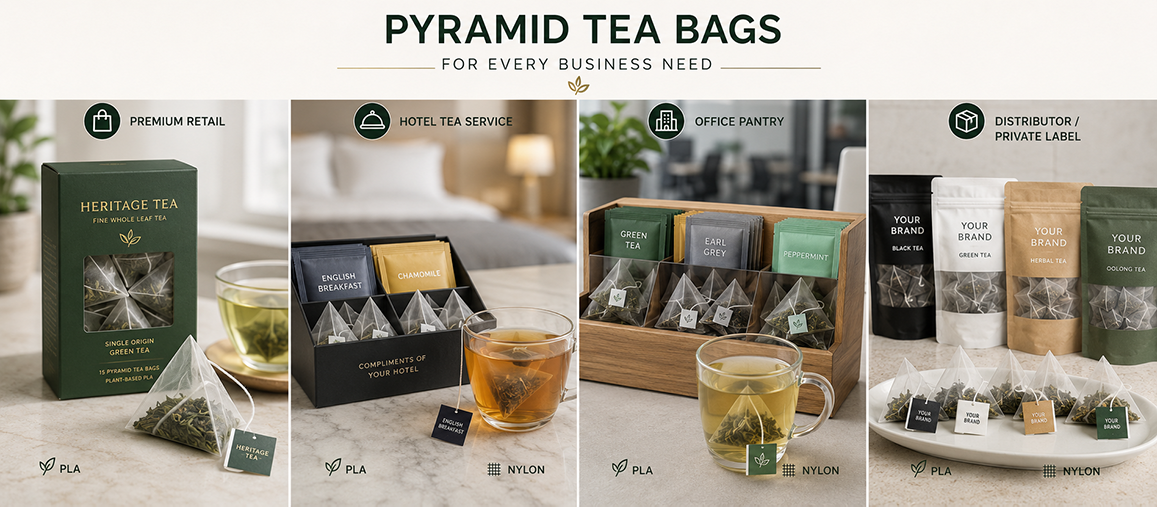
| Application | PLA | Nylon | Buyer Consideration |
|---|---|---|---|
| Premium Specialty Tea | Excellent fit | Excellent fit | Brand positioning usually decides |
| Organic / Sustainability-Led Brands | Often preferred | Less aligned | Verify environmental claims |
| Hotel & Foodservice | Suitable | Very suitable | Cost and supply reliability matter |
| Large-Volume Private Label | Suitable if budget supports it | Strong fit | Unit economics become important |
| Gift & Premium Retail | Excellent fit | Excellent fit | Visual quality is strong for both |
Pros and Cons Summary
PLA Tea Bags
Pros
- Renewable feedstock positioning
- Premium transparent mesh appearance
- Potential certified industrial compostability
- Good brewing performance
Cons
- Usually higher cost
- May require tighter machine control
- Environmental claims require careful documentation
- Composting infrastructure may be limited
Nylon Tea Bags
Pros
- Excellent wet strength
- Stable industrial performance
- Premium transparent appearance
- Often lower unit cost
Cons
- Fossil-based polymer
- Not generally compostable
- Less suitable for sustainability-led positioning
- May face stronger scrutiny from plastic-conscious buyers
Which One Is Better?
There is no universal winner.
PLA is usually the stronger option when sustainability positioning, renewable material content, and potential compostability certification are important purchasing criteria.
Nylon is often the better choice when buyers prioritize mechanical strength, established production performance, high-volume cost efficiency, and broad compatibility with existing equipment.
For a premium organic tea brand, paying more for PLA may support the product story and retail positioning.
For a distributor supplying a nationwide hospitality group, nylon may provide more predictable economics.
For a manufacturer already using nylon on high-speed machinery, switching to PLA should be treated as a production-development project rather than a simple material replacement.
How Buyers Should Choose
Procurement decisions should begin with the finished product and market requirement.
1. Define the Tea Blend
Confirm leaf size, dust content, herbs, fruit pieces, and expected fill weight. Mesh opening and bag volume should suit the actual blend.
2. Confirm the Packing Machine
Ask whether the material has already been tested on your machine model. If not, run a production trial before placing a large order.
3. Compare Total Cost
Evaluate material price, MOQ, machine efficiency, rejects, outer packaging, freight, and inventory rather than focusing only on the filter cost.
4. Review Environmental Claims
If the packaging will use words such as compostable, biodegradable, renewable, or plastic-free, confirm exactly what supporting documentation is available.
5. Check Certification Requirements
Depending on the destination market, buyers may request food-contact declarations, migration testing, FDA-related documentation, EU food-contact compliance, or compostability certification.
6. Request Finished Samples
A raw mesh sample is not enough. Test finished tea bags with the actual tea blend and boiling water. Check seal strength, infusion rate, clarity, odor, handling, and appearance.
Coffeeteabag typically recommends confirming material, machine compatibility, and environmental documentation at the same stage, because changing one factor late in the project can affect the others.
Frequently Asked Questions
1. Are PLA tea bags plastic-free?
PLA is a polymer, even though it can be produced from renewable plant-based feedstocks. Buyers should avoid calling a PLA tea bag plastic-free unless the claim is supported by the relevant definition and documentation for the target market.
2. Are PLA tea bags compostable?
Some PLA tea bag constructions may be certified for industrial composting. Certification depends on the complete product, not only the raw PLA polymer.
3. Which material is stronger?
Nylon generally offers higher toughness and wet strength. PLA can still provide sufficient performance for most tea-bag applications when the correct specification is selected.
4. Which mesh tea bag is better for pyramid tea?
Both are suitable. PLA is often chosen for sustainability-led premium products, while nylon remains popular for durability, visual clarity, and high-volume manufacturing.
5. Can PLA replace nylon on the same packing machine?
Sometimes, but machine settings may need adjustment. Seal temperature, pressure, speed, and material tension should be tested under actual production conditions before a full conversion.
Post time: Aug-21-2026