The Practical Sourcing Guide to Private Label Coffee Filter Bags
The Practical Sourcing Guide to Private Label Coffee Filter Bags
Run a roastery for long enough, and you will eventually hit the same wall: customers love your single-origin beans, but they keep asking for something easier. They want your coffee at their office desks, inside hotel rooms, on weekend camping trips, or during rushed Monday mornings. Whole bean sales stay steady, but convenience is where the market is quietly moving.
That shift explains why private label coffee bags—specifically single-serve drip filter bags and immersion brew sachets—have turned into a core revenue driver rather than a niche side item. They give roasters a way to enter the single-serve market without buying half-a-million-dollar pod production lines or putting high-scoring coffees into plastic capsules that muffle acidity and aroma.
Getting these products off the whiteboard and onto retail shelves takes more than picking a pretty box design. You have to balance filter permeability, pouch barrier properties, shelf-life chemistry, and co-packing logistics. This guide walks through how to source, evaluate, and scale private label drip coffee bags based on real floor-level packaging experience.
1. Understanding the Format: Drip Bags vs. Immersion Filters
Before sending artwork to a converter or shipping green coffee to a co-packer, you need to decide how your coffee will actually brew in the cup. The two primary formats serve entirely different consumer habits.
Hanging Ear Drip Filter Bags
These are the workhorses of portable specialty coffee. Stiff paper or non-woven arms fold out from the sides of a central pouch and hook over the rim of a standard mug. The consumer tears open the top seal, pours hot water in three or four steady pulses, and lets gravity extract the coffee into the cup below.
Because it mimics a manual pour-over, this format retains bright acidity, floral top notes, and clean mouthfeel. It works best for light-to-medium roasts, single-origin coffees, and higher-scoring lots where clarity matters.
Immersion Brew Bags (Tea-Bag Style)
Immersion bags skip the hanging arms entirely. Filled with coarsely ground coffee, they drop directly into hot or cold water and steep over several minutes. They are durable, foolproof, and ideal for dark roasts, blend profiles focused on body and chocolate notes, or full-batch cold brew kits built for home pitchers.
If your customer base prefers low-acid coffee with rich body, or if you are targeting hotel in-room pantries where guests might not have the patience for a steady pour-over, immersion bags are usually the safer bet.
2. Material Selection: Inside the Bag & Outside the Barrier
A single-serve drip bag setup relies on two separate packaging components working together: the porous inner bag that holds the grounds during brewing, and the sealed outer sachet that keeps those grounds fresh for up to two years.
Inner Filter Materials
Matching your grind size to the correct inner filter material is essential. A filter that flows too slowly over-extracts and creates bitterness, while a filter that drains too quickly yields a thin, watery cup.
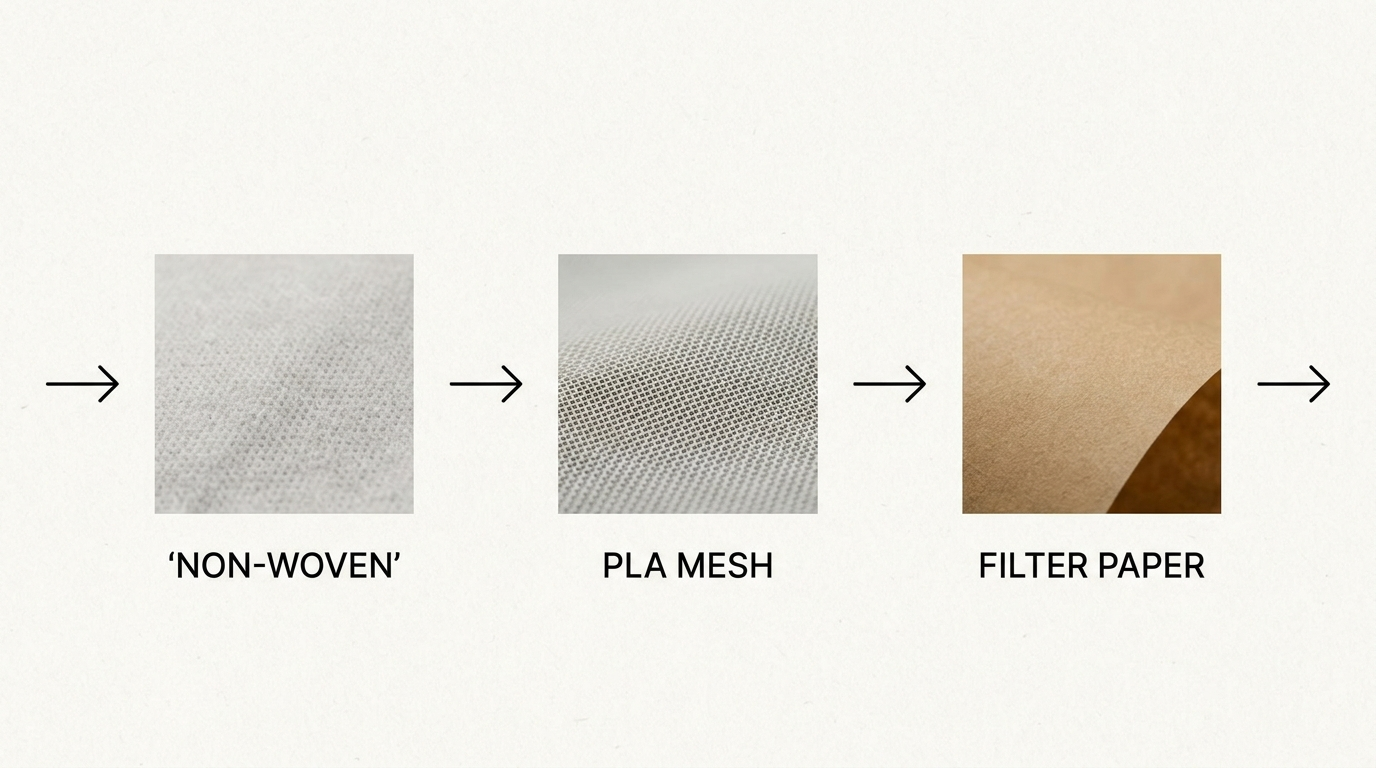
- Non-Woven Polypropylene/Polyethylene (PP/PE): The global industry standard. Non-woven synthetic fabric offers high mechanical strength under hot water, clean liquid flow, and reliable ultrasonic sealing performance. It is cost-effective, though facility-dependent for recycling.
- PLA (Polylactic Acid Mesh): Derived from renewable plant starches like corn or sugar cane, PLA features a silky texture and high transparency. It carries industrial compostability credentials (such as EN 13432), making it a natural fit for eco-conscious brands, though raw material costs run roughly 20% to 35% higher than PP/PE.
- Wood Pulp Filter Paper: A classic option made from natural cellulose fibers. It absorbs some insoluble coffee oils, producing a clean cup profile, but lacks the stretch resistance of non-woven fabrics during high-speed automated filling.
Outer High-Barrier Packaging
Ground coffee loses delicate aromatics within hours when exposed to oxygen. Your outer sachet must act as a complete barrier against oxygen, moisture, and UV light.
- PET / AL / PE (Foil Laminate): The traditional choice for maximum shelf life. The interior aluminum layer reduces oxygen permeability virtually to zero.
- Kraft / VMPET / PE: Replaces the glossy outer film with a natural kraft paper surface for an organic look on retail shelves, while maintaining an internal metallized layer for barrier protection.
- Mono-Material Recyclable Laminates (PE/PE or PP/PP): Modern high-barrier films designed for store-drop-off recycling streams. They use advanced EVOH coatings to match traditional foil barriers without mixing material classes.
3. Buyer Scenarios: Choosing the Right Setup for Your Brand
To see how these choices play out on the factory floor, consider three common brand situations:
Scenario A: The Specialty Micro-Roaster
Goal: Launch a 5-SKU lineup of seasonal single-origin drip bags without holding massive inventory or risking cash flow.
Best Approach: Work with a supplier offering short-run digital printing for outer sachets. Keep the inner filter standard (10g capacity PP/PE non-woven). Order unprinted stock boxes and apply custom textured labels for outer retail display. This keeps initial investment low while testing market demand.
Scenario B: The Regional Grocery Chain & D2C Brand
Goal: Secure placement in 200 supermarket locations with consistent margins and a 12-to-18-month shelf-life guarantee.
Best Approach: Move to high-volume rotogravure printing for outer sachets to lower unit costs. Use high-barrier foil or mono-material PE packaging with nitrogen flushing to maintain residual oxygen levels below 1%. Ship finished goods in custom offset-printed 10-pack paperboard cartons.
Scenario C: The Sustainable Outdoor Lifestyle Brand
Goal: Target hikers and campers who require zero-waste, plastic-free packaging for outdoor brewing.
Best Approach: Combine plant-based PLA filter mesh with industrially compostable outer sachets (using paper/NK/Bio-PBS structures). Highlight certifications directly on the front panel to validate environmental claims for eco-focused buyers.
4. Customization Options & Factory Realities
Customizing your coffee brand packaging goes beyond uploading a vector logo to a printing template. Every choice impacts line speeds, heat-seal temperatures, and scrap rates.
Inner Bag Customization
The paper hanging arms attached to the filter can be custom-printed with food-grade inks (such as soy-based formulas). Roasters frequently print brew instructions, water temperature recommendations, or brand icons directly onto the arms. Standard capacities range from 8 to 12 grams of ground coffee, with 10 grams serving as the sweet spot for a standard 150ml to 180ml cup.
Outer Sachet Printing Tech
Digital printing excels for short production runs (5,000 to 10,000 units per design), eliminating copper cylinder costs and allowing multiple artwork variations in a single run. Once volumes exceed 30,000 units per SKU, rotogravure printing becomes significantly more economical, delivering lower unit costs, precise Pantone color matching, and special tactile finishes like spot UV or soft-touch matte.
Retail Box Configurations
Most retail drip bags are sold in 5-pack, 10-pack, or 12-pack configurations. Straight-tuck paperboard cartons offer simple assembly, while auto-bottom boxes speed up fulfillment lines. If selling directly into office pantries or quick-service cafes, consider perforated tear-away display boxes that sit neatly on countertops.
5. Sourcing Considerations: MOQs, Lead Times & Freight
When sourcing custom packaging components or contract manufacturing services, pay close attention to minimum order thresholds and logistics timelines.
| Sourcing Tier | Production Route | Typical MOQ | Lead Time | Primary Advantage |
|---|---|---|---|---|
| Bulk Empty Filter Bags | Stock Inventory | 1,000 – 5,000 pcs | 3 – 7 Days | Immediate stock availability for in-house filling. |
| Custom Outer Sachets (Digital) | Digital Printing | 5,000 – 10,000 pcs | 2 – 3 Weeks | Low setup costs; ideal for testing multiple SKUs. |
| Custom Outer Sachets (Gravure) | Rotogravure Printing | 30,000 – 50,000 pcs | 3 – 4 Weeks | Lowest unit cost; high color precision. |
| Full OEM Co-Packing (Turnkey) | Contract Assembly | 10,000 – 20,000 pcs | 4 – 6 Weeks | Complete service including roasting, grinding, nitrogen flushing, and box assembly. |
Factory Note on Lead Times: Always factor in pre-production proofing (5 to 7 days) and international ocean or air freight (1 to 4 weeks depending on transit mode) when scheduling product launches.
6. Floor Insights: Quality Control & Nitrogen Flushing
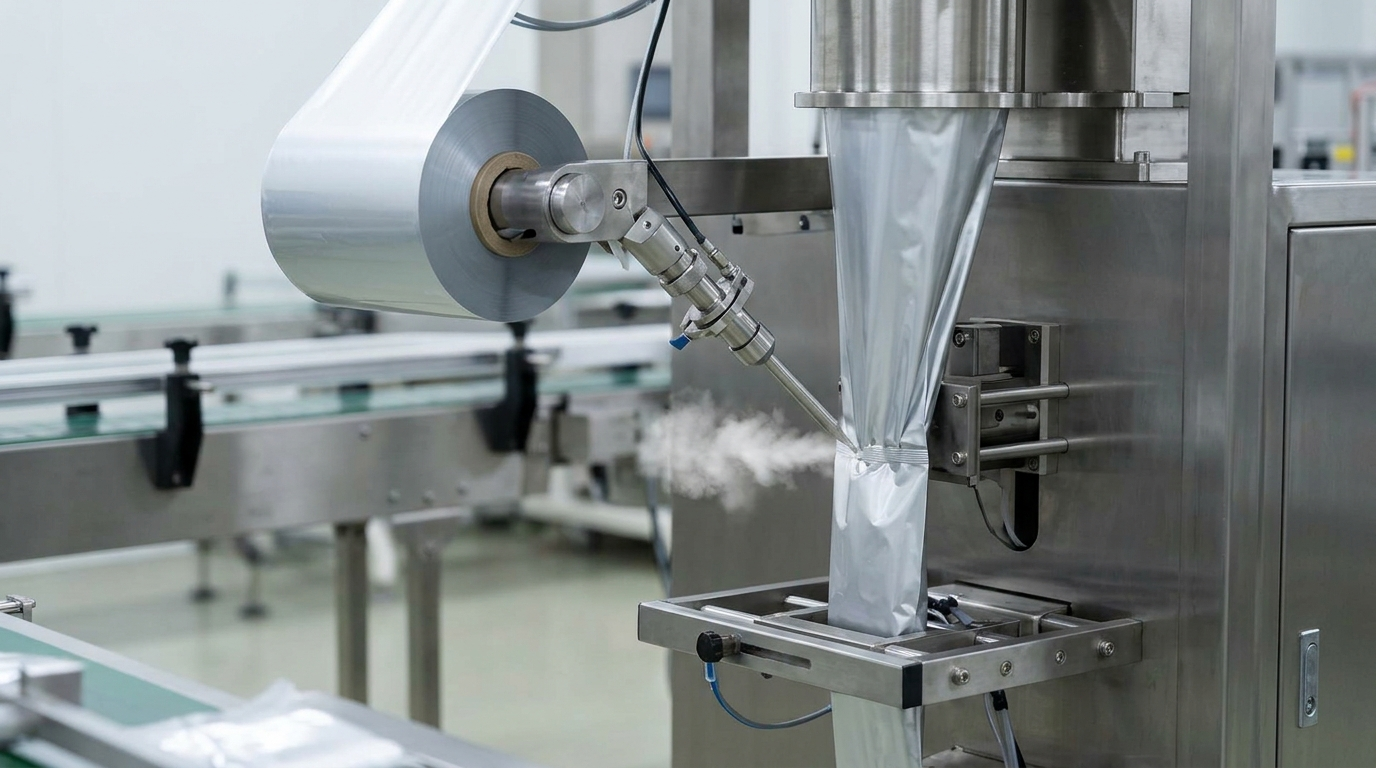
Inside a contract packaging facility, coffee freshness relies heavily on residual oxygen control. Ground coffee exposes vastly more surface area to ambient air than whole beans, speeding up staling.
During high-speed automated packaging, continuous nitrogen ($\text{N}_2$) injection flushes atmospheric oxygen out of the outer sachet immediately before the thermal jaw seals the film. Experienced factory technicians conduct twice-daily head-space sampling using needle-probe oxygen analyzers to confirm that residual oxygen levels remain strictly below 1.0% (ideally under 0.5%).
If residual oxygen rises above 2.0%, volatile coffee aromatics break down, resulting in flat, papery off-notes within 30 to 60 days of packaging. When auditing a packaging supplier or co-packer, ask to review their daily quality control logs for head-space testing and seal-integrity checks.
7. Regulatory Compliance & Essential Certificates
Because filter bags undergo high-temperature extraction ($90^\circ\text{C}$–$96^\circ\text{C}$) while in contact with hot water, compliance documentation must be verified upfront:
- Food Contact Safety: Ensure compliance with FDA 21 CFR standards (US market) or Regulation (EC) No 1935/2004 (European market) for food-contact paper and polymers.
- Food Safety Management: Look for facilities holding BRCGS Packaging Materials, FSSC 22000, or ISO 22000 certifications to ensure cleanroom manufacturing standards.
- Environmental Claims: If marketing “compostable” packaging, request third-party verification under EN 13432 or ASTM D6400 (such as OK Compost or DIN CERTCO credentials). Avoid suppliers relying on vague self-declarations.
- Chemical Safety: Request third-party lab reports confirming zero heavy metals, zero BPA leaching, and food-safe soy ink formulations for outer graphics.
8. Format Comparison: Drip Bags vs. Alternative Single-Serve Formats
Understanding how drip coffee filter bags compare with traditional single-serve packaging formats helps clarify product positioning:
| Feature | Drip Filter Bags | Rigid Coffee Pods | Soluble Instant Packets |
|---|---|---|---|
| Cup Quality | High (Fresh pour-over extraction) | Moderate to High | Variable (Soluble solids) |
| Equipment Needed | Hot water kettle only | Dedicated pod machine | Hot or cold water |
| Packaging Waste | Low (Flexible film + paper mesh) | High (Plastic/aluminum body) | Minimal (Film strip) |
| Dose Range | 8g – 12g fresh grounds | 8g – 12g fresh grounds | 1.5g – 3g freeze-dried powder |
| Shelf Life ($\text{N}_2$ Flushed) | 12 – 24 Months | 12 – 18 Months | 24+ Months |
| Equipment Investment | Low to Moderate | Very High | High |
9. Practical FAQ for Coffee Buyers
What grind size yields the best extraction rate in drip filter bags?
Aim for a medium-fine grind, slightly finer than standard V60 or drip machine settings, but coarser than espresso. A particle distribution centered around 400 to 600 microns allows water to pass through in roughly 90 to 120 seconds for a 10g dose, achieving a balanced 18% to 20% extraction yield without clogging.
Can we fill drip filter bags in-house without buying automated machinery?
Yes. Small roasteries can purchase pre-made empty filter bags in bulk, manually weigh ground coffee into each filter using a countertop scale, seal the tops with a simple hand-held impulse sealer, and insert them into pre-printed outer sachets. Once monthly volumes surpass 5,000 units, switching to an automated contract co-packer becomes far more cost-effective.
How do I prevent coffee grounds from settling during shipping?
Coffee grounds compress during transit. Using properly calibrated dosing augers during filling ensures uniform grounds distribution inside the bag. Compact outer sachet sizing prevents excess movement that could otherwise cause micro-abrasions in the inner filter material.
10. Next Steps for Launching Your Line
Adding custom drip coffee filter bags to your lineup gives customers the pour-over experience they love in a portable, single-serve format. To launch smoothly without costly design revisions or production delays, follow this step-by-step checklist:
- Lock In Your Coffee Profile: Select roasted blends or single-origin coffees that shine under pour-over brewing, and perform grind tests to dial in target flow rates.
- Request Material Physical Samples: Get physical samples from packaging suppliers to evaluate film textures, tearing notches, and heat-seal durability firsthand.
- Run Dieline Checks Early: Request exact artwork dielines from your packaging manufacturer before finalizing graphics, ensuring text and logos clear all outer seam seals.
- Audit Your Oxygen Thresholds: Confirm your co-packer or packaging supplier regularly verifies residual nitrogen levels below 1.0% using gas headspace analysis.
Investing time in material selection, grind calibration, and barrier validation upfront ensures your private label coffee bags land on consumer countertops delivering the exact freshness, clarity, and body your roast profile intended.
Post time: Oct-26-2026