B2B Coffee Packaging Comparison
UFO Drip Coffee Bags vs Traditional Filter Coffee: Which Format Makes More Sense for B2B Buyers?
An objective comparison of brewing performance, cost, packaging, sustainability, sourcing, and commercial applications.
Introduction
Coffee buyers are no longer choosing only between different beans or roast profiles. The brewing format itself has become an important purchasing decision.
For importers, distributors, wholesalers, restaurant groups, and private-label brands, two formats often serve very different needs: the UFO drip coffee bag and traditional filter coffee.
Traditional filter coffee is familiar, flexible, and well established. It normally uses a separate brewer or pour over filter, loose ground coffee, and a paper or reusable filter. A UFO drip coffee bag takes a different approach. The coffee is pre-portioned inside a single-use filter with a circular support structure that rests over the cup.
Neither format is automatically better. The commercial decision depends on where the coffee will be served, how much operational control the buyer needs, target selling price, labor requirements, packaging objectives, expected volumes, and sustainability strategy.
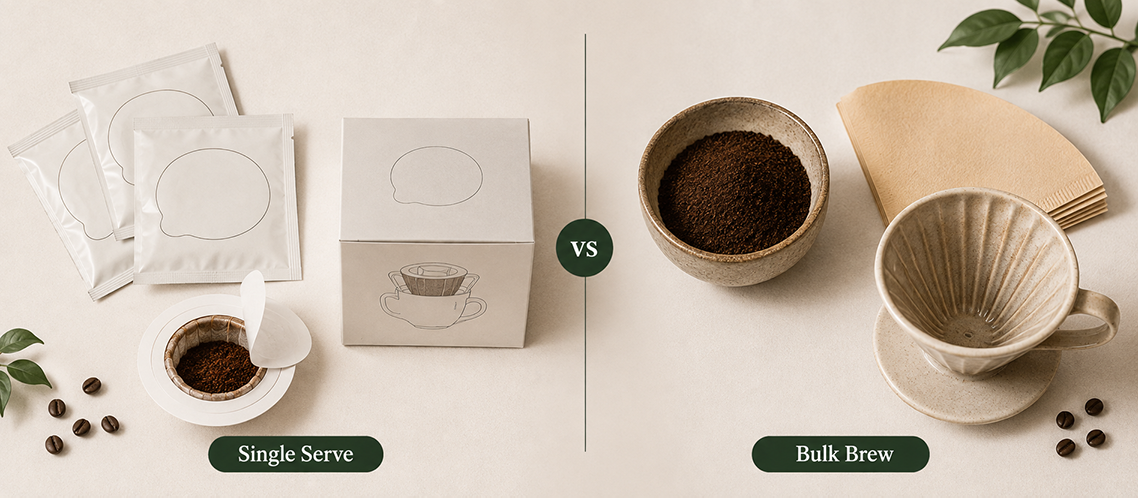
Quick Comparison Table
| Factor | UFO Drip Coffee Bag | Traditional Filter Coffee |
|---|---|---|
| Brewing setup | Cup and hot water | Filter holder, paper filter or reusable filter, coffee and hot water |
| Portion control | Pre-measured | Usually measured by staff or consumer |
| Equipment requirement | Low | Low to medium |
| Branding area | High: filter ring, lid, pouch and carton | Mostly coffee pack and outer packaging |
| Service consistency | High when dose and instructions are controlled | Depends more on operator technique |
| Packaging per serving | Higher | Usually lower for bulk coffee |
| Best suited to | Hotels, delivery, travel, sampling, premium single serve | Cafés, restaurants, offices and high-volume brewing |
What Is a UFO Drip Coffee Bag?
A UFO drip coffee bag is a pre-portioned drip coffee filter bag designed to rest directly over a cup. Instead of using two hanging paper arms, many UFO-style products use a circular paper support that spans the cup opening.
A typical unit includes:
- A circular paper or paperboard support
- A filter chamber
- A removable or peel-open center section
- Ground coffee
- An individual high-barrier pouch
The consumer places the unit over the cup, opens the center, and pours hot water over the coffee. The brewed liquid flows through the filter into the cup below.
The key commercial advantage is integration. The filter, support and coffee dose are combined into one ready-to-use unit.
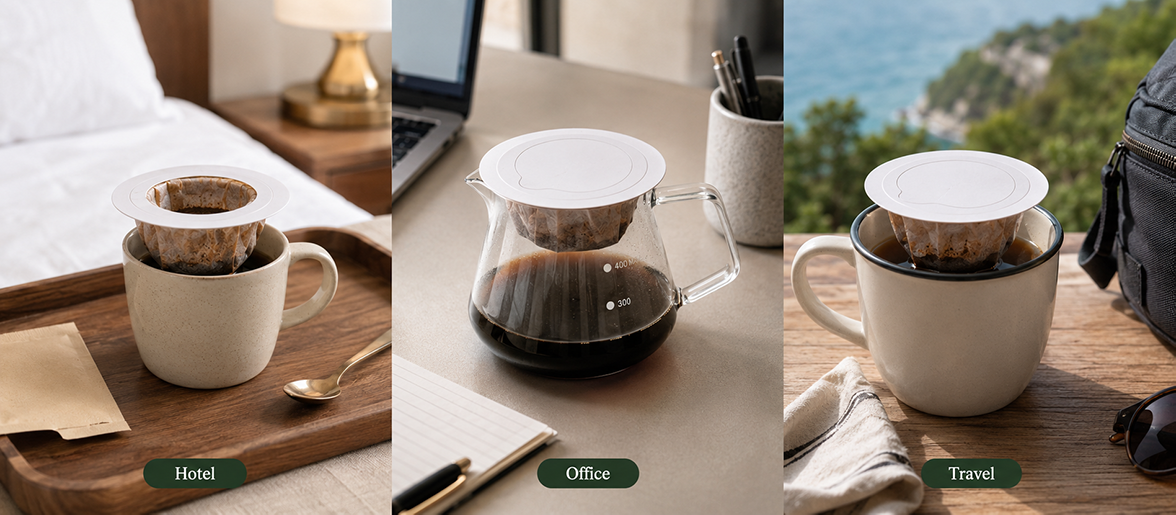
That is especially valuable when the buyer cannot control the brewing environment. A hotel guest, delivery customer or office worker may not own a dripper, but almost everyone has access to a cup and hot water.
What Is Traditional Filter Coffee?
Traditional filter coffee covers a much broader range of brewing methods. It may use a cone dripper, flat-bottom brewer, batch brewer or commercial filter machine.
The coffee is normally supplied separately from the filter. The user or staff member measures the grounds, places a paper or reusable filter in the brewer, adds coffee, and pours or distributes hot water through the bed.
This format gives operators more control over:
- Coffee dose
- Water ratio
- Grind size
- Extraction time
- Batch size
That flexibility is one reason traditional filter coffee remains important in cafés, restaurants, offices and high-volume catering environments.
The trade-off is that more control usually requires more equipment, training and consistency from staff.
Key Differences Between the Two Formats
From a B2B perspective, the largest difference is not simply the shape of the filter. It is where the complexity sits.
With traditional filter coffee, the operator manages much of the brewing process. With a UFO drip coffee bag, more of the process is standardized during manufacturing.
| Decision Area | UFO Format | Traditional Filter Coffee |
|---|---|---|
| Coffee dose | Set during packing | Measured during brewing |
| Filter selection | Fixed in finished product | Can be changed by brewer |
| Consumer skill | Relatively low | Low to high depending on method |
| Serving flexibility | Usually one serving | Single cup to large batch |
| Packaging intensity | Higher per serving | Lower when coffee is packed in bulk |
Advantages of UFO Drip Coffee Bags
1. Consistent Portioning
Each serving can be filled to a defined weight. This helps restaurant groups and hotel operators control coffee cost more accurately than loose dosing.
2. Minimal Equipment
The customer only needs hot water and a cup. This reduces the need for dedicated brewers, filter holders and cleaning procedures.
3. Strong Product Presentation
The circular structure provides visible branding space during brewing. The support, lid, pouch and carton can all contribute to the finished product identity.
4. Good for Sampling
Coffee roasters and distributors can send a complete brewing solution rather than asking the recipient to own a specific brewer.
5. Useful for Decentralized Operations
A restaurant group with many small sites can offer branded coffee without installing identical equipment everywhere.
Advantages of Traditional Filter Coffee
1. Lower Packaging Consumption per Serving
Bulk coffee combined with loose filter paper generally requires less individual packaging than individually wrapped drip bags.
2. Better for High-Volume Brewing
Commercial brewers can prepare multiple cups at once. This is usually more efficient in breakfast restaurants, conferences, staff canteens and office environments.
3. More Brewing Control
Professional operators can adjust dose, grind, water temperature and extraction time according to the coffee being served.
4. More Filter Choices
Buyers can select bleached or unbleached paper, different paper weights, metal filters, reusable cloth filters or specialty pour over filter designs.
5. Lower Unit Cost in Some High-Volume Applications
When coffee is brewed in large batches, labor and packaging can be spread across many servings.
Performance Comparison
Brewing quality depends heavily on the coffee, grind, filter and water. Neither format guarantees superior flavor on its own.
The UFO format has the advantage of repeatability because the coffee dose and filter are fixed. Traditional brewing has the advantage of adjustability.
For example, a specialty café can change the grind when switching from a washed Ethiopian coffee to a darker Brazil blend. A pre-packed UFO product cannot be adjusted after production. Its grind and dose must be validated before the commercial run begins.
This is why factory sampling matters. At Tonchant, buyers developing a drip coffee filter bag typically need to test the actual coffee with the intended filter chamber rather than approving the product from dimensions alone.
Common test points include:
- Total brew time
- Filter drainage rate
- Coffee bed expansion
- Sediment level
- Support stability
- Final cup strength
Cost Comparison
Buyers should compare total operating cost rather than filter price alone.
A UFO drip coffee bag normally carries more packaging cost per serving because it includes the filter, support ring, individual pouch, printing and packing operation.
Traditional filter coffee may have a lower packaging cost, particularly when coffee is supplied in larger bags and brewed in batches.
The calculation changes when labor and equipment are included.
Example:
A hotel may pay more per individual UFO serving but avoid purchasing, maintaining and cleaning a coffee machine in every room. A high-volume restaurant breakfast buffet, however, may achieve a lower cost per cup with a commercial batch brewer.
Purchasing teams should include the following in their calculation:
- Coffee cost per serving
- Filter cost
- Outer packaging
- Printing setup
- Labor
- Equipment investment
- Machine maintenance
- Waste
- Storage and shipping volume
Environmental Impact Comparison
Traditional bulk filter coffee often uses less packaging per serving. That is a meaningful advantage when large volumes are brewed in one location.
UFO bags create more individual packaging, but the material picture is more complex than simply “single use versus reusable.”
Some UFO products use paper supports combined with PLA, cellulose or other filter materials. The outer aroma-protection pouch may still require a multilayer barrier structure.
Traditional brewing may use disposable paper filters or reusable metal filters. Reusable filters reduce disposable filter waste but require washing and can produce a different cup profile because more oils and fine particles pass through.
Sustainability-focused buyers should review:
- Material composition
- Amount of material per serving
- Food waste prevention
- Recyclability in the destination market
- Industrial or home compostability conditions
- Certification scope
- Shipping weight and volume
Terms such as “biodegradable” or “compostable” should only be used when supported by appropriate documentation. A compostable filter does not automatically make the complete pouch system compostable.
Applications Comparison
| Application | UFO Drip Coffee Bag | Traditional Filter Coffee |
|---|---|---|
| Hotel rooms | Excellent fit | Requires additional brewing equipment |
| Restaurant breakfast buffet | Useful for premium individual service | Usually more efficient for high volume |
| Food delivery | Strong fit | Less convenient for end customer |
| Specialty café | Good for retail and takeaway | Better for controlled in-store brewing |
| Corporate gifts | Excellent presentation opportunity | Requires coffee plus brewing accessories |
| Large offices | Useful for individual premium options | Efficient for regular high-volume consumption |
Pros and Cons Summary
UFO Drip Coffee Bag
Pros
- Easy single-cup preparation
- Strong portion control
- No separate brewer required
- Good branding opportunities
- Suitable for delivery and travel
Cons
- Higher packaging use per serving
- Higher unit packaging cost
- Cup compatibility must be checked
- Less brewing flexibility after packing
Traditional Filter Coffee
Pros
- Efficient for larger batches
- Lower packaging intensity
- More brewing control
- Wide choice of filter formats
- Well established in foodservice
Cons
- Requires brewing equipment
- More staff involvement
- Greater dosing variation
- Less convenient for delivery and travel
Which One Is Better?
For high-volume centralized coffee brewing, traditional filter coffee usually makes more operational sense.
A restaurant serving hundreds of breakfast coffees from one station can prepare larger batches efficiently. The cost and packaging per serving can remain relatively low.
The UFO drip coffee bag becomes more attractive when service is decentralized.
Hotels, food delivery businesses, travel brands, gift companies and restaurant chains with smaller branches may gain more value from a ready-to-brew individual format.
The decision should therefore be based on total system efficiency rather than asking which filter makes “better” coffee.
How Buyers Should Choose
Procurement teams can narrow the decision by asking six questions.
- Where will the coffee be brewed?Hotel room, restaurant counter, office, retail customer or delivery box?
- How many servings are prepared at once?One cup favors individual formats. Dozens of cups favor batch brewing.
- How important is portion control?Pre-packed filters give buyers tighter control over coffee usage.
- What equipment is already available?Existing brewers can change the economics significantly.
- What packaging claim will be made?Request food-contact, compostability or material documentation before finalizing environmental marketing.
- What volume can the business realistically order?Custom UFO rings, printed lids and high-end pouches may carry different MOQs.
Importers should also confirm shelf life, barrier structure, labeling requirements, carton configuration and production tolerances.
Distributors may benefit from keeping the filter structure standard while customizing the pouch and carton for different private-label customers. Tonchant uses this type of modular development approach for buyers that need brand flexibility without creating a new technical specification for every SKU.
Frequently Asked Questions
1. Does a UFO drip coffee bag produce better coffee than a traditional filter?
Not automatically. Cup quality depends on coffee freshness, grind, dose, water, filter flow and brewing technique. The UFO format offers greater portion consistency, while traditional brewing offers more adjustment.
2. Are UFO drip coffee bags more expensive?
The packaging cost per serving is generally higher because each unit includes a filter, support and individual pouch. Total operating cost may still be competitive where the buyer avoids machines, maintenance or additional labor.
3. What certifications should importers request?
Depending on the destination market, buyers may need food-contact declarations, migration reports, FDA-related documentation, EU food-contact compliance and documentation supporting compostability or environmental claims.
4. Can the UFO filter be customized?
Yes. Options may include ring dimensions, filter material, coffee chamber size, coffee dose, printed support components, pouch artwork and retail packaging. More customization usually increases MOQ.
5. Which format is better for restaurant chains?
It depends on the operation. High-volume branches often benefit from traditional batch filter coffee. Smaller sites, takeaway programs and locations without coffee equipment may find pre-portioned UFO bags more practical.
Post time: Aug-10-2026