If you manage packaging procurement for a restaurant chain, a coffee franchise, or a distributor network, you know that a filter bag is more than a piece of porous substrate. It is a critical component in your hot beverage line. Choose the wrong bag, and you do not just risk burst seams during peak rush hours—you risk product recalls, customs delays, and severe damage to your brand’s sustainability claims.
As single-serve drip coffee, cold brew satchels, and pour-over pouches gain momentum in global markets, procurement managers face a complex web of regulatory demands. How do you verify that your coffee filter bag materials are safe when exposed to 98°C water? Which certifications prevent greenwashing fines in North America versus Europe? And what documentation should you demand from suppliers before placing a high-volume container order?
This guide breaks down every essential certification for coffee filter bags, explains how food contact and compostability standards protect your supply chain, and offers practical buying strategies for global procurement teams.
What Are Coffee Filter Bag Certifications?
Coffee filter bag certifications are independent, third-party verifications proving that a filter bag’s raw materials, chemical makeup, and manufacturing processes meet strict regulatory and safety standards. Because filter bags undergo high-temperature extraction (typically between 90°C and 98°C), they fall under some of the most rigorous food-contact and environmental compliance categories in the packaging industry.
Broadly speaking, these compliance credentials fall into three core pillars:
1. Food-Contact Safety
Verifies that no heavy metals, plasticizers, or toxic chemicals leach into hot liquid during brewing (e.g., FDA 21 CFR, EU 10/2011, LFGB).
2. Eco & Compostability
Proves that bio-based non-wovens (like PLA) or paper webs safely break down in industrial or home environments (e.g., BPI, DIN CERTCO, TÜV AUSTRIA).
3. Sustainable Sourcing
Ensures that paper fibers, abaca, or bio-resins are responsibly harvested without contributing to deforestation (e.g., FSC certification).
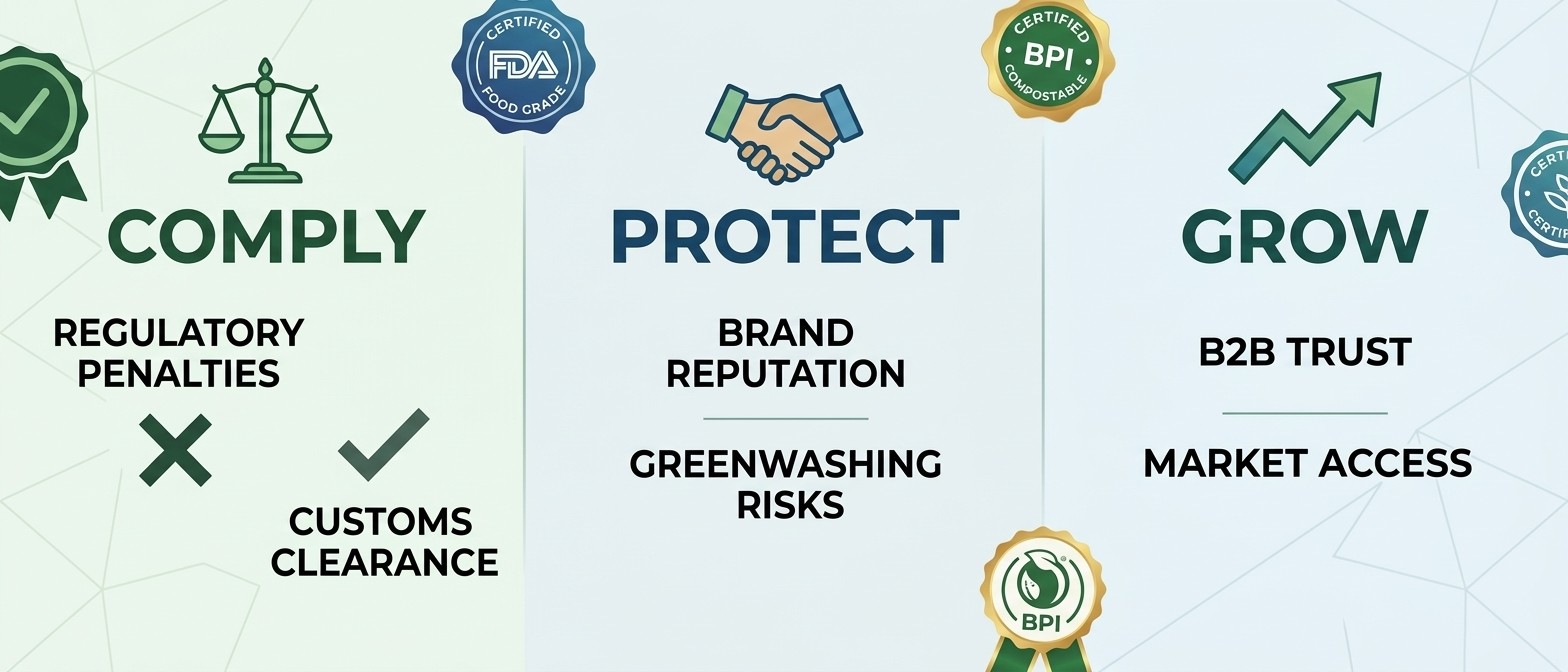
Without these verifiable credentials, placing uncertified filter bags in the market leaves your business vulnerable to regulatory penalties, customs holds, and consumer backlash over deceptive environmental claims.
Key Benefits of Sourcing Certified Coffee Filter Bags
Prioritizing fully certified roll stock or pre-made drip bags creates tangible operational, financial, and legal safeguards across your commercial supply chain:
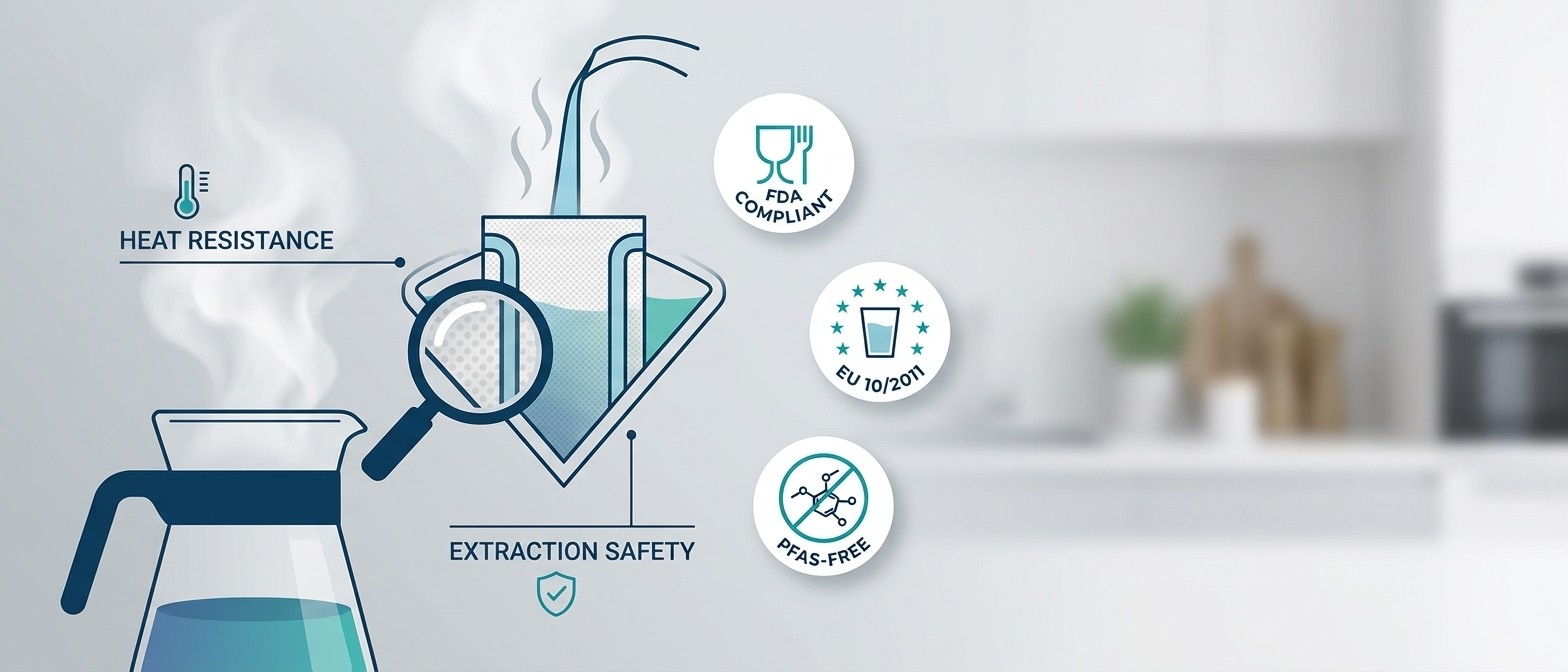
- Guaranteed Food Safety Under Extraction Conditions: Boiling water speeds up chemical migration. Certified food-grade packaging guarantees that heavy metals, phthalates, and PFAS (“forever chemicals”) remain well below legal thresholds under hot extraction.
- Smooth Customs Clearance & Global Compliance: Cross-border shipments into North America or the European Union routinely require documented proof of compliance (such as FDA food contact statements or EU Declaration of Compliance). Uncertified goods are easily flagged, tested, and held at port.
- Protection Against Greenwashing Lawsuits: Environmental enforcement agencies—such as the US Federal Trade Commission (FTC) under its Green Guides—aggressively penalize unqualified “biodegradable” claims. Holding BPI or DIN CERTCO certificates provides legally defensible proof for your sustainability marketing.
- Consistent Machine Runnability: High-grade certified materials maintain uniform basis weight (GSM) and fiber density. This prevents heat-seal failure, edge tear-outs, and machine downtime on automated form-fill-seal (FFS) lines.
- Stronger Brand Trust in B2B & Retail Markets: Wholesalers, regional grocery chains, and eco-conscious food service buyers actively screen vendors for audited supply chains before approving high-volume purchasing agreements.
Essential Coffee Filter Certifications at a Glance
Depending on your destination market and target material (cellulose paper vs. PLA non-woven mesh), here is a summary of the credentials you must request from your supplier:
| Certification / Standard | Category | Primary Market | Key Compliance Focus |
|---|---|---|---|
| FDA 21 CFR 176.170 / 177.1630 | Food Safety | United States / Global | Extraction testing for paper and polymer contact with aqueous/fatty foods under hot conditions. |
| EU Regulation (EC) No 1935/2004 & EU 10/2011 | Food Safety | European Union | Overall Migration Limit (OML) and Specific Migration Limits (SML) in food contact plastics and filters. |
| BPI (ASTM D6400 / D6868) | Compostability | North America | Third-party verification of industrial compostability, disintegration rate, and chemical safety (PFAS-free). |
| DIN CERTCO / Seedling (EN 13432) | Compostability | Europe / UK | Rigorous European standard for packaging recoverable through industrial composting and biodegradation. |
| TÜV AUSTRIA OK compost HOME | Compostability | Global | Verifies complete breakdown in cooler, ambient garden compost piles (20°C–30°C) within 12 months. |
| FSC (Forest Stewardship Council) | Sourcing | Global | Chain-of-custody tracking ensuring wood pulp and cellulose derive from responsibly managed forests. |
Certification Requirements by Product Application
Not all coffee filters require the exact same testing profile. Matching the right credentials to your specific product line prevents over-specifying costs while remaining fully compliant:
Post time: Oct-20-2026