A drip coffee bag is a single-serve coffee filter that hangs directly over a cup. It contains a measured portion of ground coffee and uses fold-out paper supports to stay in place while hot water is poured through the grounds.
The concept is simple: pour-over coffee without a separate dripper, machine, or complicated brewing setup.
Depending on the market, the product may also be called a coffee drip bag, pour over coffee bag, or hanging ear coffee bag. Although the names differ, they usually describe the same format.
For consumers, the main benefit is convenience. For coffee roasters, hotels, retailers, distributors, and private-label brands, drip bags also offer a practical way to package, sample, ship, and sell freshly brewed coffee in individual portions.
However, buying drip coffee bags involves more than choosing a filter shape and comparing prices. The filter material, coffee grind, filling weight, water flow, cup compatibility, outer pouch barrier, sealing quality, and packing method all affect the final brewing experience.
A drip bag may look attractive but still produce weak, bitter, or inconsistent coffee. This guide explains how the product works and what professional buyers should consider before placing an order.
Product Overview
A drip coffee bag is a preformed filter pouch designed to hold enough ground coffee for one serving. Two paper arms are attached to the sides of the filter. When unfolded, they hook over the rim of a cup and keep the coffee suspended above the brewed beverage.
A finished product usually includes three components:
- The inner filter bag
- The paper hanging arms
- An individually sealed outer pouch
The filter holds the coffee during extraction. The arms support the bag, and the outer pouch protects the coffee from oxygen, moisture, light, and external odors.
Most drip bags contain between 8 and 15 grams of coffee. Ten or twelve grams is common for a standard cup, but the ideal dose depends on the roast level, grind size, desired strength, and recommended water volume.
Some buyers purchase empty drip bags and fill them in their own facilities. Others need a complete private-label service that includes coffee sourcing, roasting, grinding, filling, nitrogen flushing, sealing, coding, and retail box packing.
A specialty coffee roaster with existing equipment may only need filters and custom pouches. A hotel brand launching an in-room coffee program may prefer a complete finished product. Understanding your production capabilities helps determine which sourcing model is more economical.
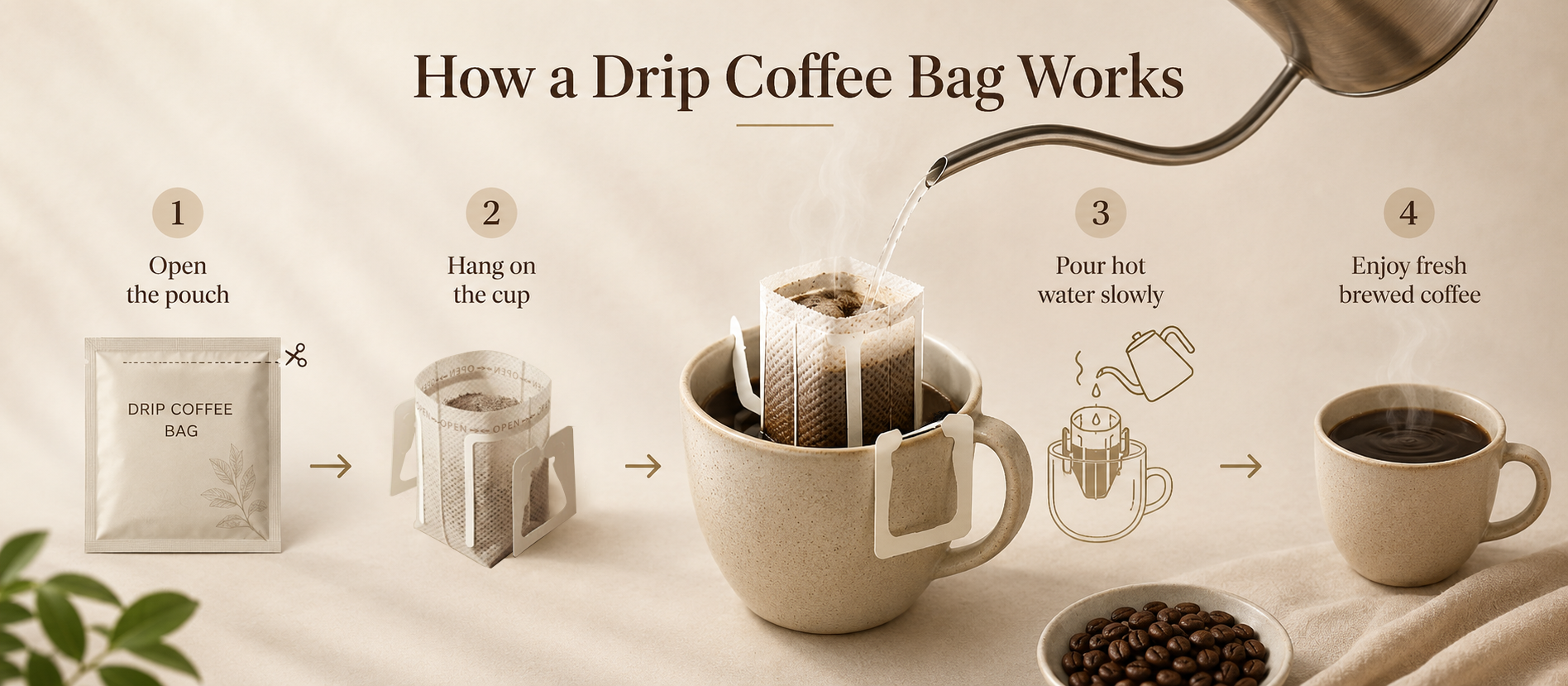
How Does a Drip Coffee Bag Work?
To use a hanging ear coffee bag, the consumer opens the outer pouch and removes the filter. The top is torn open along a marked line, and the paper arms are unfolded over the cup.
Hot water is then poured slowly over the coffee.
The water passes through the ground coffee, extracts aroma and flavor, moves through the filter, and drips into the cup. Once brewing is complete, the user removes and discards the bag.
Most brands recommend brewing in several pours. The first small pour wets the grounds and allows the coffee to bloom. After a short pause, the user adds more water in two or three stages until the desired beverage volume is reached.
Typical brewing time is around two to four minutes. However, flow speed can change significantly depending on:
- Grind size
- Coffee dose
- Filter pore structure
- Roast level
- Water temperature
- Pouring speed
- Bag dimensions
- Coffee density
If the water flows too quickly, the coffee may taste thin or under-extracted. If it drains too slowly, brewing becomes inconvenient and may produce bitter flavors.
A practical buyer scenario illustrates this clearly. A brand may test a 12-gram light-roast coffee and discover that the bag takes over five minutes to drain. The filter may not be the problem. The coffee could be ground too finely, or the bag may be packed so tightly that the coffee bed cannot expand.
For this reason, filter performance should always be tested with the actual coffee, dose, and grind intended for production.
Materials Used in Drip Coffee Bags
Material selection influences food safety, brewing performance, sealing, durability, and environmental claims. Buyers should request full technical specifications instead of relying on general terms such as “food grade” or “eco-friendly.”
Nonwoven Filter Fabric
Nonwoven fabric is widely used for coffee drip bags. Depending on the specification, it may be made from polypropylene, PET, polyethylene, PLA, or blended fibers.
Its main advantages include:
- Consistent filtration
- Reliable heat sealing
- Good mechanical strength
- Low risk of tearing
- Stable performance during automatic filling
- Controlled water flow
Consistency is especially important in commercial production. Small variations in fabric thickness, weight, or pore structure can change extraction time.
Buyers should ask about the material composition, basis weight, recommended sealing temperature, food-contact compliance, and suitable grind range.
PLA-Based Filter Material
PLA, or polylactic acid, is a bio-based polymer commonly produced from renewable plant resources. It is often selected by brands seeking a more sustainability-focused product.
However, buyers need to use environmental claims carefully. “Bio-based,” “biodegradable,” and “compostable” are not interchangeable terms.
Some PLA materials only break down under controlled industrial composting conditions. They may not decompose effectively in home compost or in the natural environment.
Before printing a compostability claim, verify:
- The exact material composition
- Applicable certification
- Required disposal conditions
- Food-contact compliance
- Heat resistance
- Whether the entire product is covered
A certificate for the filter fabric does not automatically apply to the paper arms, adhesive, printing inks, or outer pouch.
Paper Hanging Arms
The hanging arms appear simple, but they have a major effect on usability. They must be stiff enough to support wet coffee grounds while remaining flexible enough to fold flat inside the pouch.
Important factors include:
- Paperboard thickness
- Die-cutting accuracy
- Folding strength
- Steam resistance
- Bonding quality
- Cup compatibility
- Printing performance
Poorly made arms may soften during brewing, detach from the filter, or slip from the cup.
From a manufacturing perspective, these problems may come from paper quality, bonding position, storage humidity, or die-cutting pressure. The issue is rarely caused by one factor alone.
Outer Pouch Materials
Outer pouch is essential because ground coffee loses freshness quickly when exposed to oxygen.
Common structures include combinations of:
- PET
- Aluminum foil
- Metallized PET
- PE
- CPP
- High-barrier transparent film
- Paper-laminated film
Aluminum foil laminates usually provide strong protection against oxygen, moisture, and light. Metallized films can offer a good balance of barrier performance, appearance, and cost. Transparent structures may improve shelf presentation but should be evaluated carefully for oxygen and light protection.
Buyers should not choose the pouch based only on appearance.
A premium matte pouch may support the brand image, but weak seals or insufficient barrier performance can cause the coffee to become stale before the printed expiration date.
Common Applications
Drip coffee bags work well wherever consumers want freshly brewed coffee without dedicated equipment.
Specialty Coffee and Sampling
Specialty roasters use drip bags for single-origin coffee, limited editions, tasting sets, and seasonal releases.
For example, a customer may be reluctant to purchase a full bag of an unfamiliar coffee. A three-piece pour over coffee bag sampler offers a lower-risk way to try different origins or roast profiles.
Drip bags are also convenient for e-commerce. Roasters can include one sample in an online order without adding much weight or volume.
Hotels and Hospitality
Hotels often use drip coffee bags as an upgrade from instant coffee. Guests still enjoy easy preparation, but the experience feels more premium.
Hospitality buyers should test the filter with the cups already used in guest rooms. A well-designed bag may perform poorly if the cup is too narrow, too wide, or has a thick rim.
Instructions must also be clear. International hotels may need multilingual brewing directions or simple visual icons.
Offices and Corporate Gifts
Coffee drip bags are suitable for offices that want better coffee without investing in capsule machines, grinders, or maintenance programs.
They can also be included in event kits, client gifts, exhibition packages, and employee welcome boxes. Logos, messages, and QR codes can be printed on the pouch or paper arms.
Travel and Outdoor Use
A drip coffee bag is lightweight and only requires hot water and a cup. It works well for camping, business travel, road trips, and outdoor events.
For these applications, pouch durability matters. The seal must remain intact when the product is carried in luggage or backpacks.
Private-Label Programs
Retailers, cafés, hotels, and lifestyle brands can launch private-label coffee without installing their own filling line.
A complete program may include custom coffee, printed filters, branded pouches, retail cartons, gift boxes, and nitrogen flushing.
For first-time buyers, using a proven standard filter with customized packaging is often safer than developing an entirely new filter design.
Advantages of Drip Coffee Bags
The biggest advantage is convenience without sacrificing real ground coffee.
Consumers need only a cup and hot water. There is no machine to clean, no separate filter to prepare, and no coffee dose to measure.
Other benefits include:
- Lightweight and portable format
- Consistent portion control
- Minimal brewing equipment
- Strong branding potential
- Easy product sampling
- Suitable for gift packaging
- Reduced coffee waste
- Good commercial shelf-life potential
Unlike instant coffee, a coffee drip bag allows consumers to experience more aroma, acidity, body, and origin character.
For brands, every component can support communication. The hanging arms, pouch, carton, and gift box can display brewing instructions, flavor notes, origin stories, and promotional content.
Customization Options
Customization can involve the filter, pouch, coffee, and secondary packaging.
Filter Shape and Size
Options may include standard rectangular filters, wide-opening bags, deep chambers, compact designs, and specialty shapes.
The filter volume should match the intended coffee dose. A bag designed for 10 grams may not perform well with 15 grams, even if the coffee physically fits.
Overfilling can slow drainage and cause grounds to spill when the bag is opened. Underfilling may create weak extraction or poor visual presentation.
Printed Hanging Arms
Paper arms can often be printed with:
- Logos
- Brewing instructions
- Coffee origin
- Flavor notes
- QR codes
- Promotional messages
Printed arms create a strong visual impression during brewing. However, their MOQ may be higher than that of stock filters.
Smaller brands can use unprinted filters and focus their budget on custom outer pouches.
Custom Outer Pouches
Pouches can be printed digitally, flexographically, or by gravure.
Digital printing is suitable for smaller runs, market testing, and multiple coffee varieties. Gravure printing is generally more economical for large, stable orders but requires cylinders and higher setup costs.
Available finishes may include matte, gloss, metallic, paper-like, or soft-touch effects.
Functional details are equally important. The pouch should have a clear tear notch, enough sealing area, and space for production codes.
Coffee and Retail Packaging
Private-label buyers may customize the coffee origin, blend, roast, grind size, filling weight, and flavor profile.
Retail options include folding cartons, display boxes, drawer boxes, tasting kits, subscription boxes, and gift sets.
Buyers should prototype the complete pack before mass production. Finalizing a carton before checking the filled pouch dimensions can lead to excessive empty space or boxes that are too tight.
Tonchant Factory Experience
From our experience at Tonchant , successful drip coffee projects depend on coordination between the filter, coffee, pouch, and filling process.
One common mistake is selecting the filter before testing the coffee. Once filling begins, the chosen grind may cause slow drainage or excessive sediment. The buyer may blame the filter, even though the coffee and packaging were never tested as one system.
We recommend evaluating these elements together:
- Filter material
- Bag dimensions
- Coffee dose
- Grind distribution
- Roast level
- Water flow
- Sealing temperature
- Filling equipment
- Outer pouch structure
Cup testing is also important. During development, we check whether the paper arms fit different rim diameters, whether the opening remains stable, and whether the filter touches the brewed coffee.
Automatic filling creates additional considerations. Static electricity, bag stiffness, opening accuracy, and sealing consistency can affect machine speed.
A filter that works perfectly when filled by hand may not feed smoothly on an automated line.
For a new product, a proven standard filter combined with real brewing tests is often the lowest-risk approach. Custom tooling should be introduced only when it provides a clear commercial or functional advantage.
MOQ and Lead Time
MOQ depends on the product type and customization level.
Stock filters usually have the lowest minimum quantity. Printed arms, special dimensions, custom pouches, and finished private-label coffee require larger orders.
| Product Type | Typical MOQ Situation |
|---|---|
| Stock empty filters | Lowest MOQ |
| Printed hanging arms | Higher MOQ |
| Digitally printed pouches | Suitable for smaller launches |
| Gravure-printed pouches | Higher MOQ and setup cost |
| Finished private-label coffee | Depends on all components |
| Custom filter dimensions | May require tooling |
Buyers should confirm whether the MOQ applies per design, size, coffee variety, or material.
Lead time may range from one to three weeks for stock products and approximately three to six weeks for custom printed packaging after artwork approval. Fully customized projects may take longer.
Production usually begins only after the deposit, specifications, and final artwork have been confirmed.
Certificates and Compliance
Required documentation depends on the material and destination market.
Common certificates and reports may include:
- Food-contact declarations
- Migration testing
- FDA-related compliance
- EU food-contact compliance
- ISO 9001
- ISO 22000
- HACCP
- BRCGS Packaging Materials
- FSC certification
- Compostability certification
- Halal or Kosher certification
Buyers should check whether each document covers the specific material and manufacturing site.
For finished coffee products, labeling rules may also apply to net weight, ingredients, origin, lot number, best-before date, storage instructions, and importer details.
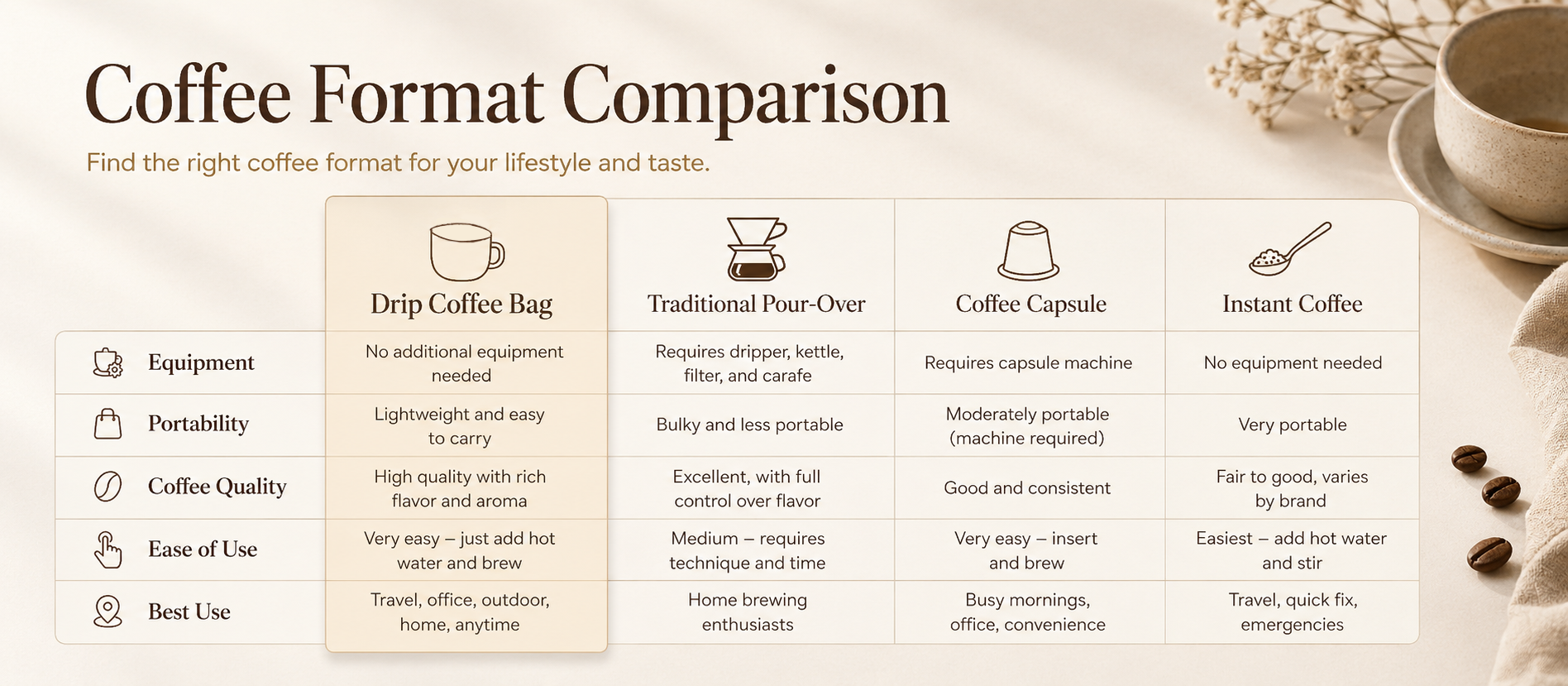
Comparison Table
| Feature | Drip Coffee Bag | Traditional Pour-Over | Coffee Capsule | Instant Coffee |
|---|---|---|---|---|
| Equipment | Cup and hot water | Dripper, filter, kettle | Capsule machine | Cup and hot water |
| Portability | Excellent | Moderate | Limited | Excellent |
| Coffee quality | High | Very high | Medium to high | Low to medium |
| Portion control | Pre-measured | User measured | Pre-measured | Varies |
| Preparation | Easy | Moderate | Easy | Very easy |
| Branding potential | High | Moderate | High | Moderate |
| Best use | Travel, hotels, offices, sampling | Home and cafés | Machine-equipped locations | Basic convenience |
Frequently Asked Questions
Q Is a drip coffee bag the same as instant coffee?
No. Instant coffee dissolves in water. A drip bag contains roasted and ground coffee that is brewed through a filter.
Q How much coffee is used?
Most bags contain 8 to 15 grams. Ten to twelve grams is common.
Q How much water is needed?
Approximately 150 to 220 milliliters, depending on the dose and desired strength.
Q Are drip bags compostable?
Some are, but not all. Buyers should verify the material, certification, and disposal conditions.
Q Is nitrogen flushing necessary?
It is not always required, but it can reduce oxygen and help maintain freshness.
Q What shelf life is typical?
Many commercial products target 12 to 18 months, but the final claim should be supported by testing.
Q Can the filter arms be printed?
Yes. Logos, instructions, and QR codes can often be added, subject to MOQ.
Q What information is needed for a quotation?
Provide the quantity, coffee dose, filter style, material, pouch structure, number of designs, filling requirements, destination market, and certification needs.
Conclusion
A drip coffee bag combines real pour-over coffee with the convenience of a single-serve package. It works well for specialty roasters, hotels, offices, travel products, gift sets, retail programs, and private-label brands.
For buyers, the goal is not simply to find the cheapest filter. The filter material, coffee grind, dose, pouch barrier, cup fit, sealing quality, and production method must work together.
A reliable coffee drip bag should open easily, stay stable on the cup, provide controlled water flow, and protect the coffee throughout its intended shelf life.
Before ordering at scale, test the final pour over coffee bag with the actual coffee, pouch, cup, and brewing instructions.
From Tonchant’s factory experience, this complete-system approach prevents most avoidable sourcing problems and helps turn a simple hanging ear coffee bag into a consistent, market-ready product.
Post time: Jul-15-2026