Coffee filter paper looks simple, but it plays a major role in brewing quality.
It must let water and soluble coffee compounds pass through while holding back grounds and fine particles. It also needs to stay strong when wet, run smoothly on production equipment, and, in some applications, seal cleanly under heat.
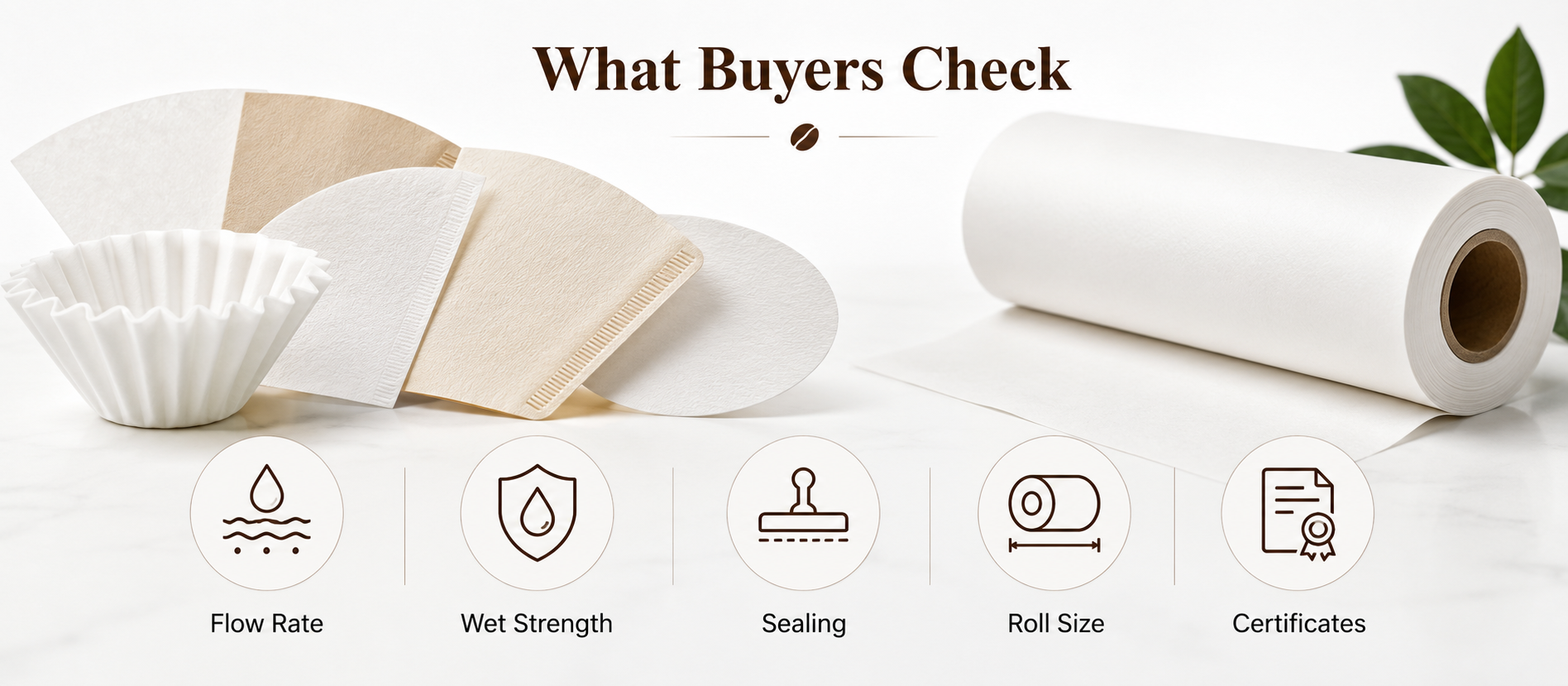
For buyers, the right coffee filter paper is not chosen by color or thickness alone. Fiber composition, pore structure, flow rate, wet strength, roll dimensions, sealing performance, and certification all matter.
A paper that drains too quickly can produce weak coffee. One that drains too slowly may cause overflow or inconsistent brewing. On an automatic line, even a small variation in roll width or stiffness can create feeding problems.
This guide explains what coffee filter paper is made from, where it is used, and what buyers should check before ordering sheets, finished filters, or a filter paper roll.
Product Overview
Coffee filter paper is a porous food-contact material used to separate coffee grounds from brewed coffee.
It is available in many formats, including:
- Cone filters
- Basket filters
- Flat sheets
- Die-cut circles
- Filter paper rolls
- Heat-sealable filter material
- Drip coffee bag material
- Coffee pod components
Retail consumers usually buy finished filters. Industrial buyers often purchase roll material that is cut, folded, formed, filled, and sealed on automated equipment.
The exact specification depends on the application.
A pour-over filter needs stable flow and enough wet strength to support the coffee bed. A commercial basket filter must handle a larger dose and more water. A hanging-ear drip bag may also need heat-sealing performance and precise machine compatibility. That is why one paper grade rarely works for every coffee product.
What Is Coffee Filter Paper Made Of?
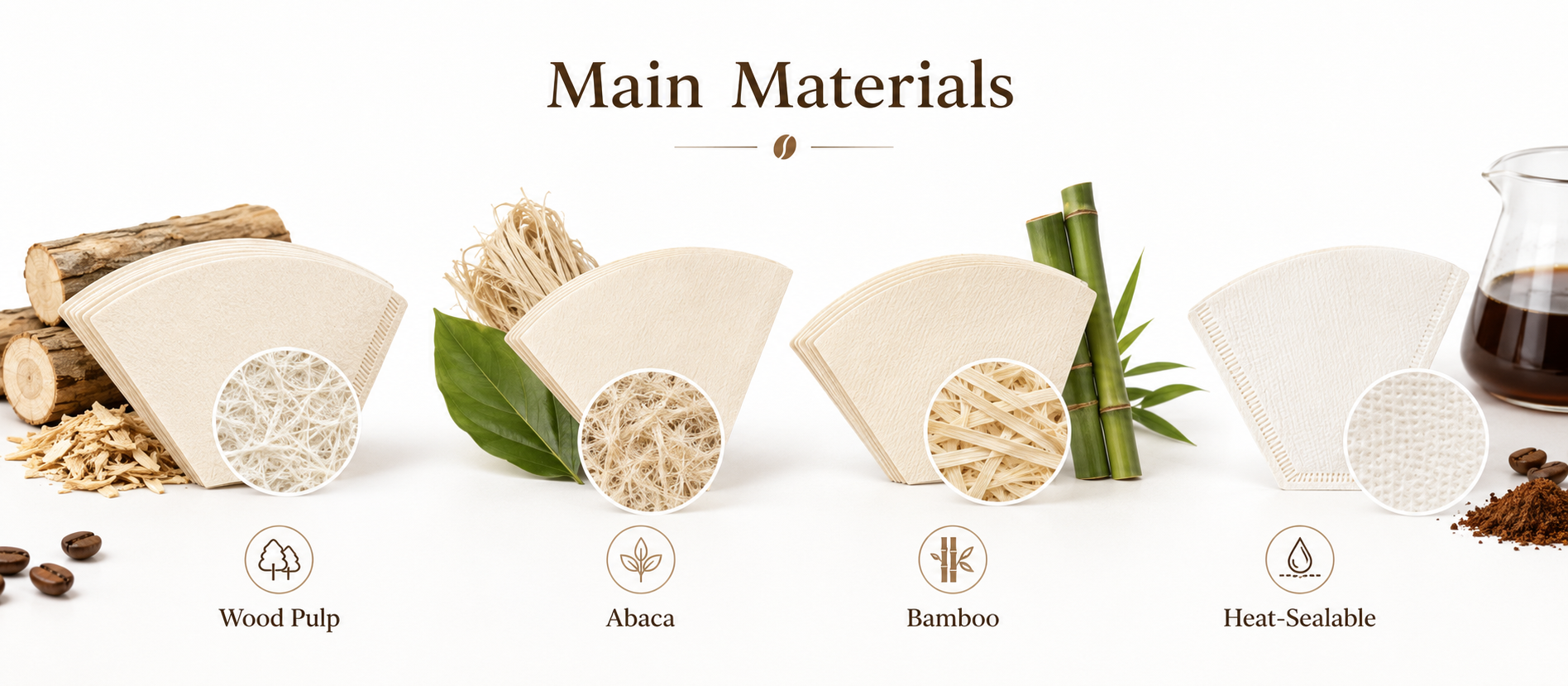
Most coffee filter paper is made from cellulose fibers. These usually come from wood pulp, abaca, bamboo, or a blend of plant-based materials.
The blend is selected to balance strength, flow rate, appearance, cost, and production performance.
Wood Pulp
Wood pulp is the most common raw material used in coffee paper.
Softwood fibers are relatively long and help improve strength. Hardwood fibers are shorter and can create a smoother, more even paper structure.
Manufacturers often combine the two.
Wood-pulp paper is widely used for:
- Cone filters
- Basket filters
- Commercial brewers
- Single-serve coffee products
- General-purpose filter paper rolls
It is usually cost-effective and easy to source. However, buyers should not assume that all wood-pulp papers perform the same way.
Two papers can have the same stated weight but very different flow rates. Fiber preparation, pore structure, and paper formation make a noticeable difference.
Abaca Fiber
Abaca is a long, strong natural fiber from a plant related to the banana family.
It is often blended with wood pulp to improve wet strength and tear resistance. This is useful when the filter must withstand heavy coffee doses, automatic forming, or long contact with water.
Abaca-containing paper is commonly used for:
- Drip coffee bags
- Commercial coffee filters
- Cold brew bags
- High-speed packaging applications
- Filters requiring strong wet performance
It usually costs more than basic wood-pulp paper. For some products, that extra cost is justified. For others, it is unnecessary.
A buyer producing a lightweight manual filter may not need the same strength as a factory packing thousands of sealed drip bags per hour.
Bamboo Fiber
Bamboo pulp is sometimes used in coffee filter paper for renewable-material positioning. It may be blended with wood pulp or other cellulose fibers. The final performance depends on the actual fiber ratio and processing method.
Buyers should ask for more than a “bamboo” label.
Useful questions include:
- What percentage of the paper is bamboo fiber?
- Is the material food-contact compliant?
- How does its wet strength compare with standard paper?
- Is the paper bleached or unbleached?
- Are environmental claims supported by certification?
- Can the same fiber blend be supplied consistently?
A bamboo-based paper may fit a sustainability-focused brand, but it still needs to brew well and run reliably in production.
Heat-Sealable Fibers
Some filter materials need to be sealed with heat. This is common in drip coffee bags, coffee pods, and other single-serve products. In these cases, the paper may include thermoplastic fibers or a heat-sealable layer. The material must create a strong seal without affecting flavor, food safety, or water flow.
Buyers should confirm:
- Sealing temperature
- Dwell time
- Seal pressure
- Machine speed
- Seal width
- Recommended sealing side
Note: At Tonchant, factory trials often show that a paper can look correct and still fail during production. If the sealing window is too narrow, the bag may open during filling or become brittle after sealing. A short machine test can reveal more than a specification sheet.
White and Brown Coffee Filter Paper
Coffee filter paper is usually white or natural brown.
White Coffee Filter Paper
White paper has undergone a bleaching process to remove natural color from the pulp. It is widely used because it provides:
- A clean appearance
- Easy visual inspection
- Consistent presentation
- Good contrast for printed marks
- Familiarity in foodservice and retail markets
Modern bleaching methods may use oxygen-based or peroxide-based processes. Buyers who need chlorine-free claims should request a specific declaration rather than relying on appearance.
Brown Coffee Filter Paper
Brown coffee paper retains more of its natural color. It is popular with brands that use kraft packaging, natural visual themes, or environmentally focused positioning.
However, brown paper is not automatically more sustainable than white paper. Fiber source, energy use, bleaching method, transportation, and end-of-life conditions all matter.
Some unbleached papers may also carry a slightly stronger paper aroma. Sensory testing is recommended, especially for light-roast coffee where subtle flavors are easier to detect.
Common Applications
Pour-Over Coffee Filters
Cone and flat-bottom filters require controlled drainage and enough strength to support wet coffee grounds. Flow rate is critical. A filter that is too open may produce a thin cup. A paper that is too dense may slow extraction and cause water to rise above the coffee bed.
Commercial Basket Filters
Restaurants, hotels, caterers, and convenience stores often use large basket filters for batch brewing. These filters need accurate dimensions and strong wet performance. A filter that is too small may collapse inward. A filter that is too large may fold unevenly and allow grounds into the brewed coffee.
Coffee Pods
Coffee pods and some capsule systems use paper or nonwoven components to hold grounds and control extraction. These materials may require precise forming, sealing, and pressure resistance.
Cold Brew Bags
Cold brew filters remain in contact with water for much longer than standard drip filters. Wet strength is therefore especially important. The bag must survive filling, soaking, lifting, and disposal without tearing.
Drip Coffee Bags
Hanging-ear drip bags need a more specialized material. The paper must provide:
- Stable water flow
- Heat-sealing performance
- Good tear resistance
- Reliable machine feeding
- Low sediment
- Consistent forming
A standard pour-over paper may not work on a drip bag line.
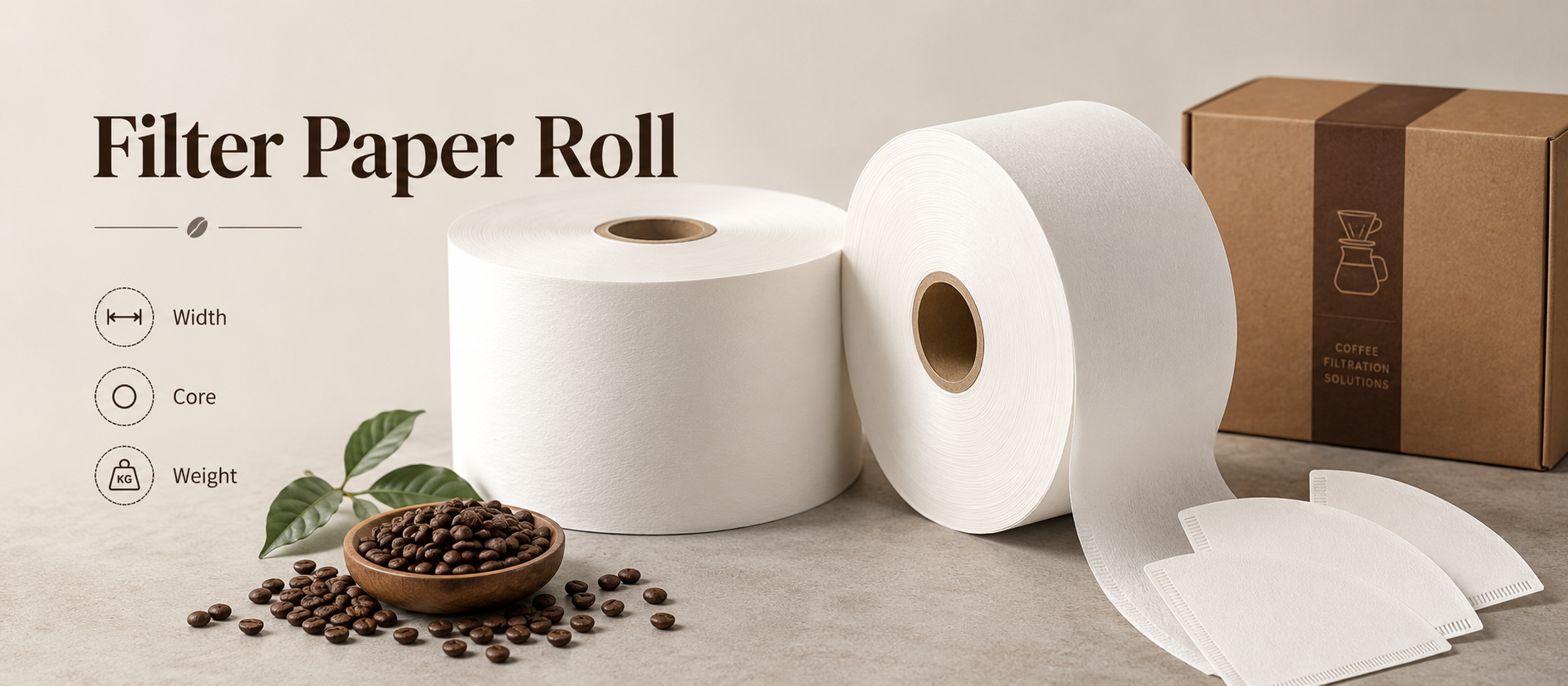
Filter Paper Rolls
A filter paper roll is commonly used by converters and coffee packers operating automated equipment. Important specifications include:
- Roll width
- Roll diameter
- Core size
- Winding direction
- Paper weight
- Joint allowance
- Sealing side
- Tension tolerance
A small error in roll width can affect tracking and sealing. Edge damage can also stop a production line. For imported rolls, moisture protection and strong export packing are essential.
Main Advantages
Cleaner Coffee
Paper retains fine particles and captures some coffee oils. The result is usually a cleaner cup than metal filtration. This is especially useful for light-roast and single-origin coffee, where clarity matters.
Consistent Extraction
A controlled pore structure supports a more predictable flow rate. For restaurant chains and contract packers, consistency is often more valuable than saving a very small amount per filter.
Lightweight and Easy to Store
Coffee filter paper is light, compact, and efficient to transport. Rolls and finished filters require much less storage space than rigid brewing components.
Flexible for Different Products
The material can be adjusted for manual filters, commercial brewing, drip bags, pods, and cold brew applications.
Simple Disposal
Pure cellulose filters may be biodegradable or compostable under suitable conditions. Heat-sealable papers may contain additional fibers, so buyers should request product-specific information before making environmental claims.
Material Comparison
| Material | Main Advantage | Possible Limitation | Typical Use |
|---|---|---|---|
| Wood pulp | Economical and widely available | Wet strength varies by grade | Cone and basket filters |
| Wood pulp with abaca | Strong and tear resistant | Higher cost | Drip bags and commercial filters |
| Bamboo blend | Renewable-material positioning | Performance varies by blend | Specialty coffee paper |
| Heat-sealable paper | Suitable for automatic sealing | May contain thermoplastic fibers | Drip bags and pods |
| Brown paper | Natural appearance | Sensory testing may be needed | Kraft-style products |
| White paper | Clean and consistent appearance | Bleaching method should be confirmed | Foodservice and retail |
Customization Options
Coffee filter paper can be customized for different brewing and production requirements.
Common options include:
- Paper weight
- Thickness
- Pore size
- Flow rate
- Roll width
- Roll length
- Core size
- White or brown color
- Embossing
- Heat-sealing performance
- Printing
Paper weight alone does not determine performance. A heavier paper is not always stronger, and a thinner paper is not always faster. Fiber type and pore structure matter just as much.
The filter should be tested with the actual coffee grind and dose.
Note: A material that works with coarse coffee may clog when used with a finer grind. Tonchant factory tests often compare several grind sizes before confirming the final paper grade.
MOQ
MOQ depends on the level of customization.
| Product Type | Relative MOQ |
|---|---|
| Standard stock filter paper | Low |
| Standard filter paper roll | Low to medium |
| Custom roll width | Medium |
| Custom paper weight or porosity | Medium to high |
| Printed filter paper | High |
| New fiber blend | High |
Buyers should confirm whether MOQ is calculated by:
- Roll
- Kilogram
- Width
- Square meter
- Production batch
A supplier may accept a reasonable total quantity but still require a minimum for each roll width. For a new project, starting with a proven paper grade and adjusting only the roll size is usually safer than developing a completely new material.
Lead Time
Stock coffee filter paper may be available within one to three weeks.
Custom material may require four to eight weeks or longer, depending on:
- Fiber blend
- Roll dimensions
- Paper weight
- Heat-sealing requirements
- Printing
- Sample approval
- Production scheduling
Specialty fibers and new formulations usually take longer. Shipping time should be added separately. Rolls should be protected from moisture, crushing, and damaged edges.
Certificates and Compliance
Coffee filter paper must comply with food-contact requirements in the destination market.
Relevant documents may include:
- Food-contact declaration
- FDA-related documentation
- EU food-contact compliance
- Migration test reports
- ISO 9001
- ISO 14001
- ISO 22000
- BRCGS Packaging Materials
- FSC or PEFC certification
- Compostability certification
- Chlorine-free bleaching declaration
Buyers should check whether the documents apply to the exact paper grade. A certificate for standard cellulose paper may not cover a heat-sealable version. An FSC certificate for the factory does not automatically prove that every roll uses certified fiber. Check the product code, material description, factory name, test standard, and validity date.
Frequently Asked Questions
Q What is coffee filter paper mainly made from?
Most coffee filter paper is made from cellulose fibers derived from wood pulp. Abaca, bamboo, or other plant fibers may be added to improve strength or support a particular product position.
Q What material is best for drip coffee bags?
Drip bags usually need strong, food-safe, heat-sealable material with controlled porosity. Wood pulp and abaca blends are common, but the right choice depends on the coffee dose, grind, bag design, and machine.
Q What is a filter paper roll used for?
A filter paper roll is used on automated equipment to produce drip bags, pods, basket filters, and other coffee filtration products.
Q Is brown coffee paper better than white paper?
Not necessarily. Brown paper offers a natural look, while white paper gives a clean appearance. Flow, strength, flavor impact, and compliance are more important than color.
Q Is coffee filter paper compostable?
Pure cellulose paper may be compostable under suitable conditions. Heat-sealable materials may include other fibers, so buyers should request product-specific certification.
Q Can coffee filter paper be printed?
Yes, in selected applications. Suitable food-contact inks should be used, and the printing must not affect flow, sealing, or flavor.
Q What information is needed for a quotation?
Provide the paper type, weight, roll width, roll diameter, core size, application, quantity, sealing requirements, machine information, and destination market.
Conclusion
Most coffee filter paper is made from cellulose fibers such as wood pulp, abaca, or bamboo.
The best material depends on the final application.
Manual filters need stable flow and wet strength. Drip bags also require sealing and machine compatibility. A filter paper roll must meet precise dimensional, winding, and tension requirements.
Buyers should compare fiber composition, pore structure, flow rate, wet strength, sealing performance, MOQ, lead time, and certification.
The safest approach is to test the final coffee paper with the actual coffee, grind size, dose, equipment, and brewing method.
A good filter does more than hold back grounds. It helps deliver consistent extraction, efficient production, and the cup profile the brand intended.
Post time: Jul-30-2026