Introduction
The global coffee industry is experiencing a shift in consumer expectations. Coffee drinkers are no longer choosing only between traditional brewed coffee and instant coffee. Increasingly, they want products that combine convenience, premium taste, portability, and sustainable packaging.
This change has created new opportunities for drip coffee bags, a single-serve coffee format that allows consumers to prepare freshly brewed coffee without requiring expensive equipment such as espresso machines or capsule systems.
Originally popular in markets such as Japan and South Korea, drip coffee bags are now expanding into Europe, North America, the Middle East, and emerging coffee markets. Specialty coffee roasters, restaurant groups, food service companies, and packaging distributors are exploring this format as consumers look for more flexible coffee experiences at home, in offices, during travel, and through online subscription channels.
Market research indicates that the drip bag coffee category is benefiting from two major consumer trends: the continued growth of specialty coffee and increasing demand for convenient brewing formats. The combination of premium coffee quality and easy preparation has helped drip bags move beyond a niche product into a broader commercial opportunity.
For importers and packaging buyers, this growth represents more than a new coffee product category. It also creates new requirements for filter materials, barrier packaging, customization capabilities, and supply chain management.
Industry Background
From Traditional Brewing to Single-Serve Premium Coffee
For decades, coffee consumption was divided mainly into several categories:
- ☑ Freshly brewed coffee prepared with machines or manual methods
- ☑ Instant coffee focused on convenience
- ☑ Coffee capsules designed for premium home preparation
Each format had advantages and limitations. Instant coffee offered speed but often lacked the aroma and flavor complexity expected by specialty coffee consumers. Capsule systems provided convenience but required dedicated equipment and created concerns around packaging waste.
Drip coffee bags emerged as an alternative solution by combining:
- ✓ The brewing experience of pour-over coffee
- ✓ The convenience of single serve coffee
- ✓ The portability of lightweight packaging
The format typically consists of a filter bag containing ground coffee, attached with hanging arms that sit over a cup. Consumers simply add hot water and allow extraction to occur. Unlike traditional coffee bags, drip coffee bags are designed as a complete brewing system rather than only a storage package.
The Role of Specialty Coffee in Market Expansion
The growth of specialty coffee has significantly influenced the development of drip coffee bags. Modern consumers increasingly care about coffee origin, roasting profile, brewing method, sustainability, and brand storytelling.
For specialty coffee brands, drip bags provide a practical way to introduce premium coffee to consumers who may not own professional brewing equipment.
Current Market Trends
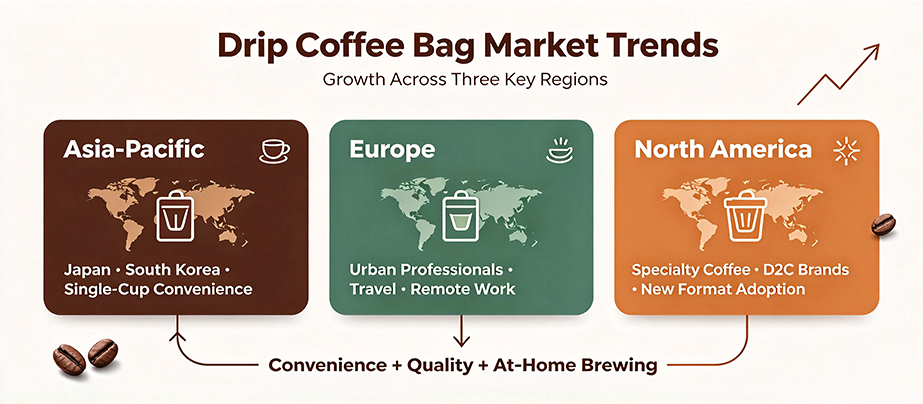
1. Growth Across Asia-Pacific Markets
Asia remains one of the strongest markets for drip coffee bags. Japan has played an important role in developing the category, with consumers familiar with convenient single-cup coffee formats. South Korea has also seen strong adoption as younger consumers combine café culture with home brewing habits.
2. Increasing Adoption in Europe
European coffee markets have traditionally emphasized café culture and professional brewing. However, consumer lifestyles are changing. Urban professionals, travelers, and remote workers are increasingly looking for convenient coffee options without sacrificing quality.
3. Expansion in North America
North America has historically been dominated by coffee pods, ready-to-drink coffee, and traditional ground coffee. However, specialty coffee consumption and direct-to-consumer coffee brands have created opportunities for drip coffee bags.
Global Drip Coffee Bag Market Overview
| Market Factor | Industry Impact |
|---|---|
| Consumer demand | Growing preference for convenient premium coffee |
| Product positioning | Combines specialty coffee quality with single-serve convenience |
| Main growth regions | Asia-Pacific, North America, Europe |
| Key buyers | Coffee brands, restaurants, distributors, hospitality companies |
Key Drivers Behind the Trend
The biggest advantage of drip coffee bags is simplicity. Consumers can prepare coffee anywhere with only a cup, hot water, and a few minutes of brewing time. This makes the format suitable for offices, hotels, travel, camping, small apartments, and food delivery packages.
Challenges Facing the Industry
Although the global demand for drip coffee bags is growing, companies entering this market also face several challenges. For manufacturers, brands, importers, and distributors, success depends not only on market demand but also on product quality, supply chain management, and compliance requirements.
What This Means for Buyers
For restaurant chains, food delivery companies, wholesalers, importers, and packaging distributors, the growth of drip coffee bags creates new business opportunities. However, selecting the right supplier requires a structured evaluation process.
Industry platforms such as Coffeeteabag.com have also reflected the increasing interest in drip coffee bag formats, filter solutions, and customized coffee packaging applications.
Frequently Asked Questions
1. Why are drip coffee bags becoming more popular?
Drip coffee bags combine the convenience of single serve coffee with the quality of freshly brewed coffee.
2. Are drip coffee bags considered specialty coffee packaging?
Yes. Many specialty coffee brands use drip bags as a premium packaging format.
Conclusion
The growing popularity of drip coffee bags reflects a broader transformation in the coffee industry. Consumers increasingly expect products that combine convenience, quality, portability, and sustainability. As global coffee consumption continues evolving, drip coffee bags are likely to remain an important format connecting specialty coffee culture with modern consumer lifestyles.
Post time: Sep-26-2026